
Visa Expands Stablecoin Settlement Pilot to Nine Blockchains
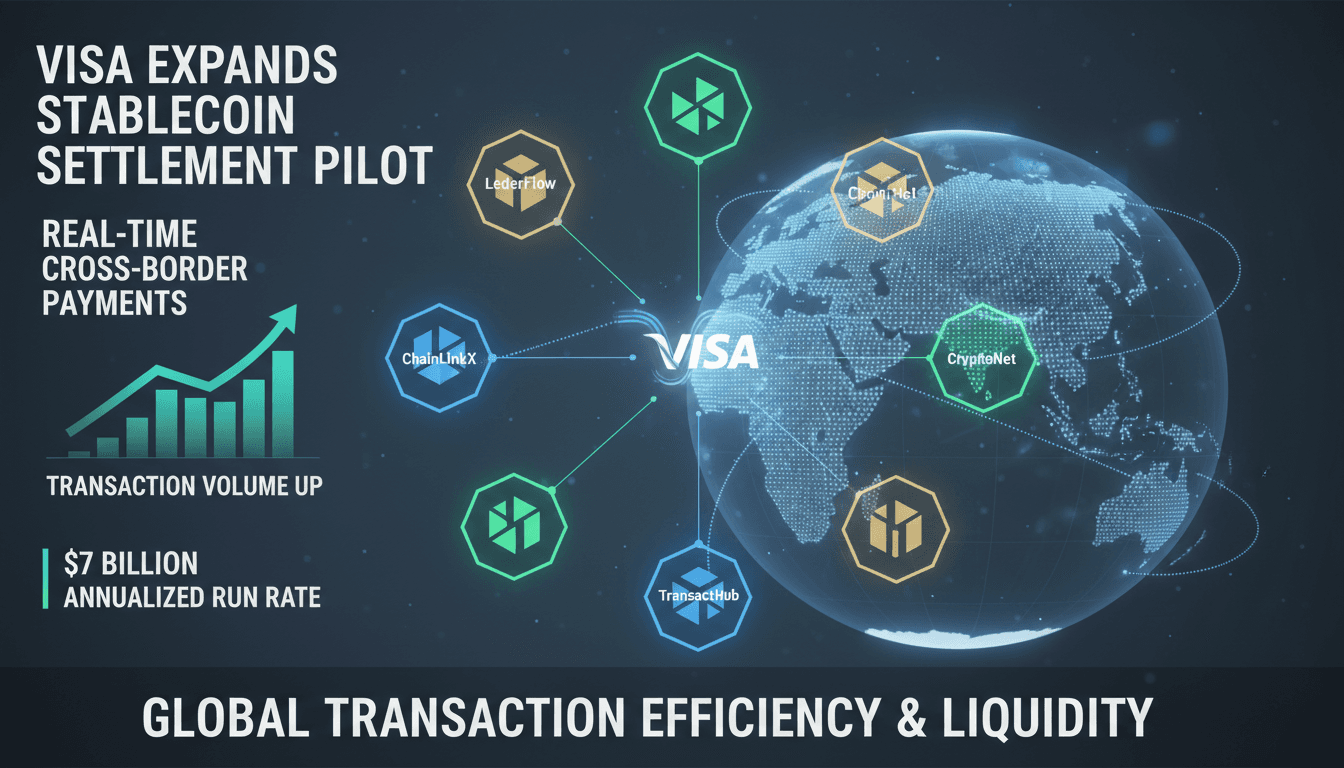
Here's what it means for you.
The expansion of Visa's stablecoin settlement pilot could streamline your cross-border transactions and enhance liquidity access.
Why it matters
Visa's move signals a significant shift towards integrating stablecoins into mainstream payment systems, impacting global financial transactions.
What happened (in 30 seconds)
- Visa announced the expansion of its stablecoin settlement pilot to nine blockchains, adding five new platforms.
- Annualized volume reached $7 billion, reflecting a 50% increase quarter-over-quarter.
- This expansion enhances Visa's ability to facilitate real-time, cross-border payments using stablecoins like USDC.
The context you actually need
- Visa's stablecoin initiatives began in 2023 with USDC settlements on Ethereum, evolving into multi-chain pilots across various regions.
- The stablecoin market is approaching a $320 billion capitalization, supported by favorable regulations like the U.S. GENIUS Act.
- This expansion addresses demands for interoperability in a multi-chain environment, positioning stablecoins as a complement to traditional fiat systems.
What's really happening
Visa's expansion of its stablecoin settlement pilot to nine blockchains is a strategic response to the growing demand for efficient, real-time payment solutions in a globalized economy. By integrating additional platforms such as Arc, Base, Canton, Polygon, and Tempo, Visa is not only enhancing its operational capabilities but also addressing the needs of its partners for interoperability across different blockchain networks.
The $7 billion annualized run rate, which has surged by 50% quarter-over-quarter, underscores the increasing reliance on stablecoins for cross-border transactions. This growth is driven by businesses seeking faster and more cost-effective ways to settle payments, particularly in regions where traditional banking infrastructure may be lacking or inefficient. The ability to use stablecoins like USDC allows for quicker settlements, reduced transaction costs, and improved liquidity access, making it an attractive option for both issuers and acquirers.
Moreover, Visa's initiative aligns with a broader trend in the financial sector where digital assets are becoming more integrated into everyday transactions. As the stablecoin market continues to expand, reaching a capitalization of nearly $320 billion, Visa's pilot serves as a critical bridge between traditional fiat currencies and the emerging digital asset ecosystem. This integration is further supported by regulatory frameworks, such as the U.S. GENIUS Act, which aim to create a conducive environment for stablecoin adoption.
The implications of this expansion are significant. It positions Visa as a leader in the evolving payments landscape, where the demand for real-time, cross-border solutions is only expected to grow. By facilitating transactions across multiple blockchains, Visa is not just enhancing its service offerings but also setting a precedent for other financial institutions to follow. This move could lead to a more interconnected financial system, where stablecoins play a pivotal role in everyday transactions, ultimately benefiting consumers and businesses alike.
Who feels it first (and how)
- Businesses engaged in cross-border trade: They will benefit from faster settlements and reduced costs.
- Consumers using stablecoin-linked cards: They will experience improved transaction speeds and liquidity.
- Financial institutions and payment processors: They will need to adapt to the growing role of stablecoins in payment systems.
What to watch next
- Regulatory developments: Keep an eye on how governments respond to the growing use of stablecoins, as this could impact their adoption.
- Market adoption rates: Monitor the uptake of Visa's stablecoin services among businesses and consumers, which will indicate the success of this initiative.
- Technological advancements: Watch for innovations in blockchain technology that could further enhance the efficiency of stablecoin transactions.
Visa's stablecoin settlement pilot has expanded to nine blockchains.
The demand for stablecoin transactions will continue to rise, leading to further expansions and innovations.
The long-term regulatory landscape for stablecoins remains uncertain, which could affect their integration into mainstream finance.
Frequently Asked Questions
- Why it matters?
- Visa's move signals a significant shift towards integrating stablecoins into mainstream payment systems, impacting global financial transactions.
- What happened (in 30 seconds)?
- Visa announced the expansion of its stablecoin settlement pilot to nine blockchains, adding five new platforms. Annualized volume reached $7 billion, reflecting a 50% increase quarter-over-quarter. This expansion enhances Visa's ability to facilitate real-time, cross-border payments using stablecoins like USDC.
- What's really happening?
- Visa's expansion of its stablecoin settlement pilot to nine blockchains is a strategic response to the growing demand for efficient, real-time payment solutions in a globalized economy. By integrating additional platforms such as Arc, Base, Canton, Polygon, and Tempo, Visa is not only enhancing its operational capabilities but also addressing the needs of its partners for interoperability across different blockchain networks. The $7 billion annualized run rate, which has surged by 50% quarter-o
- Who feels it first (and how)?
- Businesses engaged in cross-border trade: They will benefit from faster settlements and reduced costs. Consumers using stablecoin-linked cards: They will experience improved transaction speeds and liquidity. Financial institutions and payment processors: They will need to adapt to the growing role of stablecoins in payment systems.
- What to watch next?
- Regulatory developments: Keep an eye on how governments respond to the growing use of stablecoins, as this could impact their adoption. Market adoption rates: Monitor the uptake of Visa's stablecoin services among businesses and consumers, which will indicate the success of this initiative. Technological advancements: Watch for innovations in blockchain technology that could further enhance the efficiency of stablecoin transactions.
News and analysis on Bitcoin, altcoins, and blockchain innovation.
"Bitcoinist delivers news and analysis on Bitcoin, altcoins, and blockchain innovation with a focus on market trends and industry updates."
— A47 Editor
Visa Expands Stablecoin Pilot To 9 Blockchains As Usage Hits $7B Run Rate
Visa has expanded its stablecoin pilot to include nine blockchains, adding Arc, Polygon, and others, as the annualized settlement run rate reaches $7 billion, marking a 50% increase from the previous quarter. This expansion reflects Visa's commitment...
Real-time updates, analysis, and reports on the blockchain and cryptocurrency sectors.
"Crypto News delivers real-time updates, analysis, and reports on the blockchain and cryptocurrency sectors."
— A47 Editor
Visa stablecoin pilot expands to nine blockchains as volume hits $7 billion
Visa has expanded its stablecoin settlement pilot to include nine blockchains, adding Base, Polygon, Canton, Arc, and Tempo, and achieving a $7 billion annualized settlement run rate, a 50% increase from the previous quarter.
Curated tech headlines including AI stories.
"Influential aggregator surfacing the day’s top tech/AI links."
— A47 Editor
Visa says its stablecoin settlement pilot supports nine networks, including Base, Polygon, Canton Network, Arc, and Tempo, and has hit a $7B annualized run rate (Krisztian Sandor/CoinDesk)
Visa has announced that its stablecoin settlement pilot now supports nine networks, including Base, Polygon, Canton Network, Arc, and Tempo, achieving an annualized run rate of $7 billion. This expansion reflects Visa's commitment to integrating stab...
Covers Bitcoin plus altcoin news, market updates, and educational resources.
"Bitcoin.com provides news, market data, and guides focused on Bitcoin and the wider crypto industry."
— A47 Editor
Visa Scales Stablecoin Rails to Nine Networks as Partners Cite Real-World Demand
Visa has expanded its stablecoin settlement network to include nine partners, including Stripe's Tempo, Circle's Arc, Coinbase's Base, and Polygon, as the demand for stablecoin transactions continues to rise, reaching a $7 billion run rate. This expa...
Covers blockchain, cryptocurrency news, project analysis, and market insights.
"Cointelegraph is a leading crypto-focused media outlet known for timely news, analysis, and educational content related to blockchain and digital assets."
— A47 Editor
Visa adds Polygon, Base support as stablecoin settlement run rate hits $7B
Visa has expanded its stablecoin settlement capabilities by adding support for Polygon and Base, as the overall transaction volume for stablecoins reaches a significant $7 billion run rate. This expansion reflects Visa's commitment to integrating blo...
Covers blockchain, cryptocurrency news, project analysis, and market insights.
"CoinDesk is a well-established cryptocurrency and blockchain news provider, offering comprehensive insights, market data, and industry research."
— A47 Editor
Visa expands stablecoin settlement network as volume hits $7 billion run rate
Visa has expanded its stablecoin settlement network by adding support for Stripe's Tempo, Circle's Arc, Coinbase's Base, Polygon, and Canton Network, as the volume of stablecoin transactions reaches a $7 billion run rate. This move highlights the gro...