
OpenAI Requests Investigation into Elon Musk for Anti-Competitive Conduct Ahead of Trial
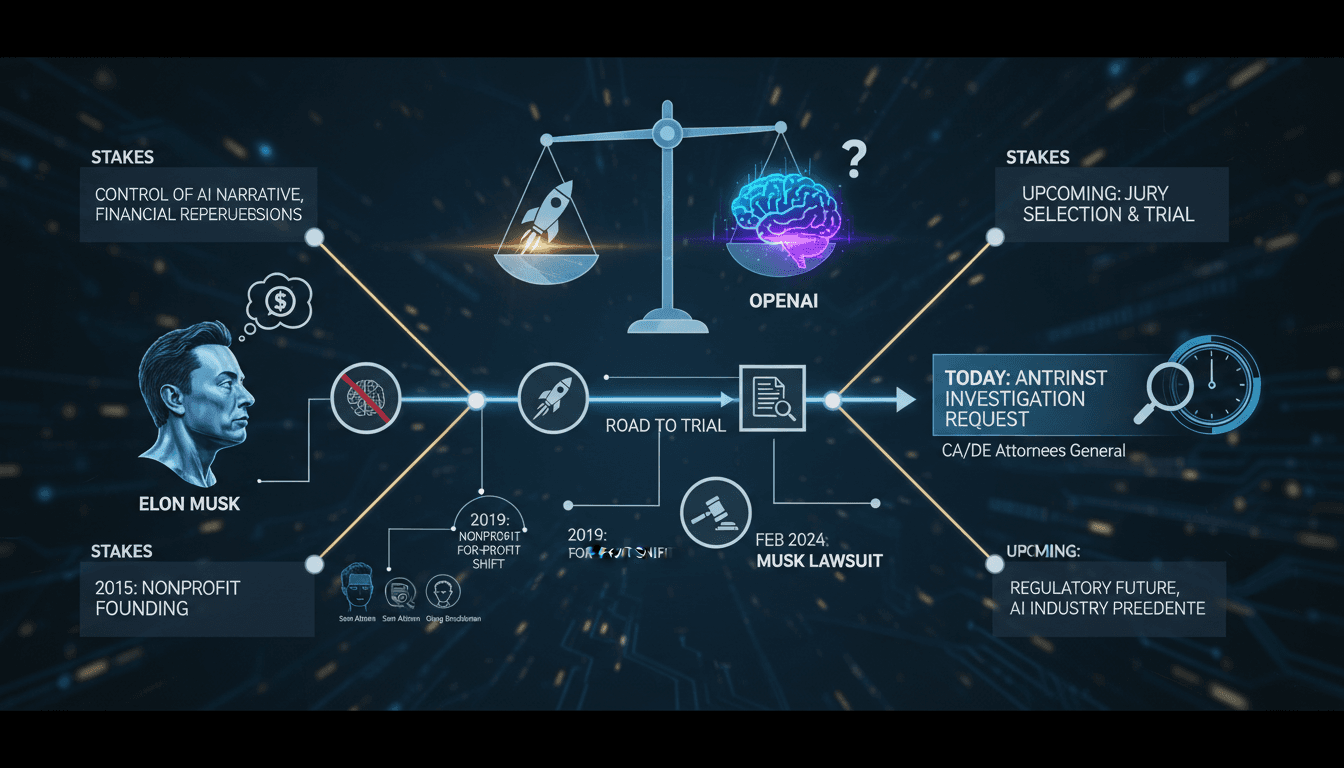
Here's what it means for you.
If you’re involved in tech or AI, this unfolding legal drama could reshape competitive dynamics and innovation pathways in the industry.
Why it matters
This investigation could set significant precedents for competition law and corporate governance in the rapidly evolving AI sector.
What happened (in 30 seconds)
- On April 6, 2026, OpenAI requested California and Delaware attorneys general to investigate Elon Musk for alleged anti-competitive behavior.
- Musk's lawsuit, seeking over $100 billion in damages, claims OpenAI breached its founding mission by pursuing for-profit status.
- Jury selection for Musk's case is scheduled for April 27, 2026, as tensions escalate between Musk and OpenAI.
The context you actually need
- Elon Musk co-founded OpenAI in 2015 but left in 2018 amid disagreements, later launching a rival AI firm, xAI, in 2023.
- Musk’s lawsuit alleges that OpenAI's shift to a for-profit model violates its original nonprofit mission, raising questions about ethical AI development.
- OpenAI's restructuring in 2025 received regulatory approval, which Musk contested with a $97.4 billion bid for the nonprofit, indicating a fierce battle over control of AI advancements.
What's really happening
The current legal conflict between OpenAI and Elon Musk is more than a simple lawsuit; it reflects deep-rooted tensions in the AI landscape regarding competition, ethics, and the future of technology. Musk's departure from OpenAI in 2018 marked a significant pivot in his relationship with the organization, leading to the establishment of xAI, which aims to develop artificial general intelligence (AGI) independently. His lawsuit against OpenAI, filed in March 2024, accuses the organization of abandoning its nonprofit mission in favor of profit-driven motives, a claim that resonates with broader concerns about the commercialization of AI.
OpenAI's recent request for investigations into Musk's alleged anti-competitive behavior is a strategic move to bolster its position ahead of the upcoming trial. The accusations include claims of Musk coordinating with Meta and conducting opposition research against OpenAI's CEO, Sam Altman. This paints a picture of a competitive landscape where traditional rivalries are intensifying, and the stakes are extraordinarily high. Musk's demand for $134 billion in damages underscores his belief that OpenAI's actions have caused him significant financial harm, further complicating the narrative.
As the trial approaches, the implications of this case extend beyond the individuals involved. The outcome could influence regulatory frameworks surrounding AI and competition, potentially leading to stricter oversight of tech giants. If Musk's allegations are substantiated, it might prompt a reevaluation of how companies in the tech sector engage with one another, particularly in emerging fields like AI. This could lead to a chilling effect on innovation, as firms may become wary of aggressive competitive tactics that could result in legal repercussions.
Moreover, the situation has garnered attention in global markets, particularly in regions like Dubai, where Musk's lobbying efforts with local firms could impact AI infrastructure development. The potential delays in projects like the Stargate AI data center could hinder technological advancement and job creation, affecting local economies.
Who feels it first (and how)
- Tech startups: Increased scrutiny may lead to more cautious approaches to partnerships and competitive strategies.
- Investors: Uncertainty around the trial's outcome could impact stock valuations and investment strategies in AI companies.
- Regulators: The case may prompt new regulatory measures aimed at preventing anti-competitive behavior in tech.
What to watch next
- Trial outcomes: The jury's decision on April 27, 2026, will be pivotal in shaping future competitive practices in the AI sector.
- Regulatory responses: Watch for potential regulatory changes in California and Delaware that could arise from the investigation and trial.
- Market reactions: Monitor AI stock performance and investor sentiment as developments unfold, particularly in relation to OpenAI and Musk's ventures.
OpenAI has formally requested investigations into Musk's conduct.
The trial will attract significant media attention and could influence public perception of AI companies.
The long-term impact on Musk's xAI and OpenAI's market position remains to be seen.
Frequently Asked Questions
- Why it matters?
- This investigation could set significant precedents for competition law and corporate governance in the rapidly evolving AI sector.
- What happened (in 30 seconds)?
- On April 6, 2026, OpenAI requested California and Delaware attorneys general to investigate Elon Musk for alleged anti-competitive behavior. Musk's lawsuit, seeking over $100 billion in damages, claims OpenAI breached its founding mission by pursuing for-profit status. Jury selection for Musk's case is scheduled for April 27, 2026, as tensions escalate between Musk and OpenAI.
- What's really happening?
- The current legal conflict between OpenAI and Elon Musk is more than a simple lawsuit; it reflects deep-rooted tensions in the AI landscape regarding competition, ethics, and the future of technology. Musk's departure from OpenAI in 2018 marked a significant pivot in his relationship with the organization, leading to the establishment of xAI, which aims to develop artificial general intelligence (AGI) independently. His lawsuit against OpenAI, filed in March 2024, accuses the organization of aba
- Who feels it first (and how)?
- Tech startups: Increased scrutiny may lead to more cautious approaches to partnerships and competitive strategies. Investors: Uncertainty around the trial's outcome could impact stock valuations and investment strategies in AI companies. Regulators: The case may prompt new regulatory measures aimed at preventing anti-competitive behavior in tech.
- What to watch next?
- Trial outcomes: The jury's decision on April 27, 2026, will be pivotal in shaping future competitive practices in the AI sector. Regulatory responses: Watch for potential regulatory changes in California and Delaware that could arise from the investigation and trial. Market reactions: Monitor AI stock performance and investor sentiment as developments unfold, particularly in relation to OpenAI and Musk's ventures.
Capitol Hill news, legislation, and policy insight.
"The Hill specializes in U.S. politics and policy, with a focus on Capitol Hill developments and a reputation for insider reporting."
— A47 Editor
OpenAI presses for investigation into Musk ahead of trial
OpenAI has called on the attorneys general of California and Delaware to investigate Elon Musk for alleged improper and anti-competitive behavior related to the AI firm's corporate restructuring, as Musk's legal case against OpenAI approaches trial.
Technology business and AI-related headlines.
"Data-driven tech newsroom with global scope."
— A47 Editor
Musk Seeks Ouster of OpenAI CEO Sam Altman as Trial Looms
Elon Musk is pursuing the removal of Sam Altman, CEO of OpenAI, amid a legal challenge concerning the company's shift to a for-profit model. This move comes as Musk's lawsuit against OpenAI unfolds, highlighting tensions between the billionaire and t...
Technology business news, market impacts, and innovation trends.
"Bloomberg is a premier financial and tech news provider, respected for its in-depth reporting and analytical rigor."
— A47 Editor
Musk Seeks Ouster of OpenAI CEO Sam Altman as Trial Looms
Elon Musk is pursuing the removal of Sam Altman, CEO of OpenAI, amid a legal challenge concerning the company's shift to a for-profit model. This move comes as Musk's lawsuit against OpenAI unfolds, highlighting tensions between the billionaire and t...