
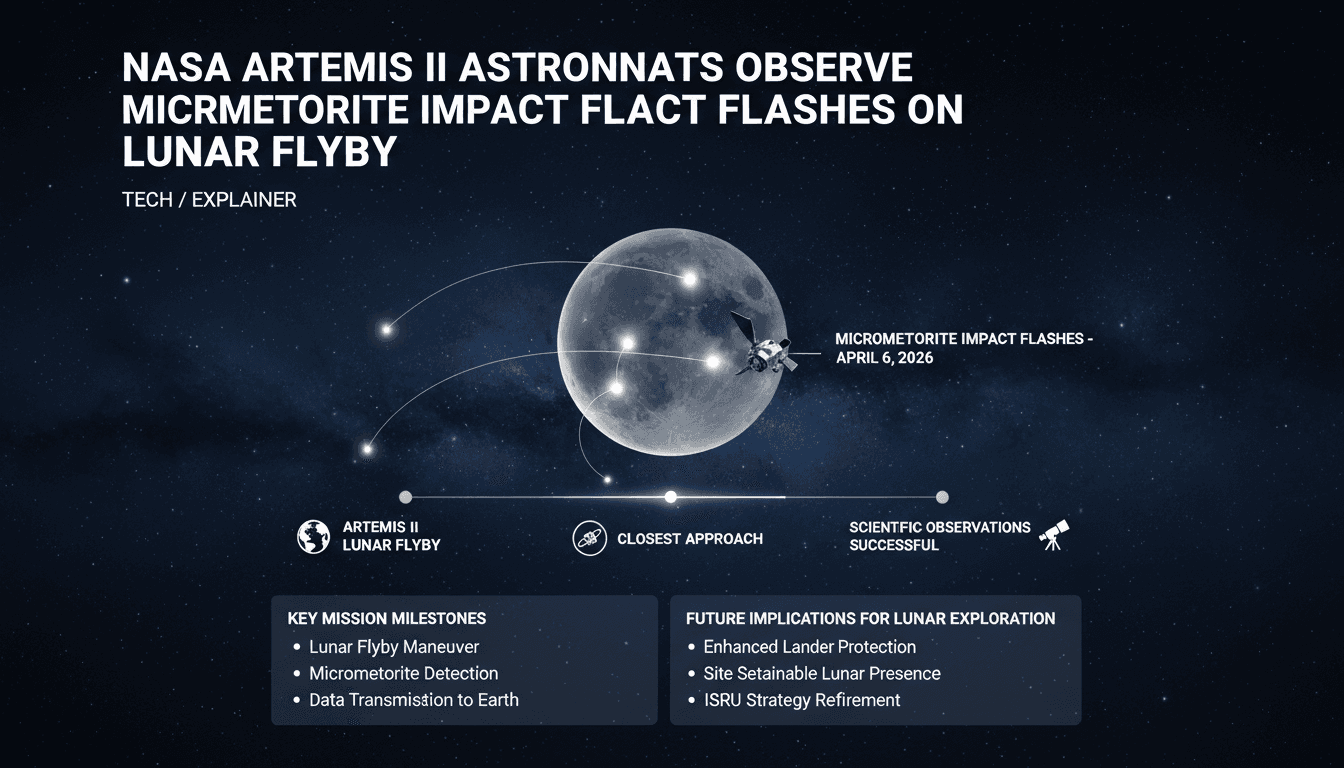
NASA Artemis II Astronauts Observe Micrometeorite Impact Flashes on Lunar Flyby
Here's what it means for you.
As space exploration progresses, advancements in lunar science could inform future technologies and industries on Earth.
Why it matters
The Artemis II mission enhances our understanding of lunar dynamics, which is crucial for future lunar habitation and resource utilization.
What happened (in 30 seconds)
- Astronauts observed five micrometeorite impact flashes on the Moon's far side during a flyby on April 6, 2026.
- NASA scientists reacted with excitement, noting the observations exceeded expectations and advanced lunar environmental understanding.
- The crew is currently en route to Earth, with ongoing analysis of the scientific data collected during the mission.
The context you actually need
- Artemis II is part of NASA's broader Artemis program, aimed at establishing a sustainable human presence on the Moon and eventually Mars.
- This mission marks the first crewed lunar flyby since Apollo 17 in 1972, integrating science operations to assess environmental hazards like micrometeoroids.
- The observations made during the flyby are critical for informing future lunar landings and potential colonization efforts, as they provide insights into the Moon's surface dynamics.
What's really happening
NASA's Artemis II mission, launched on April 1, 2026, represents a significant leap in human space exploration. The mission's crew—comprising Reid Wiseman, Victor Glover, Christina Koch, and Jeremy Hansen—conducted a flyby of the Moon, coming within approximately 4,067 miles (6,545 km) of its far side. This proximity allowed the astronauts to observe the lunar surface in unprecedented detail, particularly during a solar eclipse phase, which heightened the visibility of micrometeorite impacts.
On April 6, 2026, the crew reported witnessing five bright flashes caused by micrometeorite impacts, visible to the naked eye. This moment sparked audible excitement among NASA scientists at the Johnson Space Center, highlighting the mission's success in achieving its scientific integration goals. Kelsey Young, a NASA geologist, noted that the observations exceeded expectations, indicating a deeper understanding of the Moon's environmental dynamics.
The significance of these observations extends beyond mere excitement; they are crucial for future lunar missions. Understanding micrometeorite impacts is vital for assessing potential hazards to astronauts and equipment during future landings and habitation efforts. The data collected will inform strategies for mitigating risks associated with lunar surface operations, which is essential for the long-term sustainability of human presence on the Moon.
Moreover, the Artemis program aims to establish a sustainable lunar presence, which could serve as a testing ground for technologies and systems that will be used for Mars exploration. The insights gained from Artemis II will contribute to the development of habitats, life support systems, and resource utilization strategies, ultimately benefiting not only space exploration but also terrestrial applications in various industries.
As the crew returns to Earth, the scientific community is poised to analyze the data collected during the mission. This analysis will likely yield further insights into the Moon's surface and environment, driving advancements in lunar science and technology. The excitement surrounding the Artemis II mission reflects a broader trend in space exploration, where scientific discoveries are increasingly intertwined with technological innovation and potential commercial applications.
Who feels it first (and how)
- NASA scientists and engineers: Directly involved in analyzing the data and applying findings to future missions.
- Space industry professionals: Companies developing technologies for lunar exploration will benefit from insights gained.
- Academics and researchers: Those studying planetary science and environmental dynamics will gain valuable data for their work.
- Government agencies: Organizations focused on space policy and funding may adjust priorities based on mission outcomes.
- Space enthusiasts and the general public: Increased interest in space exploration could lead to greater support for funding and educational initiatives.
What to watch next
- Data analysis outcomes: The results from the scientific data collected during the mission will provide insights into lunar dynamics and inform future missions.
- Future Artemis missions: Upcoming Artemis missions will build on the findings from Artemis II, potentially leading to more comprehensive lunar exploration strategies.
- Technological advancements: Innovations developed for lunar exploration may find applications in other industries, influencing sectors like telecommunications, materials science, and robotics.
The Artemis II mission successfully observed micrometeorite impacts on the Moon.
The data collected will lead to advancements in lunar science and technology.
The specific long-term impacts of these findings on commercial space ventures and Earth-based industries.
Frequently Asked Questions
- Why it matters?
- The Artemis II mission enhances our understanding of lunar dynamics, which is crucial for future lunar habitation and resource utilization.
- What happened (in 30 seconds)?
- Astronauts observed five micrometeorite impact flashes on the Moon's far side during a flyby on April 6, 2026. NASA scientists reacted with excitement, noting the observations exceeded expectations and advanced lunar environmental understanding. The crew is currently en route to Earth, with ongoing analysis of the scientific data collected during the mission.
- What's really happening?
- NASA's Artemis II mission, launched on April 1, 2026, represents a significant leap in human space exploration. The mission's crew—comprising Reid Wiseman, Victor Glover, Christina Koch, and Jeremy Hansen—conducted a flyby of the Moon, coming within approximately 4,067 miles (6,545 km) of its far side. This proximity allowed the astronauts to observe the lunar surface in unprecedented detail, particularly during a solar eclipse phase, which heightened the visibility of micrometeorite impacts. O
- Who feels it first (and how)?
- NASA scientists and engineers: Directly involved in analyzing the data and applying findings to future missions. Space industry professionals: Companies developing technologies for lunar exploration will benefit from insights gained. Academics and researchers: Those studying planetary science and environmental dynamics will gain valuable data for their work. Government agencies: Organizations focused on space policy and funding may adjust priorities based on mission outcomes. Space enthu
- What to watch next?
- Data analysis outcomes: The results from the scientific data collected during the mission will provide insights into lunar dynamics and inform future missions. Future Artemis missions: Upcoming Artemis missions will build on the findings from Artemis II, potentially leading to more comprehensive lunar exploration strategies. Technological advancements: Innovations developed for lunar exploration may find applications in other industries, influencing sectors like telecommunications, materials
Space science news, astronomy updates, and spaceflight developments.
"Space.com delivers space science news, astronomy updates, and spaceflight developments with engaging coverage."
— A47 Editor
'Audible screams of delight' from NASA scientists over micrometeorite impacts on the moon witnessed by Artemis 2 astronauts
NASA scientists expressed excitement over the Artemis 2 astronauts' recent observations during their lunar flyby, particularly regarding the micrometeorite impacts that produced visible flashes on the moon's surface. This historic mission, which laun...
Science and technology stories including AI.
"Longstanding science magazine with thoughtful AI coverage."
— A47 Editor
NASA’s Artemis moon missions are a game changer for astronomy
NASA's Artemis program has successfully launched its Artemis II mission, marking the first crewed flight to the Moon in over 50 years, with four astronauts aboard the Orion spacecraft. This mission, which took off from Kennedy Space Center on April 1...
Scientific research, technology, environment, and society.
"Scientific American is one of the oldest and most authoritative science magazines, known for deep dives into science, technology, and society."
— A47 Editor
NASA’s Artemis moon missions are a game changer for astronomy
NASA's Artemis program has successfully launched its Artemis II mission on April 1, 2026, marking the first crewed flight to the Moon in over 50 years, with four astronauts aboard the Orion spacecraft. This mission aims to explore the lunar surface a...