
IMF Chief Warns of Economic Challenges Amid Ongoing Middle East Conflict and High Oil Prices
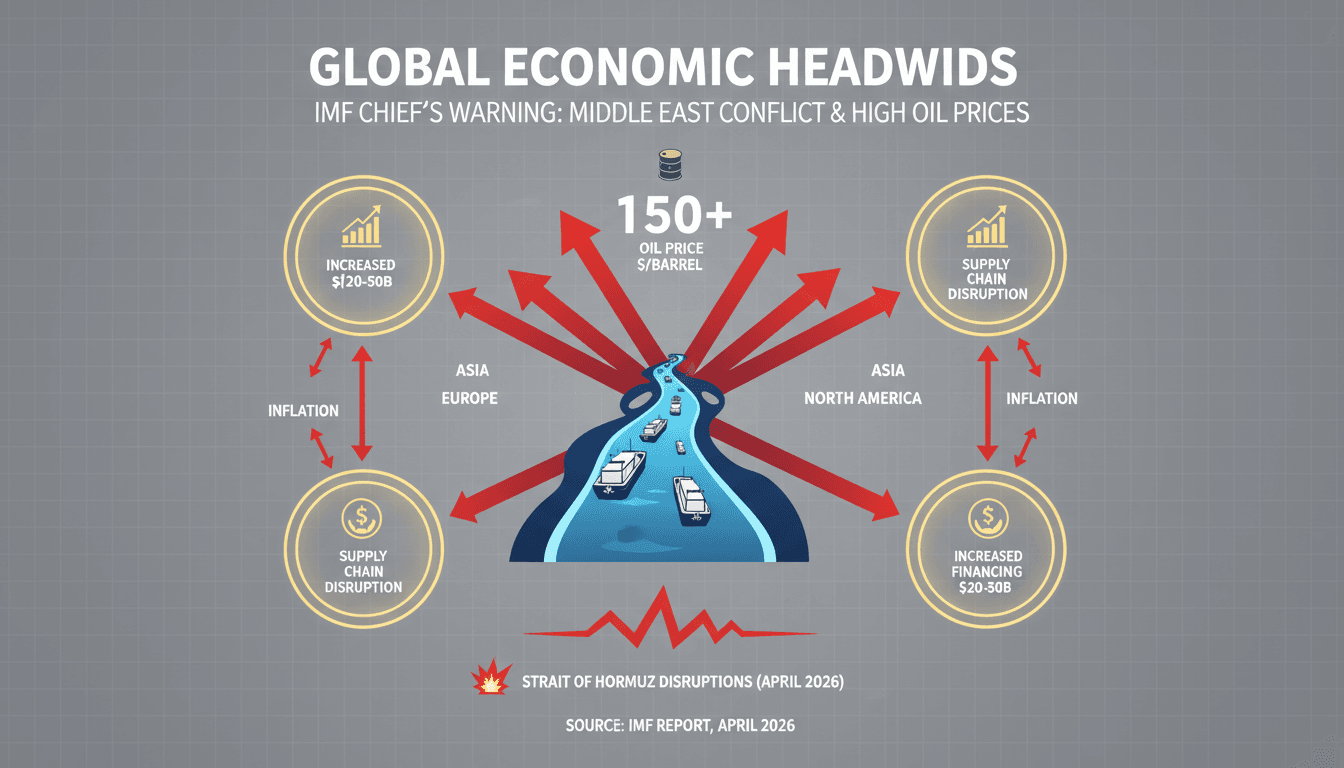
Here's what it means for you.
Rising oil prices could lead to increased costs for goods and services, impacting your budget and spending power.
Why it matters
The ongoing conflict in the Middle East is creating significant volatility in global oil markets, which can ripple through economies worldwide.
What happened (in 30 seconds)
- On April 15, 2026, IMF Managing Director Kristalina Georgieva warned of "tough times ahead" if the Middle East conflict persists and oil prices remain elevated.
- The conflict escalated after U.S.-Israeli strikes on Iran on February 28, 2026, leading to disruptions in the Strait of Hormuz, a critical chokepoint for global oil trade.
- IMF forecasts for global growth have been downgraded, with new financing demands estimated between $20-50 billion due to the economic fallout.
The context you actually need
- The Strait of Hormuz is vital for global oil trade, accounting for 20-30% of the world's oil supply, making its stability crucial for energy prices.
- Inflation risks are rising globally, particularly in energy-importing and low-income countries, as disruptions in oil and gas supply chains lead to increased costs for essential goods.
- The IMF's Spring Meetings were convened to address these challenges, with a focus on targeted fiscal aid and energy efficiency measures to mitigate the impact on vulnerable economies.
What's really happening
The recent escalation in the Middle East, particularly the U.S.-Israeli strikes against Iran, has triggered a series of events that are reshaping the global economic landscape. The Strait of Hormuz, a critical passage for oil shipments, was effectively closed due to Iranian retaliation, leading to immediate surges in oil prices. This disruption has not only affected oil but also caused significant supply chain breakdowns for other commodities, including fertilizers and gas, which are essential for food production.
As oil prices soared, the IMF adjusted its global growth forecasts downward, reflecting the anticipated economic slowdown. The previous growth estimate of 3.4% for 2025 was revised to 3.1% for 2026, with adverse scenarios suggesting a potential drop to 2%. This slowdown is particularly concerning for low-income countries that rely heavily on energy imports, as they face asymmetric burdens compared to wealthier nations.
Georgieva's warning highlights the IMF's projected financing needs of $20-50 billion to support countries grappling with these economic shocks. The IMF is advocating for a "wait and see" approach to monetary policy, suggesting that countries should avoid untargeted subsidies that could prolong economic pain. Instead, targeted fiscal aid and energy efficiency measures are recommended to help mitigate the impact on vulnerable populations.
In the UAE, including Dubai, residents are already feeling the effects of rising oil prices, with significant fuel price hikes implemented in April 2026. This has led to increased transportation costs, further straining household budgets. The UAE government has opted for monthly fuel price adjustments to reflect market rates, indicating a commitment to market-driven policies despite the pressures from rising global oil prices.
As the situation evolves, the interconnectedness of global economies means that the repercussions of the Middle East conflict will likely be felt far beyond the region, affecting everything from inflation rates to consumer spending patterns worldwide.
Who feels it first (and how)
- Low-income countries: Increased energy costs lead to higher prices for essential goods, exacerbating poverty.
- Energy-importing nations: Countries reliant on oil imports face inflationary pressures and potential economic slowdowns.
- Consumers in the UAE: Residents experience immediate impacts through rising fuel prices, affecting transportation and overall living costs.
What to watch next
- Ceasefire negotiations: Progress in talks could stabilize oil prices and alleviate economic pressures, impacting global markets.
- Oil price fluctuations: Continued volatility in Brent crude prices will signal the health of the global economy and inflation trends.
- IMF financing programs: The establishment of new financing initiatives will indicate how the international community is responding to the economic fallout.
The IMF has downgraded global growth forecasts due to the conflict and rising oil prices.
Continued volatility in oil prices will affect inflation rates and economic stability in energy-importing countries.
The long-term impact of the conflict on global supply chains and economic recovery remains uncertain.
Frequently Asked Questions
- Why it matters?
- The ongoing conflict in the Middle East is creating significant volatility in global oil markets, which can ripple through economies worldwide.
- What happened (in 30 seconds)?
- On April 15, 2026, IMF Managing Director Kristalina Georgieva warned of "tough times ahead" if the Middle East conflict persists and oil prices remain elevated. The conflict escalated after U.S.-Israeli strikes on Iran on February 28, 2026, leading to disruptions in the Strait of Hormuz, a critical chokepoint for global oil trade. IMF forecasts for global growth have been downgraded, with new financing demands estimated between $20-50 billion due to the economic fallout.
- What's really happening?
- The recent escalation in the Middle East, particularly the U.S.-Israeli strikes against Iran, has triggered a series of events that are reshaping the global economic landscape. The Strait of Hormuz, a critical passage for oil shipments, was effectively closed due to Iranian retaliation, leading to immediate surges in oil prices. This disruption has not only affected oil but also caused significant supply chain breakdowns for other commodities, including fertilizers and gas, which are essential f
- Who feels it first (and how)?
- Low-income countries: Increased energy costs lead to higher prices for essential goods, exacerbating poverty. Energy-importing nations: Countries reliant on oil imports face inflationary pressures and potential economic slowdowns. Consumers in the UAE: Residents experience immediate impacts through rising fuel prices, affecting transportation and overall living costs.
- What to watch next?
- Ceasefire negotiations: Progress in talks could stabilize oil prices and alleviate economic pressures, impacting global markets. Oil price fluctuations: Continued volatility in Brent crude prices will signal the health of the global economy and inflation trends. IMF financing programs: The establishment of new financing initiatives will indicate how the international community is responding to the economic fallout.
Regional coverage and analysis focused on politics, diplomacy, and business across the Middle East.
"Al-Monitor is known for analytical reporting on Middle East politics and policy developments."
— A47 Editor
IMF chief warns of 'tough times' if oil prices stay high
Kristalina Georgieva, the head of the International Monetary Fund (IMF), has issued a stark warning about the potential for tough economic times ahead if the ongoing conflict in the Middle East remains unresolved and oil prices continue to rise. Duri...
Sports reporting with a focus on Saudi and regional competitions.
"Okaz sports coverage is broad and audience-friendly, with strong attention to Saudi teams and leagues."
— A47 Editor
«النقد الدولي» يحذّر: رفع أسعار الفائدة يضر بالناتج الاقتصادي
Kristalina Georgieva, the Managing Director of the International Monetary Fund (IMF), warned that central banks should refrain from raising interest rates in response to the ongoing conflict in the Middle East, as it could negatively impact economic ...
Pan-Arab news coverage spanning politics, business, sports, and regional affairs.
"Asharq Al-Awsat reflects a broad Arab editorial perspective with strong attention to regional geopolitics."
— A47 Editor
غورغييفا تحذر من «أوقات عصيبة» في حال استمرار ارتفاع أسعار النفط
Kristalina Georgieva, the Managing Director of the International Monetary Fund, warned on Wednesday of difficult times ahead for the global economy if the conflict in the Middle East remains unresolved. She highlighted the potential impact of rising ...
Global markets, investing, and macroeconomics from a premier financial newsroom.
"Bloomberg is respected for in-depth financial reporting and data-driven analysis."
— A47 Editor
IMF Chief Warns Hasty Central-Bank Action Could Suffocate Growth
Kristalina Georgieva, Managing Director of the International Monetary Fund (IMF), cautioned that central banks should avoid rapid interest rate hikes in response to the ongoing crisis in the Middle East, as such actions could stifle economic growth. ...
UK and international business news, economics, and corporate coverage.
"The Guardian’s business section covers finance and markets with a progressive editorial tone."
— A47 Editor
IMF calls for countries to economise on energy supplies, and hails UK’s budget deficit improvement – business live
The International Monetary Fund (IMF) managing director Kristalina Georgieva emphasized the need for countries to economize on energy supplies during a press conference in Washington, DC, while also noting the UK's improvement in budget deficit. This...
Arabic-language UAE newspaper coverage focused on domestic affairs, public institutions, business, society, and regional developments.
"Al Khaleej coverage generally reflects a mainstream UAE editorial lens with strong attention to public affairs, institutions, and regional developments."
— A47 Editor
جورجيفا تحذّر البنوك المركزية من التسرّع في التشديد النقدي
Kristalina Georgieva, the Managing Director of the International Monetary Fund, has warned central banks against prematurely tightening monetary policies, stating that such actions could hinder economic growth. This warning came during her remarks fo...