
Anthropic Introduces Super-Voting Shares for Leadership Ahead of IPO
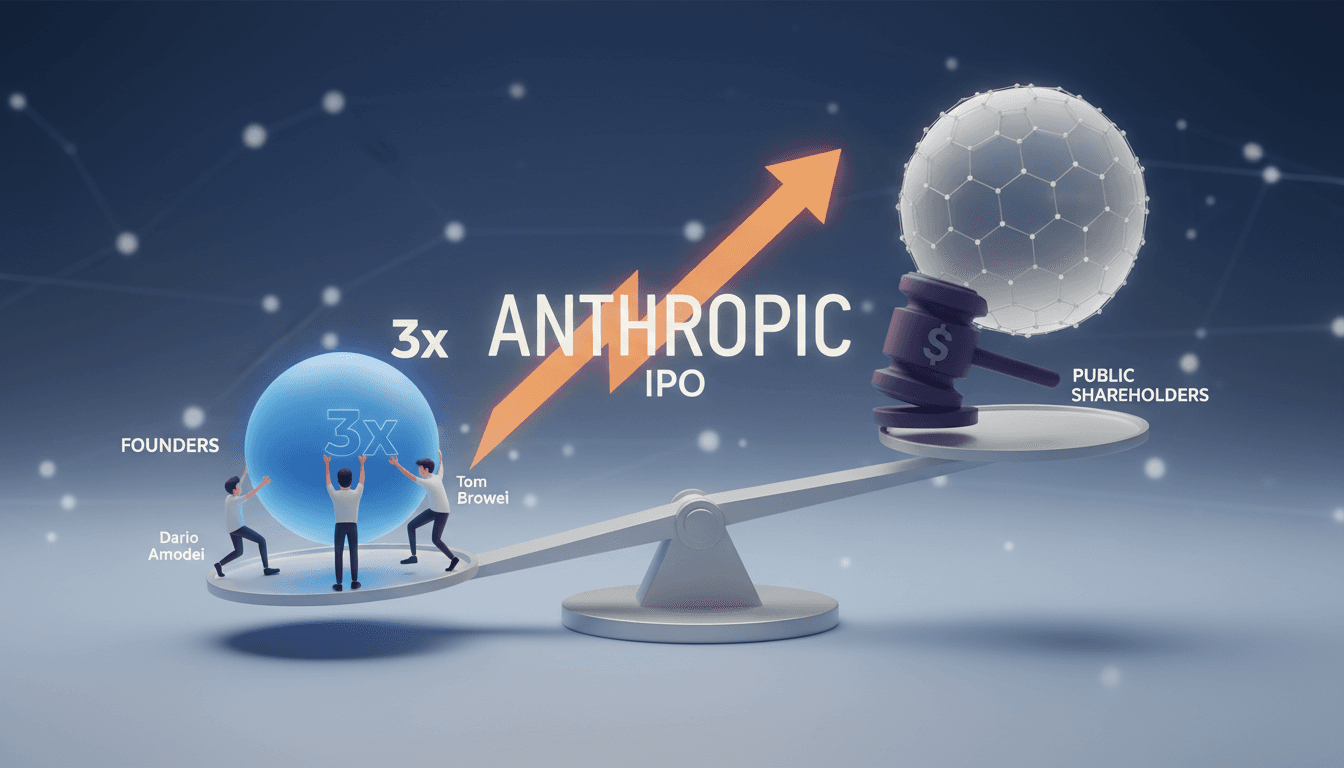
Here's what it means for you.
If you’re an investor or employee in the tech sector, this governance shift could influence how leadership stability is perceived in upcoming IPOs.
Why it matters
This move reflects a broader trend in tech governance aimed at maintaining founder control amid increasing market pressures.
What happened (in 30 seconds)
- Anthropic announced plans to grant CEO Dario Amodei and co-founders shares with extra voting power on August 18, 2026.
- This governance structure aims to ensure founder influence despite Amodei's approximate 2% ownership stake.
- The decision follows industry norms seen at companies like Meta and Snap, as Anthropic prepares for its IPO.
The context you actually need
- Anthropic is a key player in the competitive generative AI sector, known for its Claude AI models.
- The company is in the planning stage for an IPO, with founders holding relatively small ownership stakes compared to industry peers.
- Previous milestones include revenue run-rate achievements and ongoing regulatory discussions surrounding AI technologies.
What's really happening
On August 18, 2026, Anthropic's decision to implement a class of super-voting shares for its CEO and co-founders marks a significant shift in corporate governance as the company gears up for its initial public offering (IPO). This move is particularly noteworthy given that Dario Amodei, the CEO, holds only about 2% of the company's equity. The introduction of super-voting shares is designed to maintain a level of control for the founders, insulating them from potential external pressures that could arise once the company is publicly traded.
In the tech industry, it’s not uncommon for companies to adopt such governance structures. Firms like Meta and Snap have previously employed similar strategies to ensure that their founders retain significant influence over company decisions, even when their ownership stakes are relatively small. This approach can be particularly appealing in the fast-evolving tech landscape, where rapid growth and innovation are paramount, but so are the risks associated with public scrutiny and shareholder demands.
The rationale behind this governance strategy is multifaceted. First, it allows founders to pursue long-term visions without being overly swayed by short-term market fluctuations or investor pressures. This is crucial in the AI sector, where the pace of innovation is relentless, and strategic decisions often require a long-term perspective. Second, it can help attract talent and investment by signaling stability and continuity in leadership, which can be reassuring to potential investors and employees alike.
However, this approach also raises questions about accountability and governance. While super-voting shares can protect founders' interests, they can also lead to a disconnect between leadership and shareholders, potentially resulting in conflicts of interest. Investors may be wary of a governance structure that limits their influence, especially in a market where transparency and accountability are increasingly demanded.
As Anthropic prepares for its IPO, the implications of this governance structure will be closely watched. The company’s ability to balance founder control with investor interests will be critical in determining its long-term success in the public market.
Who feels it first (and how)
- Investors: Those looking to invest in Anthropic will need to assess the implications of founder control on their investment strategy.
- Tech Employees: Current and prospective employees may view this governance structure as a sign of stability or a potential barrier to influence.
- Market Analysts: Analysts will scrutinize this move as a reflection of broader trends in tech governance and its impact on IPO performance.
What to watch next
- Regulatory responses: Keep an eye on how U.S. regulators react to Anthropic's governance structure, as this could set precedents for future tech IPOs.
- Market performance post-IPO: The performance of Anthropic’s stock after its IPO will provide insights into investor sentiment regarding founder-controlled governance.
- Competitor reactions: Watch how other tech companies respond to this move, as it may influence their own governance strategies leading up to their IPOs.
Anthropic is preparing for an IPO and has announced a governance structure involving super-voting shares.
This move will influence investor perceptions of leadership stability in tech IPOs.
The long-term effects of this governance structure on Anthropic's market performance and investor relations.
Frequently Asked Questions
- Why it matters?
- This move reflects a broader trend in tech governance aimed at maintaining founder control amid increasing market pressures.
- What happened (in 30 seconds)?
- Anthropic announced plans to grant CEO Dario Amodei and co-founders shares with extra voting power on August 18, 2026. This governance structure aims to ensure founder influence despite Amodei's approximate 2% ownership stake. The decision follows industry norms seen at companies like Meta and Snap, as Anthropic prepares for its IPO.
- What's really happening?
- On August 18, 2026, Anthropic's decision to implement a class of super-voting shares for its CEO and co-founders marks a significant shift in corporate governance as the company gears up for its initial public offering (IPO). This move is particularly noteworthy given that Dario Amodei, the CEO, holds only about 2% of the company's equity. The introduction of super-voting shares is designed to maintain a level of control for the founders, insulating them from potential external pressures that co
- Who feels it first (and how)?
- Investors: Those looking to invest in Anthropic will need to assess the implications of founder control on their investment strategy. Tech Employees: Current and prospective employees may view this governance structure as a sign of stability or a potential barrier to influence. Market Analysts: Analysts will scrutinize this move as a reflection of broader trends in tech governance and its impact on IPO performance.
- What to watch next?
- Regulatory responses: Keep an eye on how U.S. regulators react to Anthropic's governance structure, as this could set precedents for future tech IPOs. Market performance post-IPO: The performance of Anthropic’s stock after its IPO will provide insights into investor sentiment regarding founder-controlled governance. Competitor reactions: Watch how other tech companies respond to this move, as it may influence their own governance strategies leading up to their IPOs.
Technology business news, market impacts, and innovation trends.
"Bloomberg is a premier financial and tech news provider, respected for its in-depth reporting and analytical rigor."
— A47 Editor
Anthropic Plans to Give CEO Extra Voting Power, Information Says
Anthropic PBC is reportedly planning to grant Chief Executive Officer Dario Amodei and other co-founders shares with enhanced voting power as the company prepares for its initial public offering (IPO), according to The Information. This move comes as...
Technology business and AI-related headlines.
"Data-driven tech newsroom with global scope."
— A47 Editor
Anthropic Plans to Give CEO Extra Voting Power, Information Says
Anthropic PBC is reportedly planning to grant Chief Executive Officer Dario Amodei and other co-founders shares with enhanced voting power as the company prepares for its initial public offering (IPO), according to The Information. This move comes as...
Curated tech headlines including AI stories.
"Influential aggregator surfacing the day’s top tech/AI links."
— A47 Editor
Sources: Anthropic prepares to give its co-founders shares with extra voting power to help insulate them from outside pressure; Amodei owns ~2% of Anthropic (The Information)
Anthropic is preparing to grant its co-founders, including CEO Dario Amodei, shares with enhanced voting power as part of its strategy ahead of a potential initial public offering (IPO). This move aims to insulate the leadership from external pressur...
Corporate leadership, finance, technology, and market trends.
"Fortune covers financial trends, leadership, and innovation with a pragmatic editorial approach."
— A47 Editor
David Sacks says Anthropic’s Dario Amodei wants a ‘DMV for AI.’ But plenty of industries thrive despite safety regulation
Dario Amodei, CEO of Anthropic, defended his regulatory approach to artificial intelligence (AI) amidst criticism from investor Gavin Baker, who suggested that Amodei's vision resembles a 'DMV for AI.' Amodei's comments on social media aimed to clari...
Daily AI news: models, tools, and policy.
"Independent outlet tracking the fast pace of AI."
— A47 Editor
Anthropic CEO says AI centralizes by nature and open models just shift power to whoever owns the chips
A public debate on AI regulation has intensified, with Anthropic CEO Dario Amodei asserting that AI inherently centralizes power, while critics like investor Gavin Baker and Meta researcher Yann LeCun accuse him of fear-mongering to gain regulatory f...
Curated tech headlines including AI stories.
"Influential aggregator surfacing the day’s top tech/AI links."
— A47 Editor
David Sacks says "Dario Amodei believes frontier AI is too powerful to distribute; we believe it is too powerful to centralize" after Amodei shared policy ideas (David Sacks/@davidsacks)
David Sacks commented on Dario Amodei's assertion that frontier AI is too powerful to distribute, countering that it is too powerful to centralize. This exchange highlights differing perspectives on AI governance and regulation in the tech industry.
News and guidance for IT pros on AI adoption.
"Enterprise-focused tips, explainers, and news for professionals."
— A47 Editor
Anthropic CEO Dario Amodei Says Open-Weight AI Won’t Decentralize Power
Anthropic CEO Dario Amodei has stated that open-weight AI technology alone will not lead to the decentralization of power, as the necessary advanced chips and computing resources remain concentrated among a few entities. This assertion highlights the...