
Volkswagen to Convert Osnabrück Plant for Air Defense Production with Israeli Partner
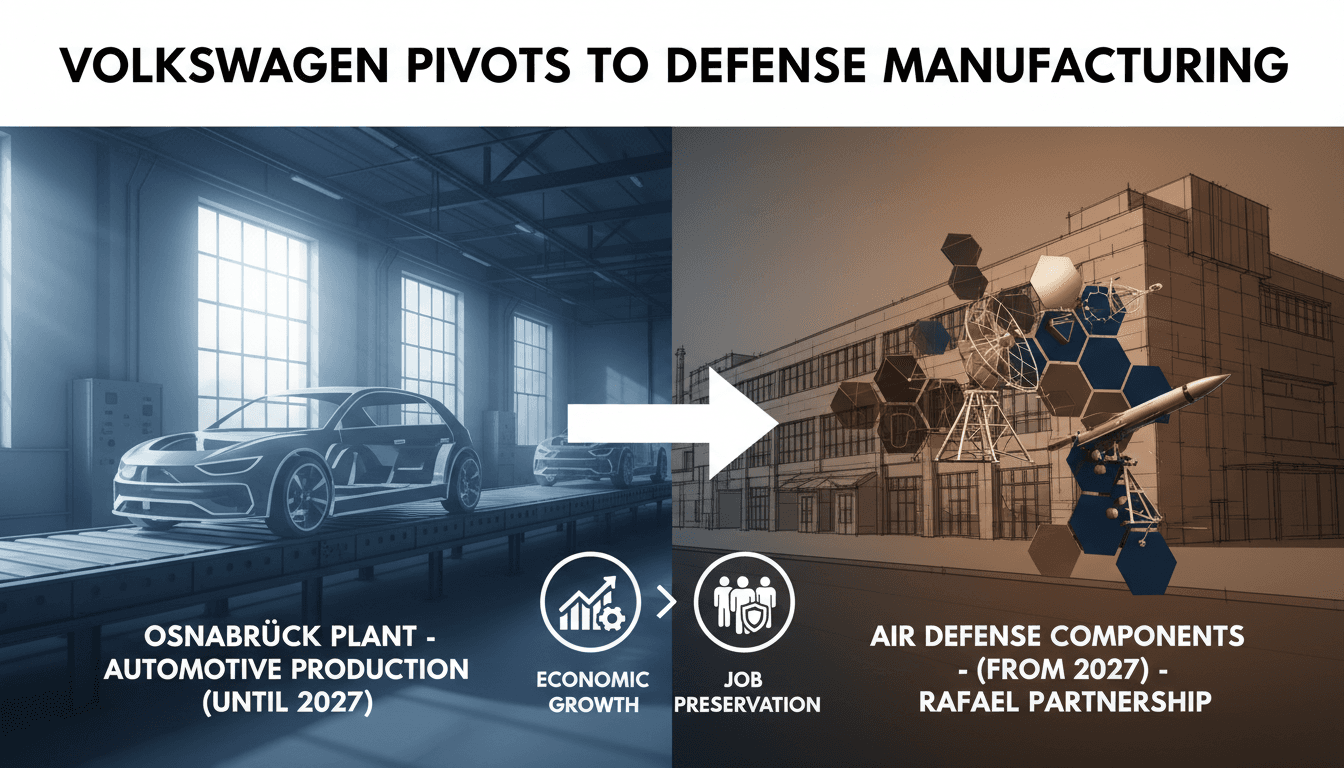
Here's what it means for you.
The transition of Volkswagen's Osnabrück plant to defense manufacturing could reshape job markets and industrial strategies across Europe.
Why it matters
This shift highlights the intersection of automotive decline and rising defense needs in Europe, impacting economic stability and job preservation.
What happened (in 30 seconds)
- Volkswagen announced the sale of its Osnabrück plant to focus on air defense component production in partnership with Israeli firm Rafael Advanced Defense Systems.
- The facility will transition from automobile manufacturing, ending vehicle production in 2027, to producing systems supporting European air defense, including elements for the Iron Dome.
- At least 1,200 jobs are guaranteed to be preserved at the site, addressing both economic pressures and defense requirements.
The context you actually need
- Volkswagen's Osnabrück plant has faced closure due to declining demand and competition, particularly from Chinese electric vehicle manufacturers.
- Germany's defense spending is increasing, driven by evolving security needs and European initiatives, creating a demand for local defense manufacturing.
- Previous discussions with Rafael since March 2026 indicated a strategic pivot towards defense, with a focus on non-lethal components to support air defense systems.
What's really happening
Volkswagen's decision to repurpose its Osnabrück plant is a strategic response to the dual pressures of a declining automotive market and the urgent need for enhanced defense capabilities in Europe. The automotive sector has been grappling with significant challenges, including a drop in demand for traditional vehicles, rising production costs, and fierce competition from Chinese electric vehicle manufacturers. As a result, Volkswagen's management recognized the necessity of pivoting away from automobile production, particularly after the cessation of T-Roc Cabriolet production in 2027.
The partnership with Rafael Advanced Defense Systems marks a significant shift in the plant's operational focus. This collaboration is not merely about transitioning to a new product line; it reflects a broader trend in which traditional manufacturing sites are being adapted to meet contemporary security needs. The agreement involves the production of air defense components, specifically designed to support systems like the Iron Dome, which is crucial for European defense strategies. This move aligns with Germany's increased defense spending and the European Union's collective efforts to bolster its defense capabilities amid geopolitical tensions.
The sale to Aurelius Capital and the state of Lower Saxony ensures that the facility remains operational, preserving at least 1,200 jobs that would have otherwise been lost. This job preservation is a critical aspect of the agreement, as it mitigates the economic fallout from the automotive sector's decline. Volkswagen's emphasis on non-lethal components further underscores its commitment to responsible manufacturing practices, distancing itself from direct weapon production while still contributing to national security.
This transition also reflects a growing recognition among European manufacturers of the need to diversify their production capabilities. As defense requirements evolve, companies are increasingly looking to leverage existing industrial infrastructure to meet these new demands. The Osnabrück plant's transformation serves as a case study for other manufacturers facing similar pressures, illustrating how strategic partnerships can facilitate a successful pivot to new markets.
Who feels it first (and how)
- Volkswagen employees: Job security for over 1,200 workers at the Osnabrück plant.
- Local economy: Businesses in Osnabrück may benefit from sustained employment and economic activity.
- Defense sector: Companies involved in air defense will see increased demand for components and systems.
What to watch next
- Defense spending trends: Monitor how Germany's increased defense budget influences other sectors and manufacturers.
- Partnership developments: Watch for further collaborations between automotive firms and defense contractors as the industry adapts.
- Market reactions: Observe how this shift impacts Volkswagen's stock performance and investor sentiment in the automotive sector.
The Osnabrück plant will cease vehicle production in 2027.
Other automotive manufacturers may explore similar partnerships to adapt to changing market conditions.
The long-term impact on Volkswagen's overall business strategy and profitability remains to be seen.
Frequently Asked Questions
- Why it matters?
- This shift highlights the intersection of automotive decline and rising defense needs in Europe, impacting economic stability and job preservation.
- What happened (in 30 seconds)?
- Volkswagen announced the sale of its Osnabrück plant to focus on air defense component production in partnership with Israeli firm Rafael Advanced Defense Systems. The facility will transition from automobile manufacturing, ending vehicle production in 2027, to producing systems supporting European air defense, including elements for the Iron Dome. At least 1,200 jobs are guaranteed to be preserved at the site, addressing both economic pressures and defense requirements.
- What's really happening?
- Volkswagen's decision to repurpose its Osnabrück plant is a strategic response to the dual pressures of a declining automotive market and the urgent need for enhanced defense capabilities in Europe. The automotive sector has been grappling with significant challenges, including a drop in demand for traditional vehicles, rising production costs, and fierce competition from Chinese electric vehicle manufacturers. As a result, Volkswagen's management recognized the necessity of pivoting away from a
- Who feels it first (and how)?
- Volkswagen employees: Job security for over 1,200 workers at the Osnabrück plant. Local economy: Businesses in Osnabrück may benefit from sustained employment and economic activity. Defense sector: Companies involved in air defense will see increased demand for components and systems.
- What to watch next?
- Defense spending trends: Monitor how Germany's increased defense budget influences other sectors and manufacturers. Partnership developments: Watch for further collaborations between automotive firms and defense contractors as the industry adapts. Market reactions: Observe how this shift impacts Volkswagen's stock performance and investor sentiment in the automotive sector.
RT is a Russian state-funded network covering global events from a Russian perspective.
"RT is widely criticized for promoting pro-Kremlin narratives and is considered by many to be a state propaganda outlet."
— A47 Editor
Volkswagen car plant to be converted for Israeli arms production
Volkswagen has announced a preliminary agreement to convert its Osnabrück plant in Lower Saxony, Germany, for the production of components for the Israeli Iron Dome air-defense system, marking a significant shift from automotive manufacturing to defe...
Global business, markets, and technology policy/industry coverage.
"France 24 provides balanced international coverage with a European perspective."
— A47 Editor
Volkswagen's Osnabrück plant to switch from cars to defence
Volkswagen has reached a preliminary agreement to sell its Osnabrück plant in Lower Saxony to the state government and Israeli investor Aurelius Capital, with plans to transition the facility to produce defense equipment for Rafael Advanced Defence S...
24/7 international news from a French perspective in multiple languages.
"France 24 is viewed as a globally focused outlet with balanced coverage and a European perspective."
— A47 Editor
Volkswagen's Osnabrück plant to switch from cars to defence
Volkswagen has reached a preliminary agreement to sell its Osnabrück plant in Lower Saxony to the state government and Israeli investor Aurelius Capital, with production set to shift from automotive manufacturing to defense equipment for Rafael Advan...
UAE-based English-language newspaper covering regional politics, economics, and global affairs.
"The National reflects Emirati policy perspectives while maintaining international editorial standards."
— A47 Editor
Volkswagen signs deal to turn factory into Israeli defence hub
Volkswagen has signed a deal to transform one of its factories into a defense hub in Israel, marking a significant shift in the company's operational focus. This development highlights Volkswagen's strategic move into the defense sector, aligning wit...