
OpenAI Projects $278 Billion Negative Cash Flow Through 2030 Amid Infrastructure Investments
Why it matters
OpenAI's projected cash burn highlights the intense capital requirements of scaling AI technologies, impacting investor confidence and market valuations.
What happened (in 30 seconds)
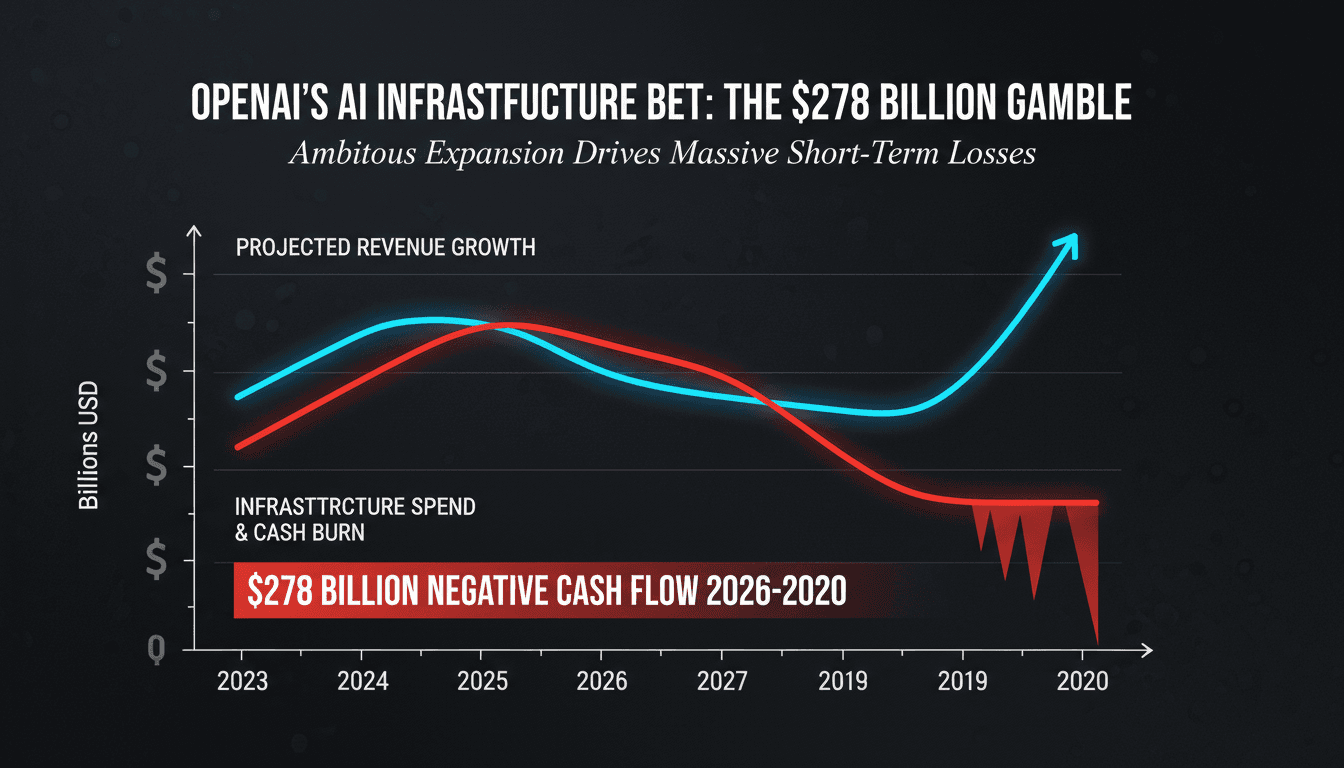
- OpenAI forecasts a $278 billion negative free cash flow from 2026 to 2030, driven by heavy investments in compute infrastructure.
- Revenue is expected to grow from $36 billion in 2026 to $350 billion in 2030, totaling approximately $840 billion over the five years.
- The company plans to spend $856 billion on compute-related outlays, raising questions about sustainability and funding needs.
The context you actually need
- OpenAI is scaling rapidly to maintain competitiveness in the generative AI sector, necessitating substantial investments in specialized hardware.
- Previous funding rounds have raised $122 billion, but projections indicate these funds may be depleted by 2028 under current spending trajectories.
- The company filed confidentially for an IPO in June 2026, but CEO Sam Altman has indicated that the listing will be delayed due to AI safety concerns.
What's really happening
OpenAI's ambitious financial forecast reveals a stark reality: the company is betting heavily on the future of AI, but this comes with significant risks. The projected $278 billion negative free cash flow from 2026 to 2030 is a reflection of the aggressive capital expenditures required to support its AI model training and operations. This cash burn is not just a number; it represents the cost of competing in a rapidly evolving market where technological advancements are paramount.
The company anticipates a tenfold increase in revenue, from $36 billion in 2026 to $350 billion in 2030, which would yield cumulative revenues of approximately $840 billion. However, this growth is predicated on the assumption that the market will continue to demand AI solutions at an unprecedented rate. OpenAI's spending of $856 billion on compute-related infrastructure underscores the scale of investment needed to maintain its competitive edge.
The context of this financial forecast is critical. OpenAI has been in a race to enhance its generative AI capabilities, driven by increasing competition from other tech giants. This has necessitated substantial investments in specialized hardware and data center capacity, which are essential for training complex AI models. The previous funding rounds, including a significant $122 billion raised in March 2026, have supported this growth but are projected to be insufficient to cover the anticipated cash burn.
Moreover, the company's plans for an IPO, initially confidentially filed in June 2026, have been complicated by concerns over AI safety. Altman has indicated that the IPO will not occur in 2026, which raises questions about how OpenAI will secure the necessary funding to sustain its operations and growth trajectory. The ongoing discussions with investors aim for a valuation near $1.2 trillion, but the viability of this valuation hinges on the company's ability to manage its cash flow effectively.
In summary, OpenAI's financial forecast is a double-edged sword. While it reflects the potential for significant revenue growth, it also highlights the immense financial pressures the company faces. Investors and stakeholders must navigate this complex landscape, weighing the risks of cash burn against the promise of future returns.
Who feels it first (and how)
- Investors: Those backing OpenAI will need to reassess their risk exposure given the projected cash burn.
- Tech companies: Competitors may feel pressure to increase their own investments in AI to keep pace.
- Data center operators: Increased demand for compute infrastructure could benefit companies in this sector.
- AI developers: Professionals in the AI field may see job growth as companies ramp up hiring to meet demand.
What to watch next
- Funding rounds: Keep an eye on OpenAI's upcoming investment rounds and how they impact its valuation and cash flow.
- Market response: Monitor how investors react to OpenAI's financial disclosures and the implications for the broader AI market.
- Regulatory developments: Watch for any changes in AI regulations that could affect OpenAI's operational strategies and funding needs.
OpenAI projects a $278 billion negative free cash flow through 2030.
The company will seek additional funding to support its ambitious growth plans.
The long-term sustainability of OpenAI's business model given its high cash burn rate.
Frequently Asked Questions
- Why it matters?
- OpenAI's projected cash burn highlights the intense capital requirements of scaling AI technologies, impacting investor confidence and market valuations.
- What happened (in 30 seconds)?
- OpenAI forecasts a $278 billion negative free cash flow from 2026 to 2030, driven by heavy investments in compute infrastructure. Revenue is expected to grow from $36 billion in 2026 to $350 billion in 2030, totaling approximately $840 billion over the five years. The company plans to spend $856 billion on compute-related outlays, raising questions about sustainability and funding needs.
- What's really happening?
- OpenAI's ambitious financial forecast reveals a stark reality: the company is betting heavily on the future of AI, but this comes with significant risks. The projected $278 billion negative free cash flow from 2026 to 2030 is a reflection of the aggressive capital expenditures required to support its AI model training and operations. This cash burn is not just a number; it represents the cost of competing in a rapidly evolving market where technological advancements are paramount. The company a
- Who feels it first (and how)?
- Investors: Those backing OpenAI will need to reassess their risk exposure given the projected cash burn. Tech companies: Competitors may feel pressure to increase their own investments in AI to keep pace. Data center operators: Increased demand for compute infrastructure could benefit companies in this sector. AI developers: Professionals in the AI field may see job growth as companies ramp up hiring to meet demand.
- What to watch next?
- Funding rounds: Keep an eye on OpenAI's upcoming investment rounds and how they impact its valuation and cash flow. Market response: Monitor how investors react to OpenAI's financial disclosures and the implications for the broader AI market. Regulatory developments: Watch for any changes in AI regulations that could affect OpenAI's operational strategies and funding needs.
Macro commentary, policy analysis, growth/inflation themes, and global outlooks.
"Contextual macro coverage that complements day-to-day market headlines."
— A47 Editor
OpenAI forecasts cash burn near $280 billion by 2030, FT reports
OpenAI has projected a staggering cash burn of approximately $280 billion by 2030, as reported by the Financial Times. This forecast reflects the company's significant investments in infrastructure amidst intense competitive pressures in the AI marke...
Curated tech headlines including AI stories.
"Influential aggregator surfacing the day’s top tech/AI links."
— A47 Editor
Leaked presentation: OpenAI expects negative free cash flow of $278B from 2026 to 2030 and projects its revenue will grow from $36B this year to $350B in 2030 (Financial Times)
A leaked presentation reveals that OpenAI anticipates a staggering negative free cash flow of $278 billion from 2026 to 2030, while projecting its revenue to increase from $36 billion this year to $350 billion by 2030. This forecast highlights the fi...
Technology business and AI-related headlines.
"Data-driven tech newsroom with global scope."
— A47 Editor
OpenAI Sees Burning Through $278 Billion by 2030: FT
OpenAI has projected a staggering negative free cash flow of $278 billion from 2026 to the end of 2030, as reported by the Financial Times. This forecast highlights the company's anticipated financial challenges amid its ongoing expansion and investm...
Technology business news, market impacts, and innovation trends.
"Bloomberg is a premier financial and tech news provider, respected for its in-depth reporting and analytical rigor."
— A47 Editor
OpenAI Sees Burning Through $278 Billion by 2030: FT
OpenAI has projected a staggering negative free cash flow of $278 billion from 2026 to the end of 2030, as reported by the Financial Times. This forecast highlights the company's anticipated financial challenges amid its ongoing expansion and investm...
Editor-curated FT homepage stories spanning markets, business, world, and opinion.
"The Financial Times is a globally respected business publication with a centrist/center-left tone and strong markets focus."
— A47 Editor
OpenAI expects to burn $280bn by 2030
OpenAI has projected a staggering $280 billion in negative cash flows by 2030 as it invests heavily in infrastructure while facing significant price pressures in the competitive AI market. This forecast highlights the financial challenges the company...