
SoftBank Issues Record $11.1 Billion High-Yield Bonds to Fund OpenAI Investment
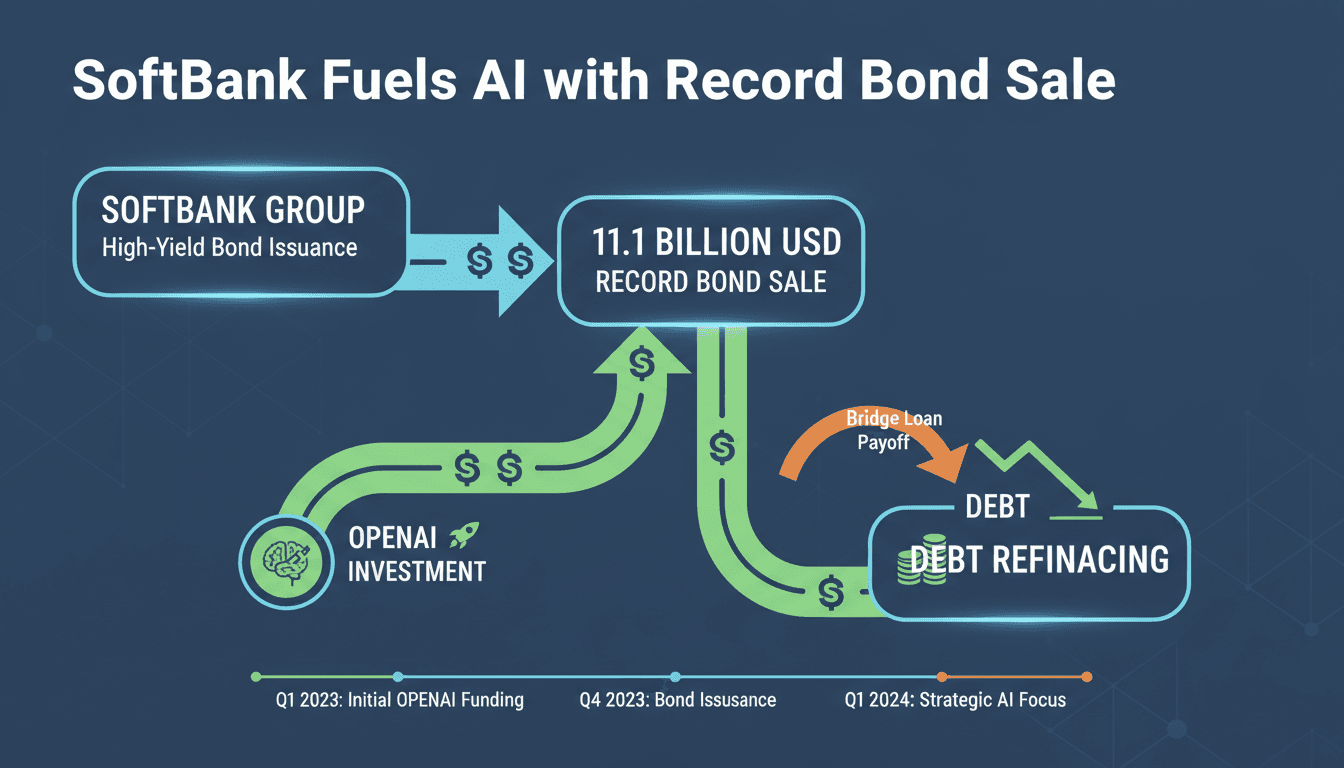
Why it matters
This record bond issuance reflects the growing appetite for high-yield investments amid rising interest rates and market volatility.
What happened (in 30 seconds)
- SoftBank Group priced a record $11.1 billion high-yield bond offering on September 24, 2026, to finance its final investment in OpenAI.
- Elevated yields on the bonds ranged from 8.625% to 9.75%, indicating increased borrowing costs due to SoftBank's financial leverage.
- Strong demand from institutional investors saw orders exceed $8 billion, despite the speculative-grade rating of the bonds.
The context you actually need
- SoftBank's commitment to OpenAI has exceeded $64 billion, with this bond issuance funding the final $10 billion tranche of investment.
- Market conditions have shifted, with rising interest rates prompting SoftBank to refinance its $40 billion bridge loan facility.
- Investor sentiment remains cautious, as the speculative-grade rating of the bonds reflects concerns over SoftBank's balance sheet and OpenAI's unlisted status.
What's really happening
On September 24, 2026, SoftBank Group executed a landmark high-yield bond issuance, raising $11.1 billion to finance its final investment tranche in OpenAI. This transaction is notable not only for its size but also for the elevated yields attached to the bonds, which ranged from 8.625% to 9.75%. These rates are indicative of the current market environment, where rising interest rates and a cautious investment climate have made borrowing more expensive.
The bond offering consisted of $10 billion in U.S. dollar-denominated senior unsecured notes and €1 billion in euro-denominated notes. The proceeds are earmarked for two primary purposes: completing the final $10 billion tranche of SoftBank's investment in OpenAI, and refinancing a portion of a $40 billion bridge loan facility that was initially arranged to support earlier investments in the AI company. This refinancing is crucial for SoftBank, as its net debt has surged significantly, necessitating a shift from short-term bridge financing to longer-term debt solutions.
Investor demand for the bonds was robust, with orders exceeding $8 billion, reflecting a strong appetite for high-yield investments despite the speculative-grade BB+ rating. This demand underscores a broader trend in the market where institutional investors, particularly U.S. asset managers and passive funds, are willing to take on higher risks for potentially higher returns. The issuance not only sets a record for Asia-Pacific non-financial corporate high-yield deals but also ranks among the largest global corporate high-yield transactions of the year.
However, the elevated yields also signal a risk premium associated with SoftBank's financial leverage and the uncertainties surrounding OpenAI's unlisted status. Credit analysts have noted that while SoftBank's balance sheet appears stretched, the refinancing effort is viewed positively as it extends the maturity of its debt, providing more breathing room for the company amid rising interest rates.
In summary, this bond issuance reflects a complex interplay of investor demand, market conditions, and SoftBank's strategic financial maneuvers as it continues to bet heavily on the future of artificial intelligence through its investment in OpenAI.
Who feels it first (and how)
- Institutional investors: They are likely to experience increased volatility in their portfolios due to the speculative nature of high-yield bonds.
- Tech sector stakeholders: Companies in the AI and tech space may see shifts in funding availability and investor sentiment.
- SoftBank's shareholders: They will feel the impact of SoftBank's financial strategies and the performance of its investments in OpenAI.
What to watch next
- Interest rate trends: Continued increases in interest rates could further affect borrowing costs and investor appetite for high-yield bonds.
- OpenAI's market performance: The success of OpenAI's products and services will be critical in justifying SoftBank's substantial investment.
- SoftBank's financial health: Monitoring SoftBank's debt levels and refinancing efforts will provide insights into its long-term viability and investment strategies.
SoftBank has committed over $64 billion to OpenAI, with this bond issuance being a significant part of that strategy.
Investor demand for high-yield bonds will remain strong, but with increased scrutiny on the underlying risks.
The long-term impact of rising interest rates on SoftBank's financial stability and its investments in AI remains uncertain.
Frequently Asked Questions
- Why it matters?
- This record bond issuance reflects the growing appetite for high-yield investments amid rising interest rates and market volatility.
- What happened (in 30 seconds)?
- SoftBank Group priced a record $11.1 billion high-yield bond offering on September 24, 2026, to finance its final investment in OpenAI. Elevated yields on the bonds ranged from 8.625% to 9.75%, indicating increased borrowing costs due to SoftBank's financial leverage. Strong demand from institutional investors saw orders exceed $8 billion, despite the speculative-grade rating of the bonds.
- What's really happening?
- On September 24, 2026, SoftBank Group executed a landmark high-yield bond issuance, raising $11.1 billion to finance its final investment tranche in OpenAI. This transaction is notable not only for its size but also for the elevated yields attached to the bonds, which ranged from 8.625% to 9.75%. These rates are indicative of the current market environment, where rising interest rates and a cautious investment climate have made borrowing more expensive. The bond offering consisted of $10 billio
- Who feels it first (and how)?
- Institutional investors: They are likely to experience increased volatility in their portfolios due to the speculative nature of high-yield bonds. Tech sector stakeholders: Companies in the AI and tech space may see shifts in funding availability and investor sentiment. SoftBank's shareholders: They will feel the impact of SoftBank's financial strategies and the performance of its investments in OpenAI.
- What to watch next?
- Interest rate trends: Continued increases in interest rates could further affect borrowing costs and investor appetite for high-yield bonds. OpenAI's market performance: The success of OpenAI's products and services will be critical in justifying SoftBank's substantial investment. SoftBank's financial health: Monitoring SoftBank's debt levels and refinancing efforts will provide insights into its long-term viability and investment strategies.
Editor-curated FT homepage stories spanning markets, business, world, and opinion.
"The Financial Times is a globally respected business publication with a centrist/center-left tone and strong markets focus."
— A47 Editor
SoftBank pays steep price for record bond sale to fund OpenAI bet
SoftBank has executed a record bond sale, raising over $11 billion at yields reaching 9.75%, to finance its investment in OpenAI. This marks the largest junk bond offering in history, reflecting the company's aggressive strategy in the rapidly evolvi...
Market-moving headlines impacting equities, bonds, and related risk assets.
"Real-time catalysts and volatility drivers across indices and sectors."
— A47 Editor
SoftBank issues $11.1 billion in bonds in OpenAI financing push
SoftBank has initiated a bond sale exceeding $11.1 billion to finance its investment in OpenAI, a move that underscores the tech giant's commitment to the rapidly evolving artificial intelligence sector. This bond issuance is expected to be denominat...
English-language digital publication covering business, politics, technology, and current affairs.
"The Arabian Post mixes original and syndicated-style coverage with a broad regional and global business-news orientation."
— A47 Editor
SoftBank markets jumbo AI bonds at record yields
SoftBank Group has initiated the marketing of over $11 billion in dollar and euro bonds, aiming for record prospective yields as it seeks to finance its growing commitments in artificial intelligence. The Tokyo-based company plans to raise $10 billio...
Technology business and AI-related headlines.
"Data-driven tech newsroom with global scope."
— A47 Editor
SoftBank Pays Steep Price to Become Goliath of Junk-Bond Markets
SoftBank Group Corp., led by billionaire Masayoshi Son, has executed one of the largest junk-bond offerings in history, offering yields higher than ever to finance its ambitious AI projects. This move comes amid a challenging financial landscape, whe...
Technology business news, market impacts, and innovation trends.
"Bloomberg is a premier financial and tech news provider, respected for its in-depth reporting and analytical rigor."
— A47 Editor
SoftBank Pays Steep Price to Become Goliath of Junk-Bond Markets
SoftBank Group Corp., led by billionaire Masayoshi Son, has executed one of the largest junk-bond offerings in history, offering yields higher than ever to finance its ambitious AI projects. This move comes amid a challenging financial landscape, whe...