
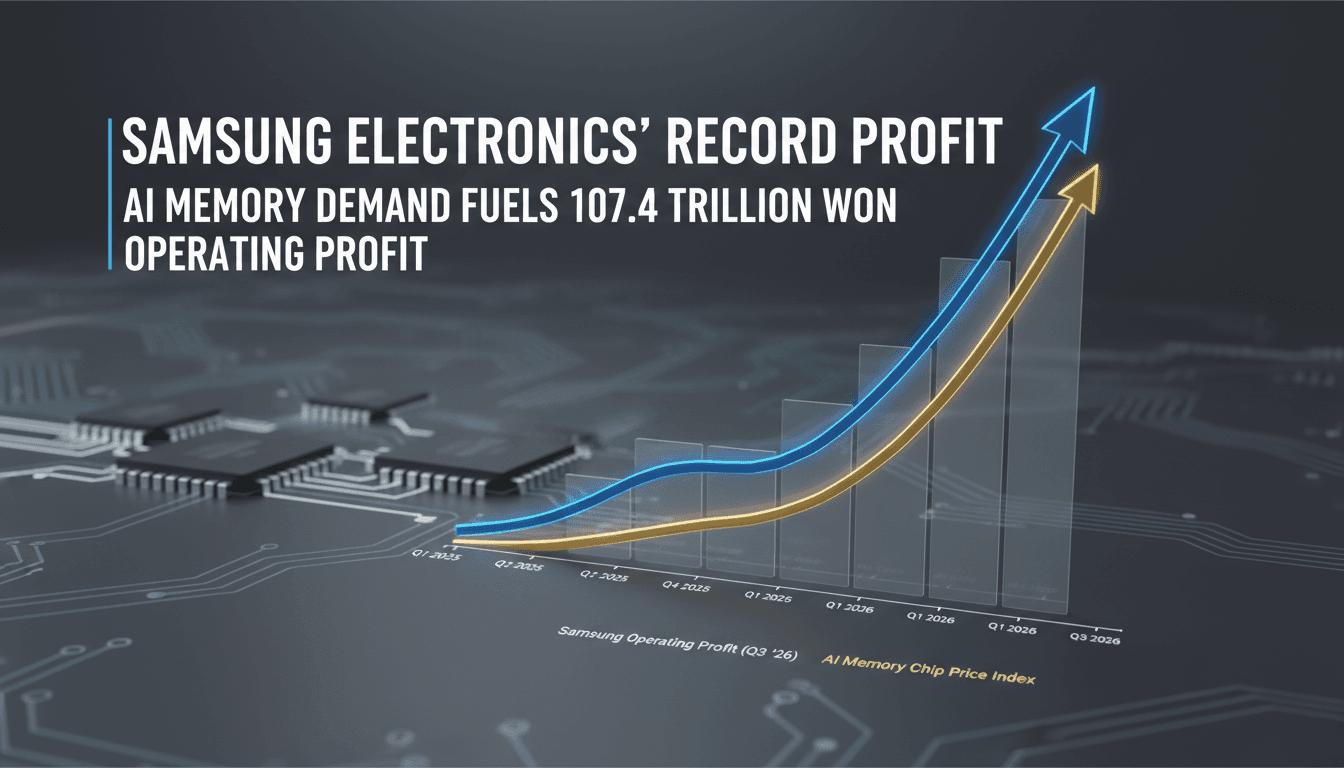
Samsung Electronics Achieves Record Q3 2026 Operating Profit of 107.4 Trillion Won Amid AI Memory Demand
Why it matters
Samsung's record profit highlights the critical role of memory chips in the booming AI sector, impacting consumer electronics pricing globally.
What happened (in 30 seconds)
- Samsung Electronics reported a record operating profit of 107.4 trillion won ($80.2 billion) for Q3 2026, driven by AI memory demand.
- Revenue surged to 195 trillion won ($145.6 billion), marking a 127% year-over-year increase and the first time any tech firm exceeded 100 trillion won in quarterly profit.
- Memory chip prices rose significantly due to a global supply shortage, affecting downstream consumer electronics manufacturers.
The context you actually need
- AI infrastructure investments have outpaced memory chip production, leading to a severe supply shortage since late 2025.
- Geopolitical tensions and export controls have further constrained supply chains, reversing previous industry downturns and enabling sharp price increases.
- Samsung's memory division is projected to have generated over 110 trillion won in profit, offsetting losses in other sectors like smartphones.
What's really happening
Samsung Electronics' preliminary earnings guidance for Q3 2026 reveals a staggering operating profit of 107.4 trillion won, a figure that underscores the company's dominance in the memory chip market. This profit surge, up 782.5% year-over-year, is primarily attributed to the skyrocketing demand for high-bandwidth memory (HBM) chips, which are essential for AI infrastructure. The global memory market has been grappling with a severe supply shortage since late 2025, driven by explosive growth in AI data center investments that have outstripped production capabilities for both conventional DRAM/NAND and specialized HBM chips.
As a result, memory chip prices have surged, with estimates indicating increases of 15-50% in Q3 alone. This price escalation has significantly boosted supplier margins, allowing companies like Samsung to report record profits. However, it has also placed immense pressure on consumer electronics manufacturers, such as Apple and Microsoft, who are now facing higher component costs. These manufacturers have begun to pass these costs onto consumers, leading to elevated retail prices for memory-intensive devices like smartphones, laptops, and SSDs.
The memory division's performance is particularly noteworthy, as it is estimated to have generated over 110 trillion won in profit, effectively compensating for losses in Samsung's smartphone and consumer electronics sectors. Despite this impressive financial performance, Samsung's shares dipped 0.7% on the announcement day, reflecting investor concerns about the sustainability of this growth amid ongoing supply constraints and geopolitical factors.
Looking ahead, analysts predict that the tight supply of memory chips will persist through 2027-2028, which could support further profit growth for Samsung and its peers. However, the broader implications for consumer electronics pricing remain uncertain, as manufacturers grapple with the challenge of balancing profitability with consumer demand.
Who feels it first (and how)
- Consumers: Higher prices for smartphones, laptops, and other memory-intensive devices.
- Consumer Electronics Manufacturers: Increased production costs leading to potential price hikes.
- Investors: Market volatility as companies adjust to changing profit margins and supply constraints.
- AI Infrastructure Investors: Increased demand for memory chips may drive further investments in AI technologies.
What to watch next
- Memory Chip Pricing Trends: Monitoring price fluctuations will indicate how supply constraints are evolving and their impact on consumer electronics.
- Samsung's Full Q3 Results: The detailed breakdown of divisional performance, scheduled for October 29, will provide insights into the sustainability of profit margins.
- Geopolitical Developments: Any changes in export controls or trade relations could significantly impact supply chains and pricing in the memory market.
Samsung's Q3 2026 operating profit is a record for any tech company.
Continued tight supply of memory chips through 2027-2028, supporting further profit growth.
How consumer electronics pricing will adjust as manufacturers respond to increased component costs.
Frequently Asked Questions
- Why it matters?
- Samsung's record profit highlights the critical role of memory chips in the booming AI sector, impacting consumer electronics pricing globally.
- What happened (in 30 seconds)?
- Samsung Electronics reported a record operating profit of 107.4 trillion won ($80.2 billion) for Q3 2026, driven by AI memory demand. Revenue surged to 195 trillion won ($145.6 billion), marking a 127% year-over-year increase and the first time any tech firm exceeded 100 trillion won in quarterly profit. Memory chip prices rose significantly due to a global supply shortage, affecting downstream consumer electronics manufacturers.
- What's really happening?
- Samsung Electronics' preliminary earnings guidance for Q3 2026 reveals a staggering operating profit of 107.4 trillion won, a figure that underscores the company's dominance in the memory chip market. This profit surge, up 782.5% year-over-year, is primarily attributed to the skyrocketing demand for high-bandwidth memory (HBM) chips, which are essential for AI infrastructure. The global memory market has been grappling with a severe supply shortage since late 2025, driven by explosive growth in
- Who feels it first (and how)?
- Consumers: Higher prices for smartphones, laptops, and other memory-intensive devices. Consumer Electronics Manufacturers: Increased production costs leading to potential price hikes. Investors: Market volatility as companies adjust to changing profit margins and supply constraints. AI Infrastructure Investors: Increased demand for memory chips may drive further investments in AI technologies.
- What to watch next?
- Memory Chip Pricing Trends: Monitoring price fluctuations will indicate how supply constraints are evolving and their impact on consumer electronics. Samsung's Full Q3 Results: The detailed breakdown of divisional performance, scheduled for October 29, will provide insights into the sustainability of profit margins. Geopolitical Developments: Any changes in export controls or trade relations could significantly impact supply chains and pricing in the memory market.
Tech news, hardware, and AI tools coverage.
"PC/tech site increasingly covering AI hardware and apps."
— A47 Editor
Memory crisis puts Samsung on track for the biggest quarterly operating profit in tech history
Samsung's preliminary guidance indicates an operating profit of 107.4 trillion won ($80.2 billion) for the third quarter of 2026, marking a significant increase from 12.17 trillion won ($9.1 billion) a year earlier. Revenue is projected to reach 195 ...
U.S. business news, corporate developments, and economy.
"The Wall Street Journal is respected for deep financial and economic reporting with a center-right editorial perspective."
— A47 Editor
Samsung Expects Operating Profit to Exceed $80 Billion for First Time
Samsung has announced that it expects its operating profit to exceed $80 billion for the first time, driven by robust global demand for advanced chips, particularly in artificial intelligence (AI) applications. This marks a significant milestone for ...
Business, markets, economy, and corporate news with strong UAE and regional relevance.
"Emirates 24|7 business coverage tends to center UAE markets, property, regulation, and regional economic developments."
— A47 Editor
Samsung flags $80 billion profit on AI boom, highest quarterly for any tech company
Samsung Electronics has projected an unprecedented quarterly profit of 107.4 trillion won ($80.17 billion) for the third quarter, driven by soaring demand for AI chips and strong memory sales, marking a historic milestone for any technology company.
Corporate news, economic trends, and markets with UK and global scope.
"BBC News is widely regarded as reputable and impartial, with a public service mandate."
— A47 Editor
AI chip boom pushes Samsung profits to record $80bn
Samsung has reported a record operating profit of $80 billion for the third quarter of 2026, driven primarily by a significant surge in demand for artificial intelligence (AI) chips. This marks a remarkable ninefold increase in profit compared to pre...
Market-moving headlines impacting equities, bonds, and related risk assets.
"Real-time catalysts and volatility drivers across indices and sectors."
— A47 Editor
Samsung flags $80 billion profit on AI boom, highest quarterly for any tech company
Samsung has reported a record profit of $80 billion for the third quarter of 2026, marking the highest quarterly profit for any technology company, primarily driven by soaring demand for artificial intelligence (AI) chips. This ninefold increase in p...
Editor-curated FT homepage stories spanning markets, business, world, and opinion.
"The Financial Times is a globally respected business publication with a centrist/center-left tone and strong markets focus."
— A47 Editor
Samsung profit surges ninefold to $80bn on AI chip demand
Samsung has reported a remarkable ninefold increase in profit, reaching $80 billion for the third quarter of 2026, driven primarily by soaring demand for artificial intelligence (AI) chips. This surge in earnings marks a continuation of the company's...
Curated tech headlines including AI stories.
"Influential aggregator surfacing the day’s top tech/AI links."
— A47 Editor
Samsung reports preliminary Q3 operating profit up 782% YoY to ~$80.1B, vs. ~$81.2B est., and revenue up 127% to ~$145.7B, lower than expected (Yoolim Lee/Bloomberg)
Samsung Electronics Co. reported a preliminary operating profit of approximately $80.1 billion for Q3 2026, marking a staggering 782% increase year-over-year, although it fell slightly short of the estimated $81.2 billion. Revenue also surged by 127%...
Technology business news, market impacts, and innovation trends.
"Bloomberg is a premier financial and tech news provider, respected for its in-depth reporting and analytical rigor."
— A47 Editor
Samsung Profit Up Almost Nine-Fold With Memory Chip Windfall
Samsung Electronics Co. reported a nearly nine-fold increase in its quarterly operating profit, driven primarily by a surge in demand for memory chips amid the ongoing AI infrastructure expansion. This performance, however, fell slightly short of the...
Technology business and AI-related headlines.
"Data-driven tech newsroom with global scope."
— A47 Editor
Samsung Profit Up Almost Nine-Fold With Memory Chip Windfall
Samsung Electronics Co. reported a nearly nine-fold increase in its quarterly operating profit, driven primarily by a surge in demand for memory chips amid the ongoing AI infrastructure expansion. This performance, however, fell slightly short of the...