
CoreWeave Bonds Enter Distressed Territory Amid AI Sector Sell-Off
Why it matters
The distress signals from CoreWeave highlight systemic vulnerabilities in the AI sector's reliance on debt financing.
What happened (in 30 seconds)
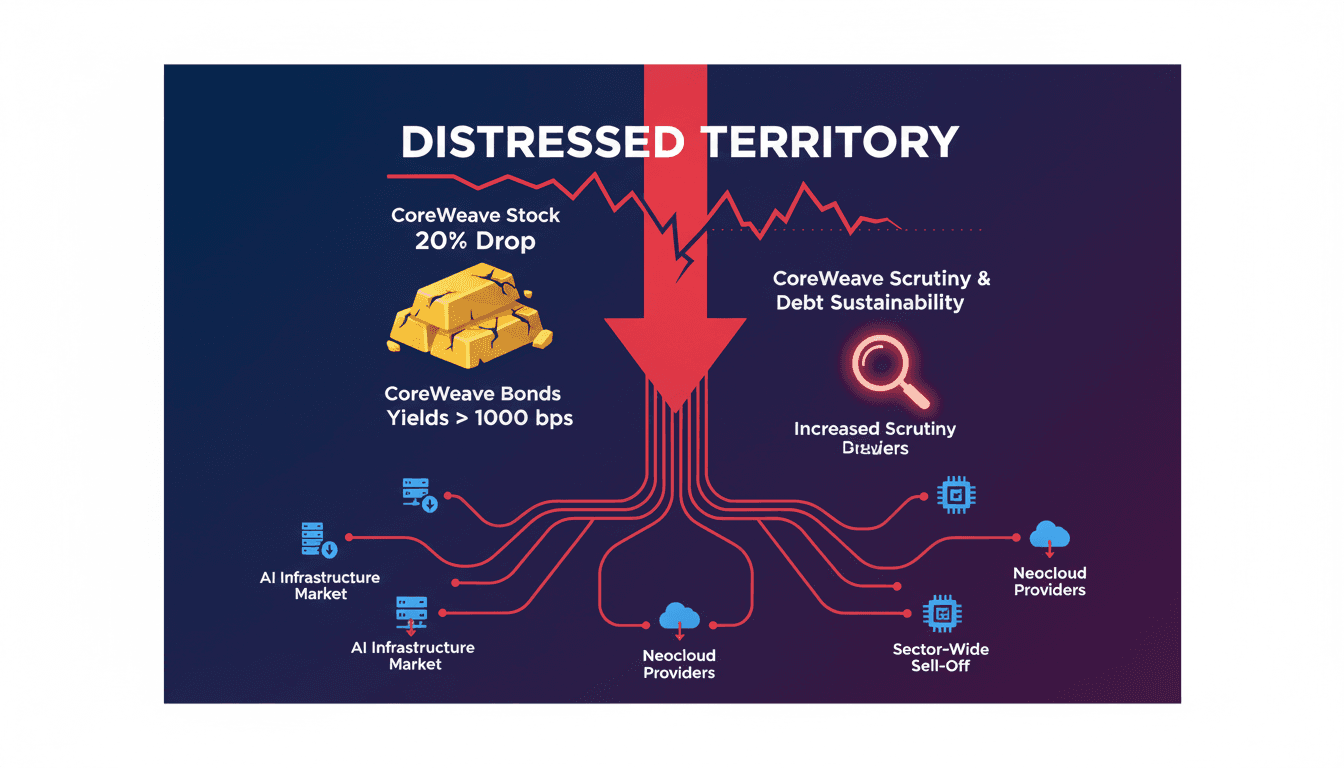
- CoreWeave's bonds entered distressed territory in mid-October 2026, with yields exceeding 1,000 basis points above government rates.
- Shares of CoreWeave plummeted over 20 percent in just days, triggering sell-offs across the AI sector.
- Major customers like Microsoft and OpenAI are now under scrutiny as investors question the sustainability of debt-funded growth in AI.
The context you actually need
- CoreWeave has amassed over $35 billion in debt while operating at a loss, relying on long-term contracts with major tech firms.
- The AI infrastructure boom has been fueled by private credit, with neocloud providers like CoreWeave leading the charge in GPU-backed loans.
- Market reactions have extended to other players like Oracle, indicating broader concerns about the viability of debt in the AI landscape.
What's really happening
In mid-October 2026, CoreWeave's financial troubles became apparent as its bonds slipped into distressed territory, with yields skyrocketing. This situation is a critical indicator of the broader risks associated with the AI infrastructure financing model, which has heavily relied on leveraged debt. CoreWeave, a New Jersey-based AI cloud provider, has aggressively scaled its operations since going public in 2025, but its business model has proven unsustainable. The company reported over $35 billion in debt and more than $1 billion in losses for the first half of the year, raising alarms about its financial health.
The spike in bond yields, exceeding 1,000 basis points above government rates, reflects investor fears about CoreWeave's ability to service its debt. This has led to a sharp decline in its stock price, which fell over 20 percent in just a few days. The fallout has not been limited to CoreWeave; other companies in the AI sector, including Oracle, have also seen their stocks and bonds affected, as investors reassess the risks associated with debt-funded growth in AI.
Key figures in the tech industry, such as Chamath Palihapitiya, have voiced concerns about a potential private credit bubble, suggesting that CoreWeave's situation could be a "canary in the coal mine" for the sector. The company's co-founder, Brannin McBee, has indicated a desire to achieve investment-grade status to access more favorable borrowing terms, but this raises further questions about the sustainability of its current debt levels.
The implications of this distress signal extend beyond CoreWeave itself. Major customers like Microsoft, OpenAI, and Nvidia, which have long-term contracts with CoreWeave, may feel pressure to support the company to avoid broader disruptions in their supply chains. However, the increasing scrutiny of AI-related debt could lead to a tightening of credit conditions across the sector, impacting future investments and growth.
Who feels it first (and how)
- Investors in AI infrastructure: Increased scrutiny on debt sustainability may lead to losses.
- Tech companies relying on CoreWeave: Potential disruptions in service could affect operations.
- Financial institutions: Heightened risk assessments may lead to tighter lending conditions.
- Employees in the AI sector: Job security could be threatened if companies face financial instability.
What to watch next
- Credit default swap spreads: Widening spreads could indicate rising default probabilities, impacting investor confidence.
- CoreWeave's next earnings report: Insights into debt management and operational performance will be critical for market sentiment.
- Market reactions to AI debt: Observing how other neocloud providers respond to CoreWeave's situation will reveal broader industry trends.
CoreWeave's bonds are in distressed territory, and its stock has dropped significantly.
Increased scrutiny of AI-related debt will affect investment strategies across the sector.
The long-term impact on major customers and the overall AI infrastructure market remains to be seen.
Frequently Asked Questions
- Why it matters?
- The distress signals from CoreWeave highlight systemic vulnerabilities in the AI sector's reliance on debt financing.
- What happened (in 30 seconds)?
- CoreWeave's bonds entered distressed territory in mid-October 2026, with yields exceeding 1,000 basis points above government rates. Shares of CoreWeave plummeted over 20 percent in just days, triggering sell-offs across the AI sector. Major customers like Microsoft and OpenAI are now under scrutiny as investors question the sustainability of debt-funded growth in AI.
- What's really happening?
- In mid-October 2026, CoreWeave's financial troubles became apparent as its bonds slipped into distressed territory, with yields skyrocketing. This situation is a critical indicator of the broader risks associated with the AI infrastructure financing model, which has heavily relied on leveraged debt. CoreWeave, a New Jersey-based AI cloud provider, has aggressively scaled its operations since going public in 2025, but its business model has proven unsustainable. The company reported over $35 bill
- Who feels it first (and how)?
- Investors in AI infrastructure: Increased scrutiny on debt sustainability may lead to losses. Tech companies relying on CoreWeave: Potential disruptions in service could affect operations. Financial institutions: Heightened risk assessments may lead to tighter lending conditions. Employees in the AI sector: Job security could be threatened if companies face financial instability.
- What to watch next?
- Credit default swap spreads: Widening spreads could indicate rising default probabilities, impacting investor confidence. CoreWeave's next earnings report: Insights into debt management and operational performance will be critical for market sentiment. Market reactions to AI debt: Observing how other neocloud providers respond to CoreWeave's situation will reveal broader industry trends.
Consumer tech and culture with frequent AI coverage.
"Influential tech outlet covering AI products and policy."
— A47 Editor
CoreWeave’s debt is becoming the whole AI industry’s problem
CoreWeave's financial situation has deteriorated significantly, with its bonds slipping into distressed territory, prompting concerns from investors and industry observers. Chamath Palihapitiya, known for his insights into SPACs, raised questions abo...
Tech news, reviews, and analysis of consumer electronics, science, art, and culture.
"The Verge is a technology-focused media outlet known for in-depth reporting, product reviews, and coverage of the intersection between technology and culture."
— A47 Editor
CoreWeave’s debt is becoming the whole AI industry’s problem
CoreWeave's financial situation has deteriorated significantly, with its bonds slipping into distressed territory, prompting concerns from investors and industry observers. Chamath Palihapitiya, known for his insights into SPACs, raised questions abo...
Stock market news, investing ideas, and trading analysis.
"TheStreet provides market news and retail-investor-focused analysis."
— A47 Editor
CoreWeave, Oracle have an interest rate problem
CoreWeave and Oracle are grappling with significant financial challenges as they borrow billions for artificial intelligence initiatives amid rising interest rates, which are inflating their interest bills and straining their credit ratings. This sit...
Curated tech headlines including AI stories.
"Influential aggregator surfacing the day’s top tech/AI links."
— A47 Editor
AI debt worries mount as CoreWeave's bond yield tops 15%, insuring SoftBank debt gets pricier, and some Oracle debt trades near 80 to 90 cents on the dollar (New York Times)
Concerns are escalating regarding AI-related debt as CoreWeave's bond yield surpasses 15%, while the cost of insuring SoftBank's debt increases and Oracle's debt trades at 80 to 90 cents on the dollar. This situation reflects growing unease among inv...