
Tesla Reports 56% Decline in Q3 2026 Operating Income Amid Increased AI Spending
Why it matters
Tesla's financial performance reflects broader trends in the electric vehicle market and the escalating costs of AI development.
What happened (in 30 seconds)
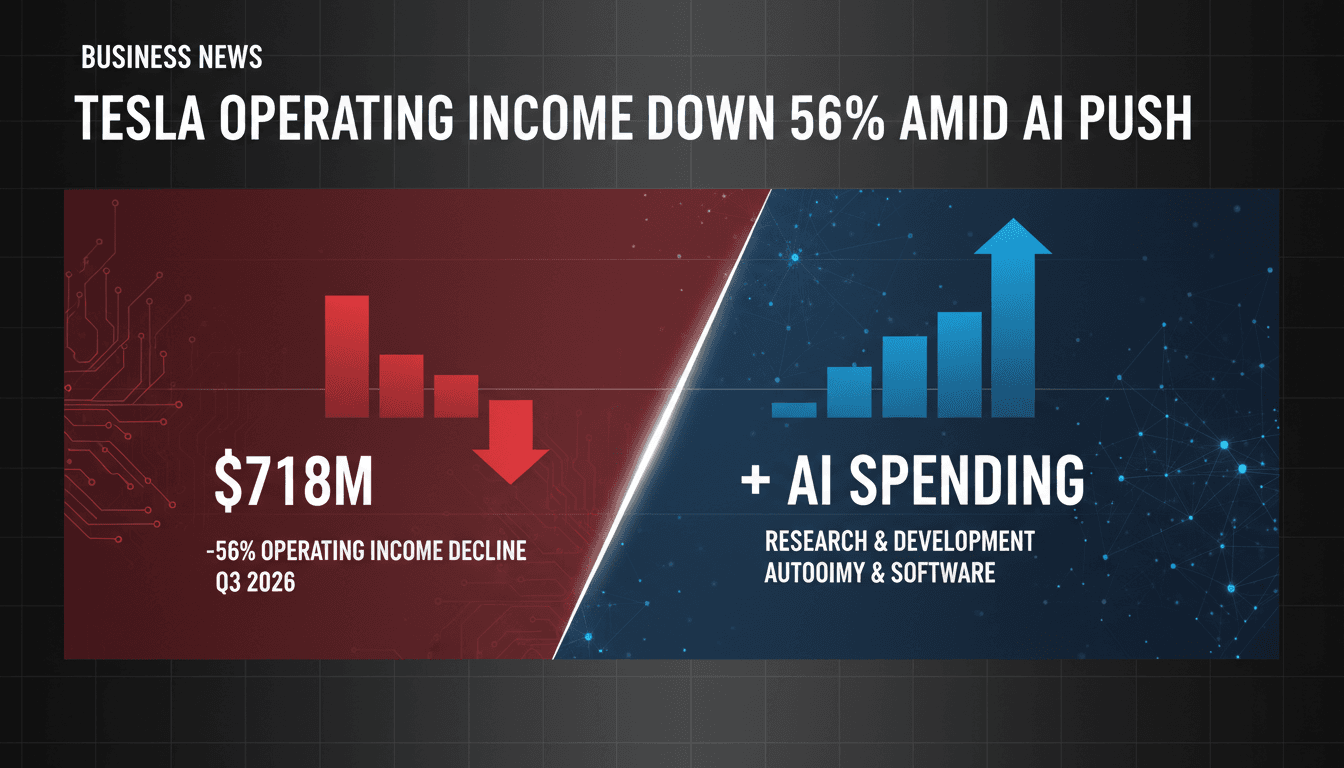
- Tesla reported a 56% year-over-year decline in operating income, totaling $718 million for Q3 2026.
- Revenue reached $28.05 billion, slightly below analyst expectations, amid rising operating expenses and reduced regulatory credit revenue.
- Despite the drop in income, Tesla generated positive free cash flow of $1.5 billion, indicating a focus on cash management amid high R&D spending.
The context you actually need
- Aggressive AI investments: Tesla has significantly increased its spending on artificial intelligence and robotics, with R&D costs rising nearly 70%.
- Regulatory credit challenges: The company has seen a decline in revenue from regulatory credits, dropping from $417 million to $113 million year-over-year.
- Market pressures: Price reductions and increased competition in the EV sector have contributed to margin compression, impacting overall profitability.
What's really happening
Tesla's Q3 2026 earnings report reveals a complex interplay of strategic investments and market pressures. The company's operating income fell to $718 million, a staggering 56% decrease from the previous year, driven primarily by a 39% increase in operating expenses, which reached $4.8 billion. This surge in costs is largely attributed to Tesla's aggressive push into artificial intelligence and robotics, particularly with its Optimus project. The company has committed substantial resources to R&D, reflecting a nearly 70% increase in AI-related expenditures.
While Tesla's revenue of $28.05 billion was slightly below analyst expectations, the firm managed to beat adjusted earnings per share forecasts at 48 cents. This indicates that despite the drop in operating income, Tesla is still capable of generating profits, albeit under pressure. The company also reported a positive free cash flow of $1.5 billion, achieved through reduced capital spending, which is a critical indicator of financial health amid rising costs.
The decline in regulatory credit revenue has been particularly impactful, as Tesla's earnings from these credits fell sharply from $417 million to just $113 million. This shift underscores the challenges the company faces as government incentives for electric vehicles evolve and become less predictable. Additionally, Tesla's energy storage segment reported a 16% drop in gross profits, further complicating its financial landscape.
Despite these challenges, Tesla remains optimistic about its future. The company highlighted a record vehicle backlog and plans to ramp up production, particularly in software and fleet-based profits. Analysts have noted that the cash flow beat was primarily due to lower-than-expected capital expenditures rather than a rebound in profitability, suggesting that the company is navigating a delicate balance between investment and financial sustainability.
Who feels it first (and how)
- Investors: Those holding Tesla stock may experience volatility as market reactions to earnings reports fluctuate.
- Consumers: Potential buyers of electric vehicles could see changes in pricing strategies as Tesla adjusts to market pressures.
- Tech sectors: Companies involved in AI and robotics may face increased competition and innovation pressures as Tesla ramps up its investments.
What to watch next
- AI spending efficiency: Monitor how effectively Tesla manages its AI investments and whether they translate into profitable innovations.
- Regulatory changes: Keep an eye on evolving government policies regarding EV incentives, which could impact Tesla's revenue streams.
- Production ramp-up: Watch for updates on Tesla's production plans and vehicle backlog, as these will indicate future sales performance.
Tesla's operating income has significantly declined due to increased R&D spending.
The company will continue to face margin pressures as it invests heavily in AI and robotics.
The long-term impact of these investments on Tesla's profitability and market position remains uncertain.
Frequently Asked Questions
- Why it matters?
- Tesla's financial performance reflects broader trends in the electric vehicle market and the escalating costs of AI development.
- What happened (in 30 seconds)?
- Tesla reported a 56% year-over-year decline in operating income, totaling $718 million for Q3 2026. Revenue reached $28.05 billion, slightly below analyst expectations, amid rising operating expenses and reduced regulatory credit revenue. Despite the drop in income, Tesla generated positive free cash flow of $1.5 billion, indicating a focus on cash management amid high R&D spending.
- What's really happening?
- Tesla's Q3 2026 earnings report reveals a complex interplay of strategic investments and market pressures. The company's operating income fell to $718 million, a staggering 56% decrease from the previous year, driven primarily by a 39% increase in operating expenses, which reached $4.8 billion. This surge in costs is largely attributed to Tesla's aggressive push into artificial intelligence and robotics, particularly with its Optimus project. The company has committed substantial resources to R&
- Who feels it first (and how)?
- Investors: Those holding Tesla stock may experience volatility as market reactions to earnings reports fluctuate. Consumers: Potential buyers of electric vehicles could see changes in pricing strategies as Tesla adjusts to market pressures. Tech sectors: Companies involved in AI and robotics may face increased competition and innovation pressures as Tesla ramps up its investments.
- What to watch next?
- AI spending efficiency: Monitor how effectively Tesla manages its AI investments and whether they translate into profitable innovations. Regulatory changes: Keep an eye on evolving government policies regarding EV incentives, which could impact Tesla's revenue streams. Production ramp-up: Watch for updates on Tesla's production plans and vehicle backlog, as these will indicate future sales performance.
Business and tech news excluding paywalled content.
"High-volume business/tech outlet with frequent AI coverage."
— A47 Editor
Tesla's profits are under pressure
Tesla's operating income has experienced a significant decline, falling 56% year over year, primarily due to rising costs associated with artificial intelligence and research and development. This financial downturn raises concerns about the company'...
In-depth reporting on tech, policy, and science including AI.
"Respected analysis for technically savvy readers, including AI topics."
— A47 Editor
Tesla profits drop 43% in Q3
Tesla reported a significant 43% drop in profits for Q3 2026, alongside a contraction in its energy storage business, highlighting ongoing challenges for the company.
In-depth coverage of hardware, software, science, and policy.
"Ars Technica provides expert technology news, hardware reviews, and analysis for a technically savvy audience."
— A47 Editor
Tesla profits drop 43% in Q3
Tesla reported a significant 43% drop in profits for Q3 2026, alongside a contraction in its energy storage business, highlighting ongoing challenges for the company.
Consumer tech and culture with frequent AI coverage.
"Influential tech outlet covering AI products and policy."
— A47 Editor
Flying Roadsters can’t lift Tesla’s flat Q3 revenues
Tesla reported its Q3 earnings, revealing a net income of $1.7 billion on $28.0 billion in revenue, with revenues remaining flat and profits declining by 4%. This follows a high-profile demonstration of its new Roadster, which showcased its ability t...
Tech news, reviews, and analysis of consumer electronics, science, art, and culture.
"The Verge is a technology-focused media outlet known for in-depth reporting, product reviews, and coverage of the intersection between technology and culture."
— A47 Editor
Flying Roadsters can’t lift Tesla’s flat Q3 revenues
Tesla reported its Q3 earnings, revealing a net income of $1.7 billion on $28.0 billion in revenue, with revenues remaining flat and profits declining by 4%. This follows a high-profile demonstration of its new Roadster, which showcased its ability t...