
Anthropic Cites $40 Trillion Annual Market Opportunity in IPO Prospectus Tied to Global Knowledge Worker Output
Why it matters
By anchoring its addressable market to global knowledge worker output, Anthropic is redefining enterprise software from a productivity cost center into a direct substitute for aggregate labor value across one-third of the global economy.
What happened (in 30 seconds)
* The filing benchmark: Anthropic filed its initial public offering prospectus ahead of a planned Nasdaq listing under the ticker ANT, framing its annual market opportunity around the $40 trillion-plus economic output generated by global knowledge workers in 2025. * The revenue baseline: The filing documented first-half 2026 revenue of $16.3 billion, representing a 1,300% increase year-over-year, driven by consumption-based token fees across more than 11,900 enterprise customers, including all Fortune 10 corporations. * The valuation target: The San Francisco-based maker of the Claude model family positioned the public offering to seek up to $100 billion in proceeds at a target valuation approaching $2 trillion.
The context you actually need
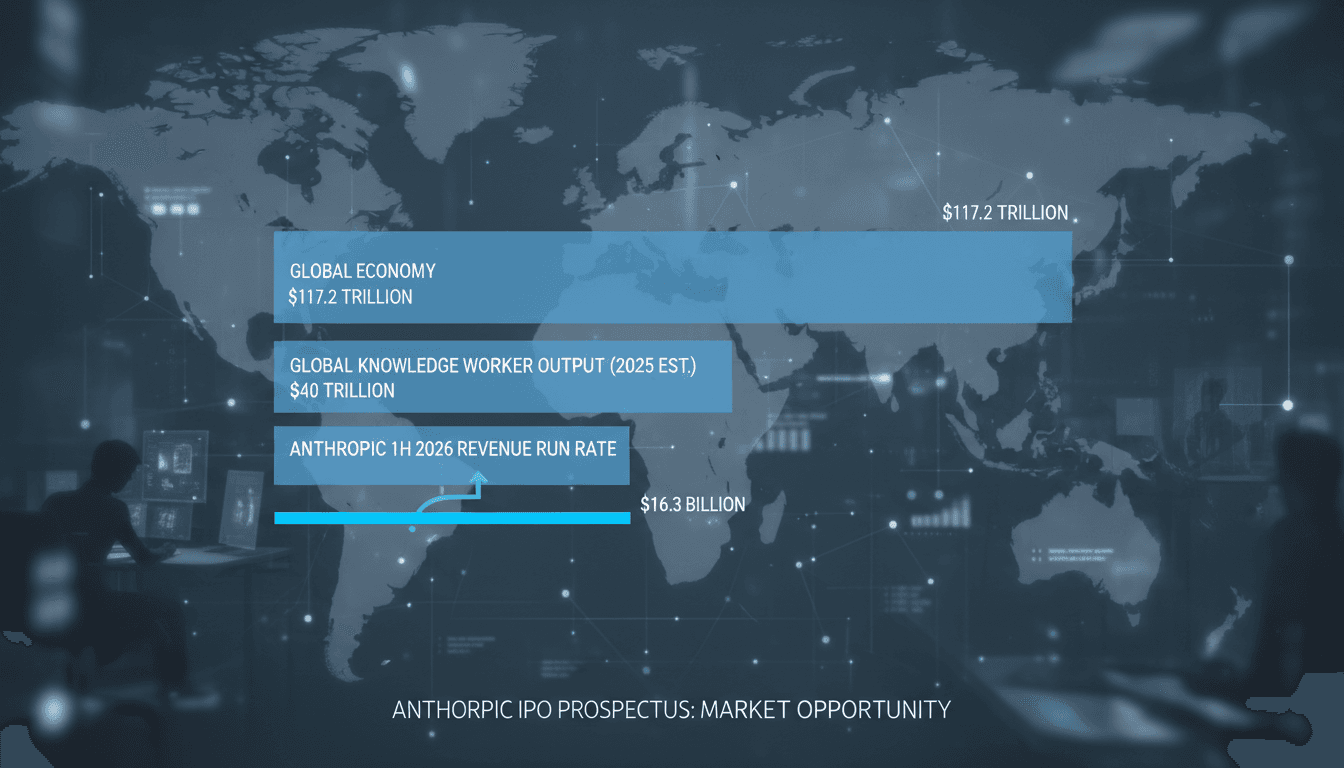
* The comparative scale: At more than $40 trillion, Anthropic's opportunity calculation exceeds SpaceX’s May 2026 estimate of $28.5 trillion and aligns with roughly 34% of the $117.2 trillion total global economy reported by the International Monetary Fund. * The broader industry runway: Independent market estimates, including projections from International Data Corporation, calculate the cumulative economic impact of artificial intelligence at $22.5 trillion by 2031, positioning Anthropic's annual metric at the top of market disclosure benchmarks. * The shifting pricing model: Enterprise technology historically framed its total addressable market within existing corporate information technology budgets, which globally sit in the single-digit trillions, rather than total human payroll output.
What's really happening
The mechanics behind Anthropic’s $40 trillion prospectus figure reveal a structural pivot in how software companies build financial projections for public markets.
Rather than calculating total addressable market (TAM) through the lens of traditional enterprise software spending—historically bounded by corporate IT budgets that rarely exceed 4% to 8% of enterprise revenue—Anthropic calculated its market ceiling by measuring the gross economic value created by cognitive labor worldwide. According to International Monetary Fund data, the global economy generated $117.2 trillion in 2025. Knowledge worker activity across coding, scientific research, financial modeling, legal analysis, and corporate administration represents more than one-third of that entire aggregate output.
The strategic incentive for Dario Amodei and Daniela Amodei to adopt this methodology relates directly to the capital requirements of frontier model development. Training and serving frontier foundational models demands multi-billion-dollar infrastructure commitments. To justify a valuation target approaching $2 trillion and support an offering seeking up to $100 billion in capital, the underlying company cannot present itself merely as a vendor of software-as-a-service (SaaS) seats.
Instead, the economic model is consumption-driven. Anthropic generated $16.3 billion in the first six months of 2026 predominantly through token-based pricing. Unlike fixed-seat licensing models that scale linearly with enterprise headcount, consumption-based pricing scales directly with workload volume. When an enterprise replaces or augments a knowledge worker task with Claude, Anthropic captures revenue based on the density of tokens processed rather than an arbitrary monthly seat license.
This mechanism structurally realigns the vendor's economic incentives. In a traditional SaaS model, enterprise software aims to make employees 10% more efficient so the client buys additional user seats as the business grows. In a labor-substitution or labor-multiplier token model, the AI provider captures a direct fraction of the economic value of the task completed. If a global enterprise deploys autonomous systems to execute engineering audits, document discovery, or algorithmic portfolio balancing, the spend migrates out of the general software procurement budget and directly into operational cost lines historically allocated to salaries, bonuses, and outsourced consulting.
By codifying this metric in an SEC registration statement, Anthropic sets a precedent that treats cognitive task automation not as a specialized software vertical, but as an infrastructure layer built to absorb a percentage of global wage expenditure.
Who feels it first (and how)
* Enterprise procurement executives: Software budget allocations will face pressure to merge with operational headcount budgets, as token consumption fees outpace traditional per-seat licensing caps. * Early-career knowledge workers (analysts, junior coders, paralegals): Entry-level production roles will see direct automation pressures first, as enterprises prioritize replacing routine task output to capture the productivity multiples cited in enterprise deployments. * Venture-backed AI application developers: Software firms building on top of foundational models face margin compression if foundational providers like Anthropic capture the primary value of cognitive task replacement through model-level token fees. * Public equity portfolio managers: Technology funds must recalibrate valuation models to assess whether cognitive output substitution can realistically sustain a 1,300% annualized revenue growth trajectory at scale.
What to watch next
* First-week Nasdaq trading performance under ticker ANT: Initial public trading volume and valuation settlement will signal whether institutional allocators accept labor-value displacement as a sound financial basis for a $2 trillion valuation. * Enterprise token consumption net retention rates: Upcoming quarterly filings will show whether the 11,900 enterprise customers, including the Fortune 10, maintain or accelerate consumption-based spending once early proof-of-concept projects conclude. * Competitive SEC prospectus filings from foundational peers: Future filings from peers like OpenAI will reveal whether equating market size to global knowledge worker compensation becomes standard practice across the frontier AI industry.
Anthropic filed its initial public offering documentation listing a target ticker of ANT, logged $16.3 billion in revenue for the first half of 2026, and anchored its core market opportunity against the $40 trillion-plus 2025 knowledge worker output.
The scale of the filing will force other enterprise technology vendors preparing public offerings to abandon traditional software-market definitions in favor of aggregate labor-replacement metrics to compete for institutional capital.
It remains uncertain whether corporate technology budgets can officially reclassify labor capital expenditures into third-party token consumption quickly enough to support projected multi-hundred-billion-dollar enterprise revenue trajectories.
Frequently Asked Questions
- Why it matters?
- By anchoring its addressable market to global knowledge worker output, Anthropic is redefining enterprise software from a productivity cost center into a direct substitute for aggregate labor value across one-third of the global economy.
- What happened (in 30 seconds)?
- The filing benchmark: Anthropic filed its initial public offering prospectus ahead of a planned Nasdaq listing under the ticker ANT, framing its annual market opportunity around the $40 trillion-plus economic output generated by global knowledge workers in 2025. The revenue baseline: The filing documented first-half 2026 revenue of $16.3 billion, representing a 1,300% increase year-over-year, driven by consumption-based token fees across more than 11,900 enterprise customers, including all Fortu
- What's really happening?
- The mechanics behind Anthropic’s $40 trillion prospectus figure reveal a structural pivot in how software companies build financial projections for public markets. Rather than calculating total addressable market (TAM) through the lens of traditional enterprise software spending—historically bounded by corporate IT budgets that rarely exceed 4% to 8% of enterprise revenue—Anthropic calculated its market ceiling by measuring the gross economic value created by cognitive labor worldwide. Accordi
- Who feels it first (and how)?
- Enterprise procurement executives: Software budget allocations will face pressure to merge with operational headcount budgets, as token consumption fees outpace traditional per-seat licensing caps. Early-career knowledge workers (analysts, junior coders, paralegals): Entry-level production roles will see direct automation pressures first, as enterprises prioritize replacing routine task output to capture the productivity multiples cited in enterprise deployments. Venture-backed AI application de
- What to watch next?
- First-week Nasdaq trading performance under ticker ANT: Initial public trading volume and valuation settlement will signal whether institutional allocators accept labor-value displacement as a sound financial basis for a $2 trillion valuation. Enterprise token consumption net retention rates: Upcoming quarterly filings will show whether the 11,900 enterprise customers, including the Fortune 10, maintain or accelerate consumption-based spending once early proof-of-concept projects conclude. Compe
Tech business coverage, major deals, product launches, and Silicon Valley trends.
"WSJ’s tech section offers authoritative reporting on the intersection of technology and business, including exclusive industry analysis."
— A47 Editor
See How Anthropic Arrived at Its Mind-Boggling $40 Trillion Market Opportunity
Anthropic's market opportunity, estimated at roughly $40 trillion and tied to the economic value of work performed by knowledge workers, surpasses the enormous figure SpaceX cited earlier this year, according to the Wall Street Journal's technology c...
U.S. business news, corporate developments, and economy.
"The Wall Street Journal is respected for deep financial and economic reporting with a center-right editorial perspective."
— A47 Editor
See How Anthropic Arrived at Its Mind-Boggling $40 Trillion Market Opportunity
The Wall Street Journal reports on how Anthropic arrived at an estimated $40 trillion market opportunity, a figure tied to the economic value of work produced by knowledge workers and exceeding SpaceX's earlier estimate. The base story centers on the...
Tech business coverage, major deals, product launches, and Silicon Valley trends.
"WSJ’s tech section offers authoritative reporting on the intersection of technology and business, including exclusive industry analysis."
— A47 Editor
Opinion | Anthropic’s Big IPO Gamble
Anthropic, the artificial intelligence company behind the Claude chatbot, is pursuing a planned initial public offering on Nasdaq under the ticker ANT, a move that WSJ Tech's opinion piece frames as a high-stakes wager, with the company itself saying...
Consumer technology news with AI coverage.
"Gadget and tech site reporting on AI in products."
— A47 Editor
Anthropic files to go public
Anthropic has filed to go public, according to a report by Engadget, with the company reportedly possibly valued as high as $2 trillion. The filing marks a major step toward a public listing for the AI firm, whose offering is being closely watched ac...
Covers consumer technology, electronics, gadgets, and product reviews.
"Engadget is a trusted source for gadget reviews and consumer tech news, known for its hands-on analysis and industry coverage."
— A47 Editor
Anthropic files to go public
Anthropic has filed to go public, according to a report by Engadget, with the company reportedly possibly valued as high as $2 trillion. The filing marks a major step toward a public listing for the AI firm, whose offering is being closely watched ac...