
OPay Withdraws $304 Million NYSE IPO After Foreign Regulatory Inquiry Halts Listing
Why it matters
The sudden cancellation of a $4 billion listing hours after pricing establishes that multi-jurisdictional underwriting syndicates will terminate fully subscribed offerings rather than absorb undisclosed regulatory risk on U.S. public exchanges.
What happened (in 30 seconds)
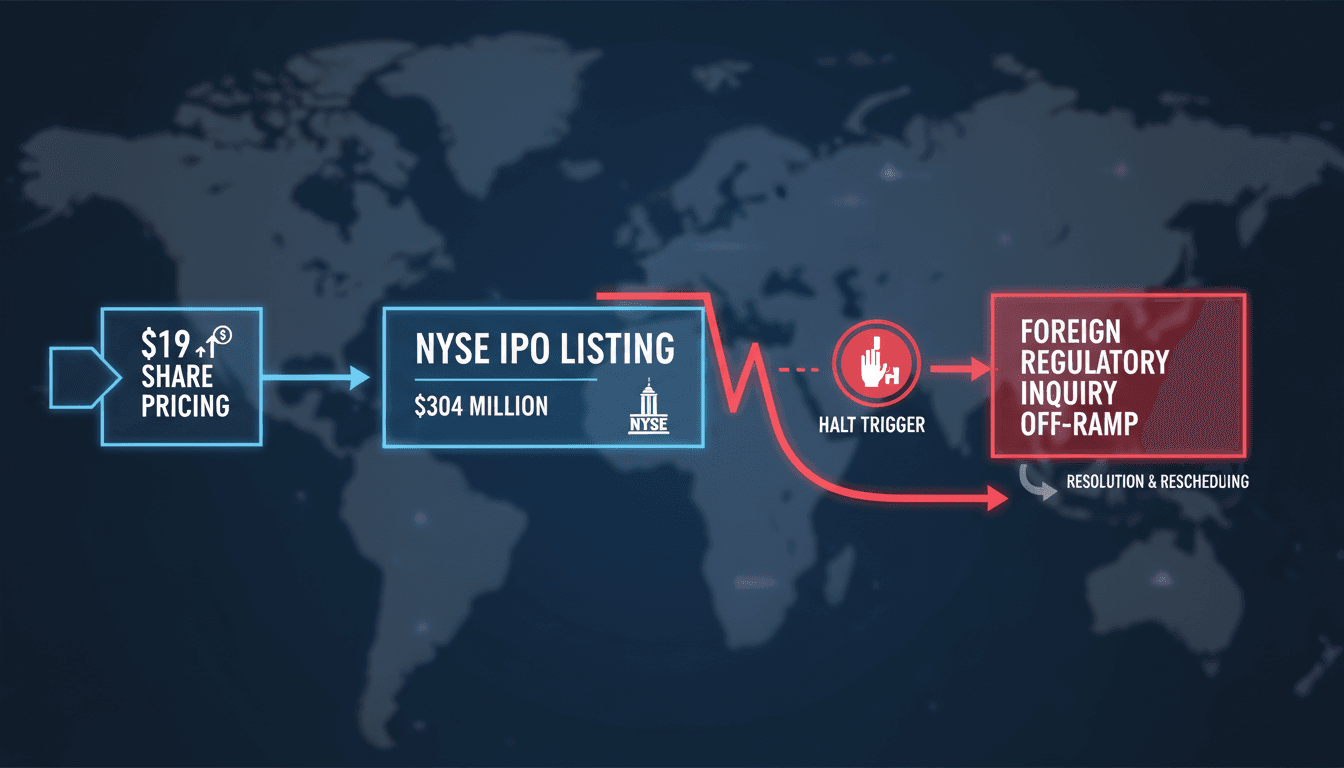
* Priced at the lower limit: OPay Ltd. priced its initial public offering on October 30, 2026, selling 16 million American depositary shares at $19 each to secure $304 million against an initial $19 to $21 range. * Hours from market open: Following an opening bell ceremony at the New York Stock Exchange, a regulatory inquiry notice arrived from an unidentified foreign jurisdiction, forcing an immediate pre-trading halt. * Agreement formally scrapped: Underwriters Citigroup, Deutsche Bank, and Standard Bank mutually agreed with the SoftBank-backed company to terminate the underwriting agreement, leaving zero shares traded and the listing formally withdrawn.
The context you actually need
* Capitalization and reach: Backed by SoftBank Group, OPay scaled its core business by processing digital payments for more than 50 million users across Nigeria, alongside secondary footprints in Egypt, Pakistan, and Indonesia. * Valuation targets: The offering aimed for a market value between $4 billion and $4.4 billion, testing appetite for African fintech against backdrop volatility in artificial intelligence equities and global interest-rate pressures. * Operational insulation: OPay reported that the foreign inquiry falls outside its core operational jurisdiction and asserts that ongoing platform clearing, merchant settlements, and wallet activities remain functional without disruption.
What's really happening
The mechanics behind a post-pricing, pre-trading withdrawal point directly to underwriter liability under U.S. securities legislation. Once an issuer prices its American Depositary Shares, legal risk shifts directly onto the syndication tier—in this case, Citigroup, Deutsche Bank, and Standard Bank. Under Section 11 of the U.S. Securities Act of 1933, underwriters face statutory liability for material omissions or misstatements in an effective registration statement.
If an unidentified foreign regulator delivers an inquiry after pricing but before clearing the first trade, underwriters confront a binary trade-off. They can either proceed and assume joint liability for any financial or operational fallout stemming from an undisclosed regulatory action, or invoke contractual termination clauses to step away from the $304 million float. The underwriters chose termination.
This maneuver highlights the specific tension of emerging-market digital financial platforms operating across disparate regulatory jurisdictions. While OPay maintains that the inquiry involves an entity or jurisdiction outside its core Nigerian engine, modern fintech platforms share common balance sheets, routing integrations, and capital lines. The public market requires full transparency regarding foreign compliance probes, regardless of whether internal management classifies the inquiry as immaterial. What an executive team deems non-material to its 50 million retail users in Nigeria can still represent a material disclosure breach to a U.S. institutional investor buying equity at a $4 billion valuation.
Furthermore, pre-trading order flow indicated that OPay was already tracking to open below its $19 offering price. When an asset prices at the bottom of an indicative range ($19 against a $21 ceiling) amid broader market caution, the margin for handling unexpected friction disappears. The confluence of soft demand, macro inflation pressure, and an incoming foreign compliance inquiry altered the risk-reward calculus for both SoftBank and the underwriting banks. Rather than defending a broken deal on open markets while running parallel legal responses to a foreign authority, the consortium chose to pull the plug, absorb the reputational friction, and keep the entity privately held until cross-border regulatory exposure is eliminated.
Who feels it first (and how)
* Institutional equity syndicates: Investment banks processing cross-border fintech deals must reassess disclosure checklists for all secondary and tertiary operating licenses before launching listing roadshows. * Late-stage venture backers: SoftBank and other pre-IPO growth funds face extended liquidity timelines, locking target capital inside privately held balance sheets until multi-jurisdictional clearances settle. * Cross-border compliance officers: Legal counsels managing emerging-market tech firms will see scrutiny expand from primary revenue generators to peripheral holding structures and remote operating entities. * Emerging-market IPO candidates: Technology companies operating across frontier regions will confront higher due-diligence demands, higher underwriter fees, and tighter liability terms when attempting U.S. dual listings.
What to watch next
* Identity of the foreign regulator: Clarification on which jurisdiction issued the notice will establish whether the issue stems from licensing infractions, currency clearing protocols, or secondary-market business lines in Asia or North Africa. * Underwriter syndicate re-engagement: Whether Citigroup, Deutsche Bank, and Standard Bank retain their advisory roles will signal institutional confidence in the firm's formal explanation. * Private funding alternatives: Monitor whether OPay approaches secondary private markets or existing backers like SoftBank to balance corporate expansion plans without the $304 million public capital infusion.
OPay priced 16 million ADS at $19 each to raise $304 million, entered an NYSE listing ceremony, and halted before trading began due to an external regulatory notice, leading to agreement termination.
The underwriting consortium invoked market-out or material adverse change conditions to avoid post-effective disclosure litigation under U.S. market rules.
The exact country and specific authority that initiated the regulatory action, and the concrete timeline required to resolve the inquiry.
Frequently Asked Questions
- Why it matters?
- The sudden cancellation of a $4 billion listing hours after pricing establishes that multi-jurisdictional underwriting syndicates will terminate fully subscribed offerings rather than absorb undisclosed regulatory risk on U.S. public exchanges.
- What happened (in 30 seconds)?
- Priced at the lower limit: OPay Ltd. priced its initial public offering on October 30, 2026, selling 16 million American depositary shares at $19 each to secure $304 million against an initial $19 to $21 range. Hours from market open: Following an opening bell ceremony at the New York Stock Exchange, a regulatory inquiry notice arrived from an unidentified foreign jurisdiction, forcing an immediate pre-trading halt. Agreement formally scrapped: Underwriters Citigroup, Deutsche Bank, and Standard
- What's really happening?
- The mechanics behind a post-pricing, pre-trading withdrawal point directly to underwriter liability under U.S. securities legislation. Once an issuer prices its American Depositary Shares, legal risk shifts directly onto the syndication tier—in this case, Citigroup, Deutsche Bank, and Standard Bank. Under Section 11 of the U.S. Securities Act of 1933, underwriters face statutory liability for material omissions or misstatements in an effective registration statement. If an unidentified foreign
- Who feels it first (and how)?
- Institutional equity syndicates: Investment banks processing cross-border fintech deals must reassess disclosure checklists for all secondary and tertiary operating licenses before launching listing roadshows. Late-stage venture backers: SoftBank and other pre-IPO growth funds face extended liquidity timelines, locking target capital inside privately held balance sheets until multi-jurisdictional clearances settle. Cross-border compliance officers: Legal counsels managing emerging-market tech fi
- What to watch next?
- Identity of the foreign regulator: Clarification on which jurisdiction issued the notice will establish whether the issue stems from licensing infractions, currency clearing protocols, or secondary-market business lines in Asia or North Africa. Underwriter syndicate re-engagement: Whether Citigroup, Deutsche Bank, and Standard Bank retain their advisory roles will signal institutional confidence in the firm's formal explanation. Private funding alternatives: Monitor whether OPay approaches secon
U.S. company headlines: M&A, product launches, legal/regulatory actions, and leadership moves.
"U.S.-centric corporate tape; good for tracking single-name catalysts."
— A47 Editor
SoftBank-backed OPay cancels $304M U.S. IPO over regulatory inquiry - Bloomberg
OPay, the financial technology company backed by SoftBank, has cancelled its planned $304 million U.S. initial public offering following a regulatory inquiry, according to a report by Bloomberg published on Investing.com. The inquiry involves the U.S...
Technology business and AI-related headlines.
"Data-driven tech newsroom with global scope."
— A47 Editor
SoftBank-Backed OPay Halts IPO to Respond to Regulatory Inquiry
SoftBank-backed OPay Ltd., a Nigeria-focused payments platform, halted an initial public offering on the New York Stock Exchange that had been scheduled to begin trading on Friday, citing a regulatory inquiry. Related coverage reports that the compan...
Technology business news, market impacts, and innovation trends.
"Bloomberg is a premier financial and tech news provider, respected for its in-depth reporting and analytical rigor."
— A47 Editor
Opay Shares Fail to Trade After Raising $304 Million in US IPO
Shares of Opay Ltd., a Nigeria-focused payments platform, failed to begin trading in New York as expected after the company raised $304 million in its US initial public offering, which was priced at the bottom of the range.
Technology business and AI-related headlines.
"Data-driven tech newsroom with global scope."
— A47 Editor
Softbank-Backed OPay Prices at $4 Billion Value in IPO
Softbank Group Corp.-backed OPay Ltd. priced its initial public offering in New York at $19 a share, valuing the Africa-focused fintech at about $4 billion, according to Bloomberg Technology.
Technology business news, market impacts, and innovation trends.
"Bloomberg is a premier financial and tech news provider, respected for its in-depth reporting and analytical rigor."
— A47 Editor
Softbank-Backed OPay Prices at $4 Billion Value in IPO
Softbank Group Corp.-backed OPay Ltd. priced its initial public offering in New York at $19 a share, valuing the Africa-focused fintech at about $4 billion, according to Bloomberg Technology.