
Nvidia Board Opens Investigation Into CEO Jensen Huang's Ties to Suspected Chinese Intelligence Asset Alice Huang
Why it matters
The intersection of high-end semiconductor supply chains and executive personal conduct has escalated into a structural governance test for the world’s leading artificial intelligence chipmaker.
What happened (in 30 seconds)
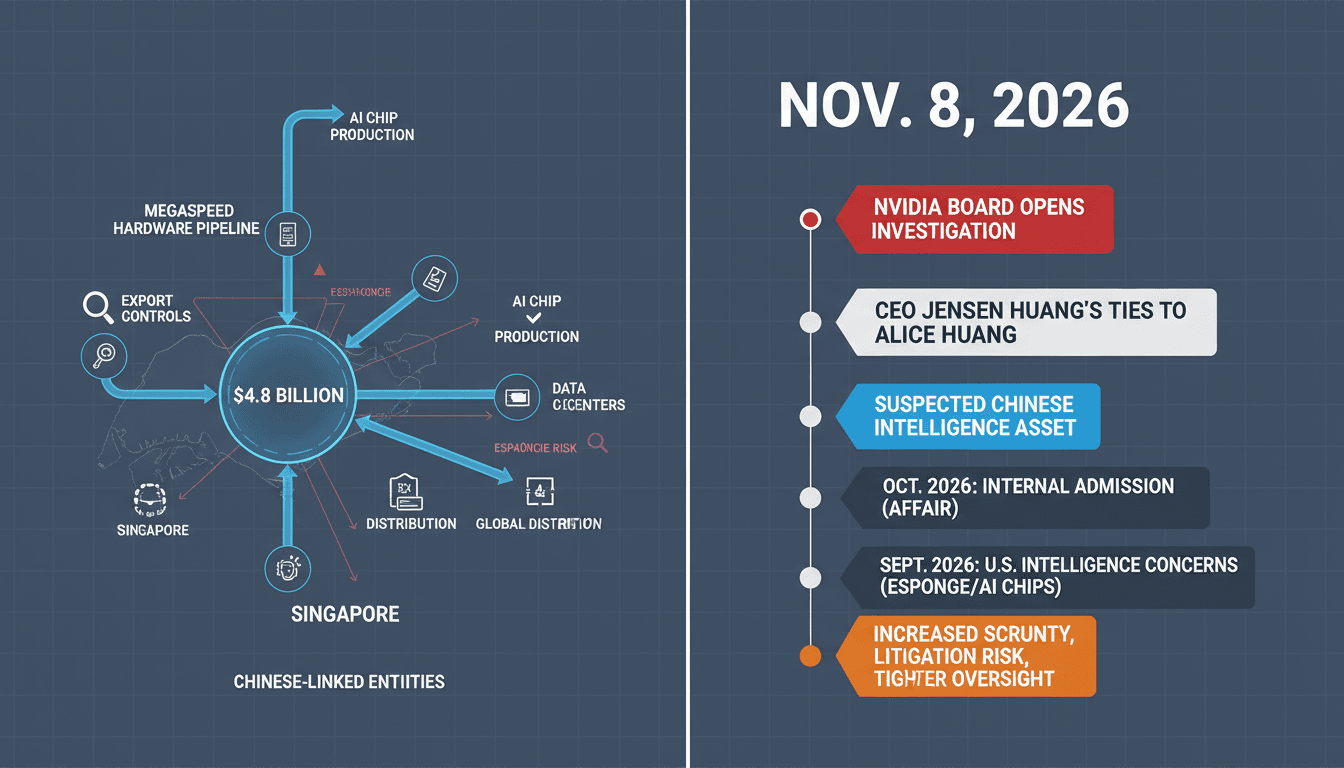
- Board probe launched: On November 8, 2026, Nvidia's board of directors initiated an independent investigation into Chief Executive Officer Jensen Huang following disclosures surrounding an extramarital relationship with an executive at a Singapore-based data center operator.
- Counterintelligence flags: United States intelligence officials identified the executive, Alice Huang (also known as Huang Le), as an alleged Chinese Ministry of State Security asset, prompting an FBI investigation into technology diversion channels.
- Shareholder legal action: Investors filed a class-action lawsuit in California federal court on November 9, 2026, alleging governance failures and the nondisclosure of material national security risks to market participants.
The context you actually need
- Hardware flow volume: Singapore-based Megaspeed completed $4.8 billion in Nvidia hardware acquisitions over a two-year window amid tightening cross-border semiconductor trade constraints.
- Early analytical signals: Short-seller Culper Research documented and flagged associations between Jensen Huang and Megaspeed leadership approximately six months prior to formal board action.
- Executive leadership continuity: Following an internal acknowledgment of the affair by Huang, President Donald Trump stated the Federal Bureau of Investigation was examining the matter while publicly expressing support for Huang's continued leadership role.
What's really happening
The operational challenge confronting Nvidia sits at the collision point between corporate governance disclosure mandates and multilateral semiconductor containment policies.
Under current regulatory frameworks, United States export controls on advanced compute units have incentivized intermediaries in third-party jurisdictions to aggregate high-performance hardware. Megaspeed, operating out of Singapore, transacted $4.8 billion in Nvidia hardware across a 24-month horizon. Because Singapore operates as an open commercial hub with substantial regional data center capacity, high-volume transactions historically cleared baseline trade compliance checks. However, intelligence assessments tracking Alice Huang established ties to the Chinese Ministry of State Security, transforming a supplier-customer commercial relationship into a counterintelligence vector.
From an incentive standpoint, the semiconductor manufacturer operates under intense market pressure to sustain record data center revenue while navigating tightening unilateral trade guardrails. When third-party buyers purchase chips at scale outside restricted jurisdictions, the seller records verified top-line growth. The systemic friction surfaces when personal relationships bypass formal corporate counterparty friction. By engaging in an undisclosed extramarital relationship with a key counterparty executive under active counterintelligence surveillance, leadership compromised the standard separation between executive discretion and regulatory compliance.
The market reaction is driven primarily by disclosure liability rather than immediate operational disruption. The shareholder lawsuit filed in California federal court does not require definitive proof of an active design breach or proprietary source transfer to succeed. Under federal securities statutes, the core legal question centers on materiality: whether management knowingly withheld personal relationships that carried an acute risk of regulatory intervention, export license revocation, or executive removal.
Nvidia maintains that internal audits show no evidence of proprietary architectural secrets or national security parameters being compromised. Similarly, Chinese authorities have dismissed the counterintelligence allegations as external political positioning. Nonetheless, the structural mechanism remains volatile. When key leadership becomes the subject of a simultaneous board probe, federal intelligence review, and securities litigation, enterprise valuation absorbs a structural risk premium. Institutional capital must price the dual risks of secondary export enforcement targeting intermediate hubs and potential structural leadership succession at the company defining global artificial intelligence architecture.
Who feels it first (and how)
- Semiconductor Institutional Investors: Portfolios exposed to megacap chip design face near-term volatility as California federal courts evaluate the materiality of leadership disclosure failures.
- Data Center Developers in Intermediary Hubs: Infrastructure operators across Southeast Asia and the Middle East face expanded compliance audits on hardware procurement, extending lead times for advanced compute installations.
- Enterprise Enterprise Risk Officers: Corporate governance teams are forced to extend executive background screening and disclosure mandates to key hardware counterparty leadership.
What to watch next
- Board Investigation Findings: Independent counsel findings regarding whether corporate communications or proprietary roadmaps crossed non-secure channels will establish executive tenure continuity.
- Federal Trade Enforcement Shifts: Regulatory reviews evaluating Megaspeed’s $4.8 billion procurement history will indicate whether secondary export controls tighten around Southeast Asian distribution channels.
- California Securities Litigation Rulings: Preliminary motions in the shareholder suit will define the legal boundaries of what personal executive conduct must be disclosed to public equity markets.
Nvidia's board initiated an independent inquiry on November 8, 2026; Jensen Huang admitted to an extramarital relationship; Megaspeed purchased $4.8 billion in hardware; a federal class-action suit was filed in California.
Nvidia and its international distributors will encounter heightened end-use documentation protocols from regulatory authorities across third-party fulfillment jurisdictions.
Whether proprietary hardware specifications were transferred, and whether the company's executive committee faces structural reorganization following the board probe.
Frequently Asked Questions
- Why it matters?
- The intersection of high-end semiconductor supply chains and executive personal conduct has escalated into a structural governance test for the world’s leading artificial intelligence chipmaker.
- What happened (in 30 seconds)?
- Board probe launched: On November 8, 2026, Nvidia's board of directors initiated an independent investigation into Chief Executive Officer Jensen Huang following disclosures surrounding an extramarital relationship with an executive at a Singapore-based data center operator. Counterintelligence flags: United States intelligence officials identified the executive, Alice Huang (also known as Huang Le), as an alleged Chinese Ministry of State Security asset, prompting an FBI investigation into tech
- What's really happening?
- The operational challenge confronting Nvidia sits at the collision point between corporate governance disclosure mandates and multilateral semiconductor containment policies. Under current regulatory frameworks, United States export controls on advanced compute units have incentivized intermediaries in third-party jurisdictions to aggregate high-performance hardware. Megaspeed, operating out of Singapore, transacted $4.8 billion in Nvidia hardware across a 24-month horizon. Because Singapore op
- Who feels it first (and how)?
- Semiconductor Institutional Investors: Portfolios exposed to megacap chip design face near-term volatility as California federal courts evaluate the materiality of leadership disclosure failures. Data Center Developers in Intermediary Hubs: Infrastructure operators across Southeast Asia and the Middle East face expanded compliance audits on hardware procurement, extending lead times for advanced compute installations. Enterprise Enterprise Risk Officers: Corporate governance teams are forced to
- What to watch next?
- Board Investigation Findings: Independent counsel findings regarding whether corporate communications or proprietary roadmaps crossed non-secure channels will establish executive tenure continuity. Federal Trade Enforcement Shifts: Regulatory reviews evaluating Megaspeed’s $4.8 billion procurement history will indicate whether secondary export controls tighten around Southeast Asian distribution channels. California Securities Litigation Rulings: Preliminary motions in the shareholder suit will
Research, news, and analysis on blockchain startups, DeFi, and regulations.
"Crypto Briefing provides research, news, and analysis on blockchain startups, DeFi, and crypto regulations with investor-focused coverage."
— A47 Editor
Nvidia CEO’s ties to suspected Chinese spy flagged months before scandal
Nvidia's CEO Jensen Huang is at the center of an investigation after reports linked him to a suspected Chinese spy, with the flagged ties said to have been identified months before the scandal surfaced publicly. The company's board has opened an inde...
Research, news, and analysis on blockchain startups, DeFi, and regulations.
"Crypto Briefing provides research, news, and analysis on blockchain startups, DeFi, and crypto regulations with investor-focused coverage."
— A47 Editor
Nvidia faces scrutiny over CEO’s alleged ties to suspected Chinese spy
Nvidia is facing scrutiny after reports linked CEO Jensen Huang to a suspected Chinese spy, prompting the company's board to open an independent review of foreign intelligence claims. Huang has apologized and pledged to protect U.S. national security...
Research, news, and analysis on blockchain startups, DeFi, and regulations.
"Crypto Briefing provides research, news, and analysis on blockchain startups, DeFi, and crypto regulations with investor-focused coverage."
— A47 Editor
Nvidia faces scrutiny over China ties amid spy scandal investigation
Nvidia is facing scrutiny over its ties to China as an investigation into alleged links between CEO Jensen Huang and a suspected Chinese spy unfolds. The company's board has opened an independent review of foreign intelligence claims, and Huang has a...
U.S. business news, corporate developments, and economy.
"The Wall Street Journal is respected for deep financial and economic reporting with a center-right editorial perspective."
— A47 Editor
The Morning Risk Report: Nvidia’s Board Probes Reports That CEO Was Spying Target
Nvidia's board has opened an independent investigation into reports, citing U.S. intelligence assessments, that CEO Jensen Huang was a target of a Chinese intelligence operation, including a reported romantic relationship with Alice Huang, an alleged...
Research, news, and analysis on blockchain startups, DeFi, and regulations.
"Crypto Briefing provides research, news, and analysis on blockchain startups, DeFi, and crypto regulations with investor-focused coverage."
— A47 Editor
Nvidia investigates CEO’s ties to suspected Chinese spy amid US scrutiny
Nvidia is investigating its chief executive's ties to a suspected Chinese spy amid heightened scrutiny from U.S. authorities, according to Crypto Briefing's report on the base story. The matter has drawn attention to the company's governance and its ...