
Nebius Plans $40-45 Billion 2027 AI Capex Financed by Customer Prepayments as Third-Party Site Delays Emerge
Why it matters
Nebius is stress-testing an aggressive neocloud capital expenditure model that finances over 1 gigawatt of physical expansion through customer prepayments rather than balance sheet cash alone.
What happened (in 30 seconds)
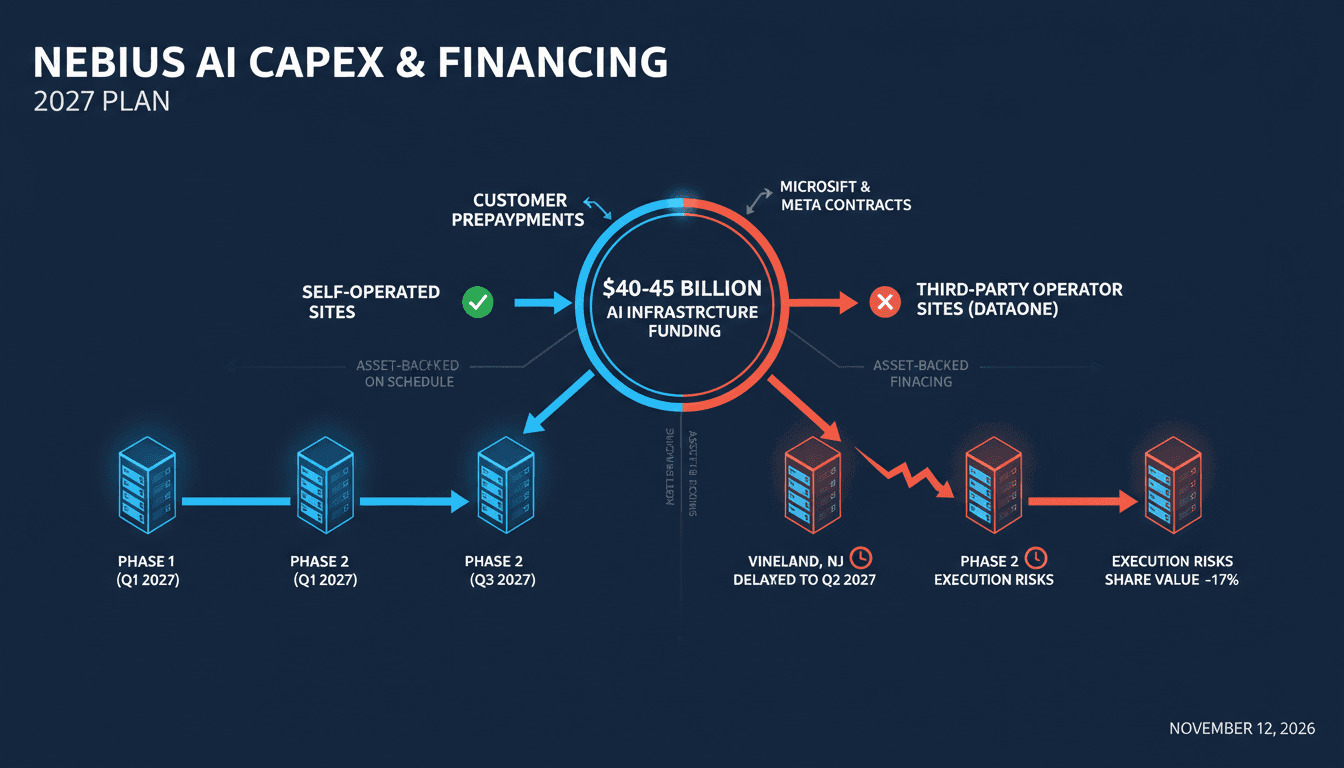
- A $40 billion to $45 billion capital plan was unveiled: During its third-quarter earnings call on November 12, 2026, Amsterdam-based Nebius outlined a multi-billion-dollar 2027 capex plan to expand AI data center capacity.
- Customer prepayments cover the bulk of deployment: Nebius reported ending Q3 with $7.4 billion in cash, projecting that customer advances and asset-backed financing tied to investment-grade accounts like Microsoft and Meta will fund up to 85% of the total spend.
- Site delays provoked a market repricing: Construction and regulatory slippage at a third-party facility in Vineland, New Jersey pushed Microsoft-dedicated capacity into Q2 2027, contributing to a 17% single-day decline in Nebius shares.
The context you actually need
- Hyper-growth meets high capital requirements: Nebius posted third-quarter revenue of $981 million—a 571% increase year-over-year—reflecting rapid enterprise and hyperscaler procurement of specialized AI clusters.
- Contract concentration anchors the balance sheet: The company holds multi-year contracts with Microsoft valued at up to $19.4 billion, alongside major commitments from Meta, creating high asset-backed debt capacity.
- Physical delivery risks diverge by site control: While Nebius reported that its self-operated buildouts remain on or ahead of schedule, third-party operators face headwinds from local power delivery, permitting, and environmental scrutiny.
What's really happening
The neocloud playbook is confronting physical delivery realities. Nebius's blueprint to deploy $40 billion to $45 billion in 2027 rests on a circular capital structure: hyperscalers demand compute faster than legacy cloud providers can erect facilities, prompting them to sign long-term advance contracts. Nebius monetizes those commitments—using customer advances and asset-backed debt secured by contracts with investment-grade clients like Microsoft and Meta—to fund up to 85% of its buildout costs.
This model shifts funding away from corporate debt and equity dilution, but it ties balance sheet execution directly to third-party construction schedules. The financial mechanism works seamlessly only as long as physical sites deliver on contractual milestones. When site operational dates slip, revenue recognition is deferred, cash flow cycles elongate, and client oversight intensifies.
The breakdown at the Vineland, New Jersey facility highlights the central operational friction. The facility, managed by third-party operator DataOne, suffered delays traced to temporary power generation wind-down and prior regulatory violations around noise and emissions. These physical-layer bottlenecks deferred the activation of Microsoft capacity from planned targets to Q2 2027. Consequently, Microsoft tightened its operational oversight over external partners and reduced capex expectations tied to delayed pipelines, though it has not canceled its contracts.
The 17% equity decline illustrates the margin of error baked into Nebius's forward guidance. Management has guided toward $12 billion to $13 billion in revenue for 2027, targeting pre-tax breakeven by the fourth quarter of that year. However, closing the gap between its $7.4 billion third-quarter cash position and a $40-plus billion deployment schedule demands near-flawless operational rollouts.
Crucially, Nebius notes a performance divergence: self-operated data centers remain on or ahead of schedule, whereas outsourced or co-located partner footprints remain exposed to municipal permitting backlogs and grid interconnect frictions. The operational imperative is no longer securing demand—hyperscaler appetite remains verified—but navigating the localized infrastructure constraints that delay capacity delivery.
Who feels it first (and how)
- Enterprise Infrastructure Buyers: Procurement teams waiting on specialized GPU capacity face timeline adjustments if contracted capacity relies on third-party data center operators facing local permitting delays.
- Hyperscale Cloud Operators: Firms like Microsoft and Meta are forced to allocate additional technical auditing resources and enforce stricter delivery covenants on neocloud suppliers.
- Data Center Co-location Developers: External site operators face harsher commercial terms, contract penalties, and regulatory scrutiny over emissions and noise mitigation from both enterprise clients and municipal bodies.
What to watch next
- The Vineland Q2 2027 commissioning milestone: Watch whether the DataOne facility achieves final power energization and passes regulatory muster without extending delivery past the second quarter of 2027.
- Cash flow conversion from prepayments: Track subsequent earnings statements to see if asset-backed debt and customer advances consistently sustain 85% of capex as quarterly cash burn accelerates toward the 2027 peak.
- The self-build versus third-party operational split: Monitor whether Nebius shifts capital allocation away from third-party operated facilities in favor of fully self-managed sites to preserve delivery control.
Nebius outlined a $40 billion to $45 billion 2027 capex plan; ended Q3 2026 with $7.4 billion in cash; generated $981 million in quarterly revenue; and experienced a 17% share decline following delays at its Vineland, New Jersey site.
Large hyperscalers will demand more stringent service-level agreements and direct oversight of site power delivery before releasing prepayments on multi-billion-dollar deals.
Whether Nebius can attain pre-tax breakeven by Q4 2027 if additional third-party data center operators face local grid connection or permitting setbacks.
Frequently Asked Questions
- Why it matters?
- Nebius is stress-testing an aggressive neocloud capital expenditure model that finances over 1 gigawatt of physical expansion through customer prepayments rather than balance sheet cash alone.
- What happened (in 30 seconds)?
- A $40 billion to $45 billion capital plan was unveiled: During its third-quarter earnings call on November 12, 2026, Amsterdam-based Nebius outlined a multi-billion-dollar 2027 capex plan to expand AI data center capacity. Customer prepayments cover the bulk of deployment: Nebius reported ending Q3 with $7.4 billion in cash, projecting that customer advances and asset-backed financing tied to investment-grade accounts like Microsoft and Meta will fund up to 85% of the total spend. Site delays pr
- What's really happening?
- The neocloud playbook is confronting physical delivery realities. Nebius's blueprint to deploy $40 billion to $45 billion in 2027 rests on a circular capital structure: hyperscalers demand compute faster than legacy cloud providers can erect facilities, prompting them to sign long-term advance contracts. Nebius monetizes those commitments—using customer advances and asset-backed debt secured by contracts with investment-grade clients like Microsoft and Meta—to fund up to 85% of its buildout cost
- Who feels it first (and how)?
- Enterprise Infrastructure Buyers: Procurement teams waiting on specialized GPU capacity face timeline adjustments if contracted capacity relies on third-party data center operators facing local permitting delays. Hyperscale Cloud Operators: Firms like Microsoft and Meta are forced to allocate additional technical auditing resources and enforce stricter delivery covenants on neocloud suppliers. Data Center Co-location Developers: External site operators face harsher commercial terms, contract pen
- What to watch next?
- The Vineland Q2 2027 commissioning milestone: Watch whether the DataOne facility achieves final power energization and passes regulatory muster without extending delivery past the second quarter of 2027. Cash flow conversion from prepayments: Track subsequent earnings statements to see if asset-backed debt and customer advances consistently sustain 85% of capex as quarterly cash burn accelerates toward the 2027 peak. The self-build versus third-party operational split: Monitor whether Nebius shi
Startup news with frequent AI coverage.
"Covers launches, funding, and product updates in AI."
— A47 Editor
Nebius tests the neocloud playbook with $40 billion in planned spending
Nebius plans to fund a $40 billion AI infrastructure expansion through customer prepayments and loans, according to TechCrunch, even as delays at a Microsoft-linked data center raise questions about the neocloud's financing model.
Stock market news, investing ideas, and trading analysis.
"TheStreet provides market news and retail-investor-focused analysis."
— A47 Editor
Nvidia-backed AI cloud stock sinks 18% despite record quarter
Nebius, an Nvidia-backed AI cloud provider, saw its stock sink 18% despite beating revenue and profit expectations in a record quarter, as investors reacted to delayed third-party capacity and a $45 billion spending plan.
Curated tech headlines including AI stories.
"Influential aggregator surfacing the day’s top tech/AI links."
— A47 Editor
Neocloud Nebius' stock falls 16%+ after it reported Q3 revenue up 571% YoY to $980.8M, vs. $907.5M est., increased 2026 capex spend, and issued a weak outlook (Jordan Novet/CNBC)
Nebius shares fell more than 16% on Thursday after the neocloud reported third-quarter revenue up 571% year over year to $980.8 million, ahead of the $907.5 million analyst estimate, but also raised its 2026 capital expenditure plans and issued a wea...
U.S. business news, corporate developments, and economy.
"The Wall Street Journal is respected for deep financial and economic reporting with a center-right editorial perspective."
— A47 Editor
Nebius Lowers Outlook, Addresses Worries Over Financing AI Buildout
Nebius lowered its full-year revenue outlook, citing a delay in some third-party capacity, according to The Wall Street Journal, and the company addressed investor worries over how the AI infrastructure buildout is being financed.
Technology business news, market impacts, and innovation trends.
"Bloomberg is a premier financial and tech news provider, respected for its in-depth reporting and analytical rigor."
— A47 Editor
Nebius Shares Drop on Neocloud’s Disappointing Sales Outlook
Nebius Group NV shares fell by as much as 23% after the AI computing provider reported a disappointing sales outlook, while backer Nvidia Corp. ousted Chief Executive Jensen Huang amid an internal board investigation into his personal conduct.
Technology business and AI-related headlines.
"Data-driven tech newsroom with global scope."
— A47 Editor
Nebius Shares Drop on Neocloud’s Disappointing Sales Outlook
Nebius Group NV shares fell by as much as 23% after the AI computing provider reported a disappointing sales outlook, while backer Nvidia Corp. ousted Chief Executive Jensen Huang amid an internal board investigation into his personal conduct.
Global markets, investing, and macroeconomics from a premier financial newsroom.
"Bloomberg is respected for in-depth financial reporting and data-driven analysis."
— A47 Editor
Nvidia Punches a Hole in Bull Case for AI Stocks
Nvidia shares slumped again in extended trading as the company's board reportedly weighed the future of CEO Jensen Huang, following an independent, board-led investigation prompted by U.S. intelligence assessments reported by The New York Times that ...
Markets desk coverage, trading insights, and investor updates.
"WSJ’s markets reporting provides in-depth analysis and context for investors."
— A47 Editor
Nvidia Leadership Crisis Drags on U.S. Stock Futures, Pressures AI Trade
Nvidia shares and U.S. stock futures came under pressure as the chipmaker's leadership crisis deepened, weighing on a rally in artificial-intelligence stocks. The Wall Street Journal reported the decline following an independent, board-led investigat...
Market-moving headlines impacting equities, bonds, and related risk assets.
"Real-time catalysts and volatility drivers across indices and sectors."
— A47 Editor
Why is NVIDIA stock tumbling after hours today?
NVIDIA shares tumbled after hours in a negative-toned Investing.com markets report asking why the chipmaker's stock was falling, with the base coverage not specifying a single company-level catalyst for the drop.