
Global AI Equity Selloff Erases Over $6 Trillion and Exposes Concentration Risk in Pension Portfolios
Why it matters
A multi-trillion-dollar valuation reset has revealed that global equity indexes and public retirement systems quietly concentrated up to 11% of their entire asset base into a single, tightly correlated supply chain.
What happened (in 30 seconds)
- A $6 trillion drawdown hit global markets: Between September 30 and November 6, 2026, MSCI calculations show that equity declines across the artificial intelligence ecosystem erased over $6 trillion in market capitalization.
- Hardware and physical layers absorbed the steepest drops: Physical infrastructure companies tumbled 22%, digital infrastructure lost 10%, and application-layer software firms fell 6% as markets questioned near-term revenue generation against massive capital outlays.
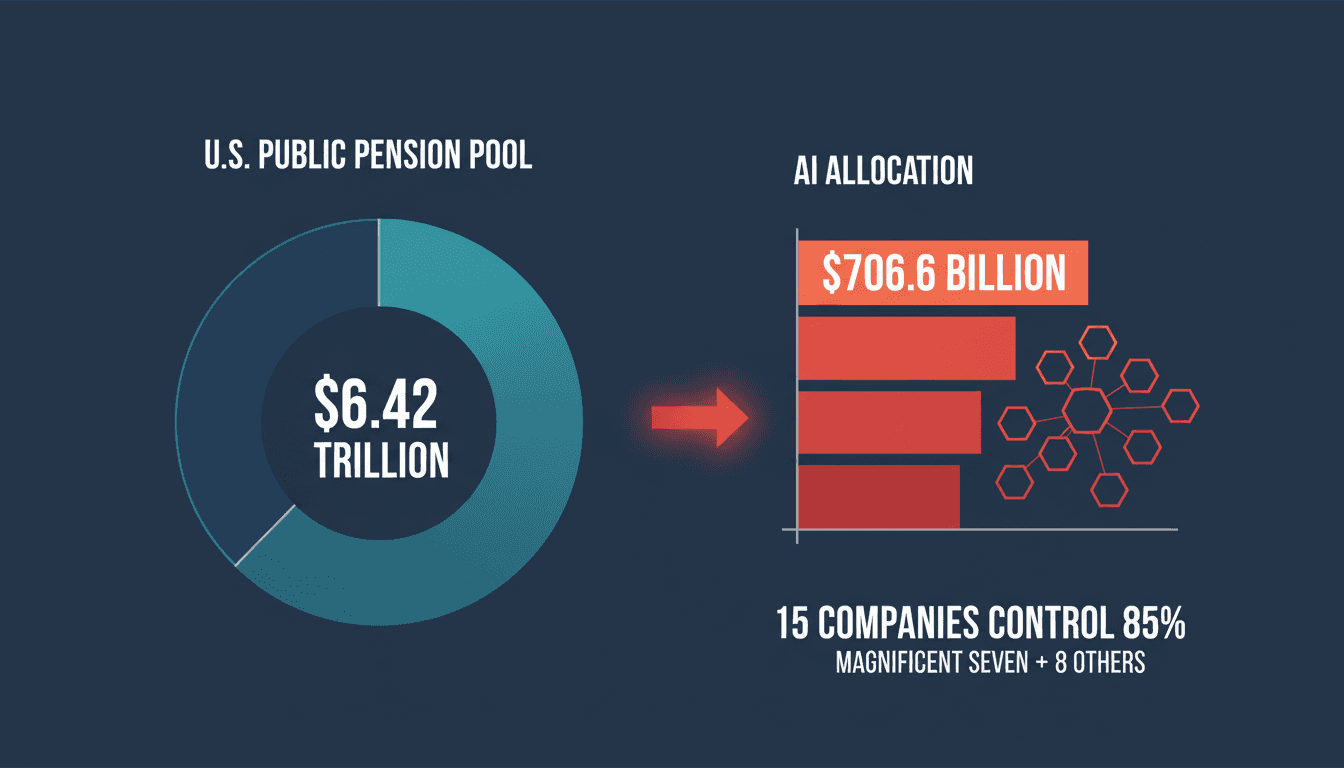
- Institutional retirement capital faced direct exposure: Analysis by Equable Institute revealed that U.S. state and local pension systems held between $578.1 billion and $706.6 billion in AI-tied assets as of June 30, representing 9% to 11% of their $6.42 trillion in aggregate assets.
The context you actually need
- Index concentration reached historic extremes: By late October 2026, U.S. firms accounted for nearly 80% of MSCI's broad AI Value Chain Index, compared to a baseline of 64% in the wider global equity benchmark.
- Fifteen companies effectively controlled the trade: Just 15 enterprises accounted for 85% of institutional AI equity holdings, with the Magnificent Seven alone—Alphabet, Amazon, Apple, Meta, Microsoft, Nvidia, and Tesla—comprising 63.3% of that capital pool.
- Prior gains masked systemic structural vulnerability: Strong runs in these exact equities previously enabled institutional funds to recover from earlier market contractions, incentivizing asset allocators to let winners run rather than rebalancing into uncorrelated sectors.
What's really happening
The core mechanism driving this reset is not simply an equity market correction; it is the structural unraveling of assumed portfolio diversification. Over several quarters, trillions of dollars flowed into benchmark index-tracking strategies under the assumption that buying broad-market equity vehicles spread risk across diverse business models. In reality, because capitalization-weighted indexes allocate capital in direct proportion to company size, passive and active institutional funds became heavily concentrated in a single industrial vertical: the build-out of artificial intelligence compute.
According to Reuters, at least $25.3 trillion was invested in firms carrying direct AI exposure through the MSCI Global Intelligence Index prior to the pullback. When capital allocation reaches that scale, the traditional divisions between asset classes begin to blur. A public pension fund holding sovereign bonds, corporate debt, and global equities may believe its asset allocation model protects capital. Yet if the underlying revenues, debt issuances, and capital spending budgets of those holdings all originate from the same supply chain, an operational slowdown hits the entire portfolio simultaneously.
This cross-asset exposure is precisely what prompted credit managers like PGIM to begin screening nearly $1 trillion in fixed-income assets for hidden AI-related business model risks. The vulnerability extends beyond declining equity share prices. Infrastructure builds require utility-scale power agreements, private credit facilities for data center construction, and corporate bond offerings from hardware suppliers. When the physical infrastructure segment drops by 22% in five weeks, credit spreads and debt obligations throughout that ecosystem face immediate repricing pressures.
For public pension systems managing $6.42 trillion, funded ratios depend on consistent, annualized actuarial return targets. An 11% concentration in assets that drop sharply within weeks creates a funding deficit that cannot be easily offset by defensive holdings, especially when fixed-income portfolios carry secondary credit exposure to the exact same corporate borrowers.
Who feels it first (and how)
- Public pension plan trustees and fiduciaries: Investment committees must now defend portfolio funded ratios and determine whether to rebalance out of mega-cap leaders at lower valuations or absorb ongoing equity volatility.
- Fixed-income and credit analysts: Asset managers screening debt instruments must now account for cash-flow strain among suppliers and data center developers whose revenue assumptions relied on uninterrupted infrastructure spending.
- Passive index retail investors: Individuals holding standard target-date retirement funds or broad-market exchange-traded funds will see quarterly drawdowns that reflect hardware and chip-maker valuations rather than general economic growth.
- International allocators and sovereign funds: Global institutional portfolios that mirror MSCI world equity weightings absorb cross-border spillover due to the heavy 80% U.S. concentration within the sector's supply chain.
What to watch next
- Fixed-income credit screening adjustments: Watch whether managers like PGIM expand their review of bond portfolios to reprice corporate debt tied to secondary data center and utility supply contracts.
- Quarterly pension funded ratio updates: Track upcoming state and local pension reporting periods to see whether aggregate asset values fall below actuarial benchmarks following the $6 trillion drawdown.
- Capital expenditure disclosures from the Magnificent Seven: Monitor upcoming earnings reports to see if corporate leaders revise infrastructure spending projections downward, which would directly impact hardware valuations.
The MSCI-tracked selloff erased more than $6 trillion across the AI value chain between September 30 and November 6, 2026, with physical infrastructure assets declining 22%.
Institutional asset allocators will trim mega-cap technology index weightings to prevent single-sector concentration from dictating their aggregate annual portfolio returns.
Whether institutional fixed-income assets face direct default risks or credit downgrades if corporate capital spending on data centers decelerates over the next fiscal cycle.
Frequently Asked Questions
- Why it matters?
- A multi-trillion-dollar valuation reset has revealed that global equity indexes and public retirement systems quietly concentrated up to 11% of their entire asset base into a single, tightly correlated supply chain.
- What happened (in 30 seconds)?
- A $6 trillion drawdown hit global markets: Between September 30 and November 6, 2026, MSCI calculations show that equity declines across the artificial intelligence ecosystem erased over $6 trillion in market capitalization. Hardware and physical layers absorbed the steepest drops: Physical infrastructure companies tumbled 22%, digital infrastructure lost 10%, and application-layer software firms fell 6% as markets questioned near-term revenue generation against massive capital outlays. Institut
- What's really happening?
- The core mechanism driving this reset is not simply an equity market correction; it is the structural unraveling of assumed portfolio diversification. Over several quarters, trillions of dollars flowed into benchmark index-tracking strategies under the assumption that buying broad-market equity vehicles spread risk across diverse business models. In reality, because capitalization-weighted indexes allocate capital in direct proportion to company size, passive and active institutional funds becam
- Who feels it first (and how)?
- Public pension plan trustees and fiduciaries: Investment committees must now defend portfolio funded ratios and determine whether to rebalance out of mega-cap leaders at lower valuations or absorb ongoing equity volatility. Fixed-income and credit analysts: Asset managers screening debt instruments must now account for cash-flow strain among suppliers and data center developers whose revenue assumptions relied on uninterrupted infrastructure spending. Passive index retail investors: Individuals
- What to watch next?
- Fixed-income credit screening adjustments: Watch whether managers like PGIM expand their review of bond portfolios to reprice corporate debt tied to secondary data center and utility supply contracts. Quarterly pension funded ratio updates: Track upcoming state and local pension reporting periods to see whether aggregate asset values fall below actuarial benchmarks following the $6 trillion drawdown. Capital expenditure disclosures from the Magnificent Seven: Monitor upcoming earnings reports to
Global business headlines with AI angles.
"General business outlet that frequently covers AI."
— A47 Editor
AI Stocks Lose $6 Trillion. Pension Funds Face Hidden Exposure Risks.
A roughly $6 trillion selloff in AI stocks has exposed concentration risks across investment portfolios, prompting pension funds and bond managers to examine how far their exposure to the sector extends, according to International Business Times.
Curated tech headlines including AI stories.
"Influential aggregator surfacing the day’s top tech/AI links."
— A47 Editor
Analysis: global manufacturing, utility, and mining companies have shed $4.2T in market value since June as the AI "picks and shovels" trade swings into reverse (Clara Murray/Financial Times)
Global manufacturing, utility, and mining companies have shed $4.2 trillion in market value since June as the AI "picks and shovels" trade, which had lifted suppliers of hardware and infrastructure, has swung into reverse, according to a Financial Ti...
Sports reporting with a focus on Saudi and regional competitions.
"Okaz sports coverage is broad and audience-friendly, with strong attention to Saudi teams and leagues."
— A47 Editor
فقدت 9.4 تريليون دولار..هل ينحسر الاستثمار بمراكز البيانات المرتبطة بالذكاء الاصطناعي؟
Shares of industrial, utility and mining companies tied to building AI data centers have fallen worldwide, with roughly $4.2 trillion in market value lost since June, according to the Financial Times as reported by Al Arabiya Business. The selloff ha...
Arabic tech news covering startups, apps, AI, and gadgets.
"AITnews is a well-known Arabic technology outlet covering regional tech developments."
— A47 Editor
تحليل: شركات مرتبطة بتشييد مراكز بيانات الذكاء الاصطناعي تفقد 4.2 تريليونات دولار من قيمتها السوقية
A Financial Times analysis reports that companies linked to building AI data centers have lost about $4.2 trillion in market value since June 2026, even as major suppliers continue to report strong orders.
Editor-curated FT homepage stories spanning markets, business, world, and opinion.
"The Financial Times is a globally respected business publication with a centrist/center-left tone and strong markets focus."
— A47 Editor
Data centre construction stocks lose $4.2tn as boom in AI trade unravels
Data centre construction and AI-linked stocks lost about $4.2tn in value as the boom in the AI trade unravelled, according to the Financial Times, following a sharp tech sell-off that followed the Democratic gains in the November 3 midterm elections.