
Nvidia Delays Routine SEC 10-Q Filing Amid Scrutiny of Huang Investigation and Export Compliance Disclosures
Why it matters
A rare administrative filing delay by a semiconductor bellwether indicates that corporate governance and export compliance risks are actively outpacing top-line financial growth.
What happened (in 30 seconds)
- Nvidia halted its standard reporting cadence, opting not to file its formal quarterly 10-Q report with the U.S. Securities and Exchange Commission on the same day it released earnings on November 18, 2026.
- Interim leadership acknowledged the timeline shift, with interim CEO and CFO Colette Kress stating the 10-Q would arrive in the coming weeks rather than alongside the quarterly release.
- Management confirmed disclosure reviews, later clarifying to analysts that the delay stems from evaluating additional risk factor disclosures connected to the ongoing investigation into former CEO Jensen Huang.
The context you actually need
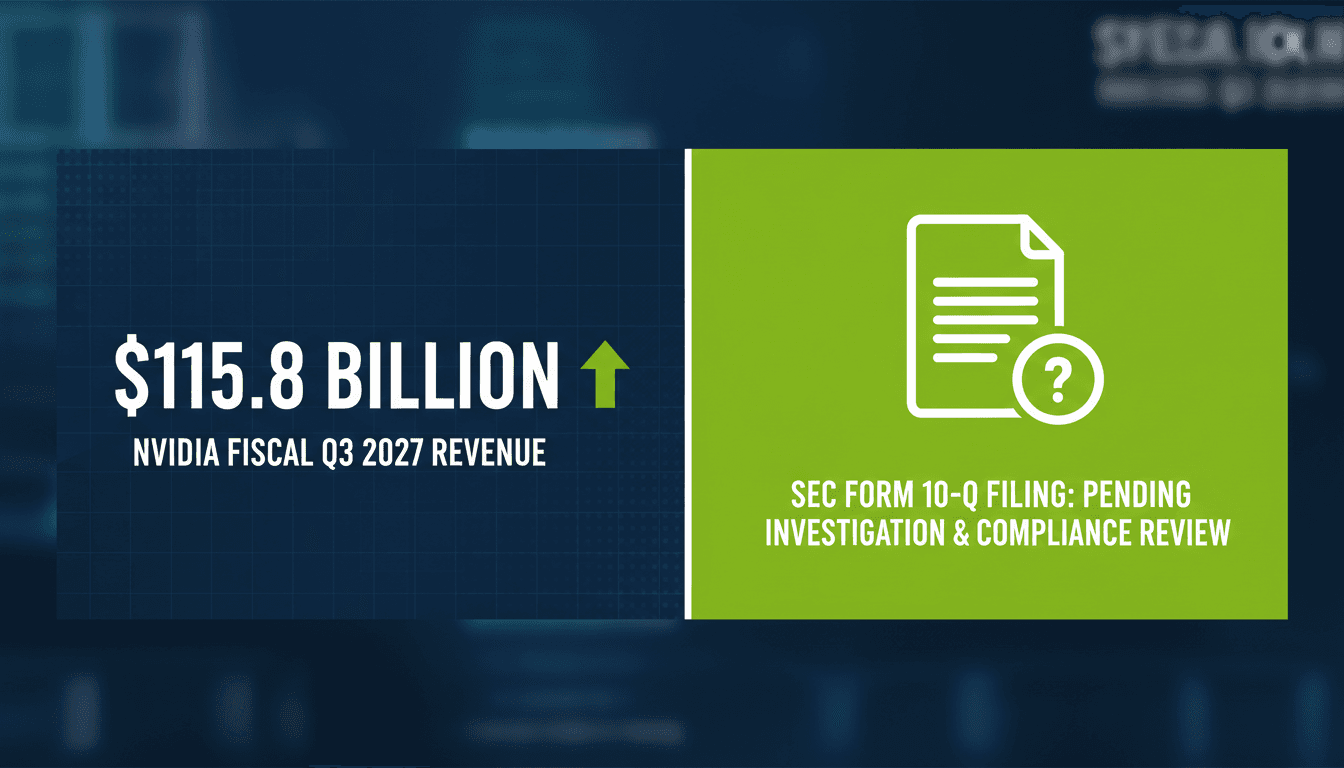
- Top-line performance hit historic highs, generating $115.8 billion in revenue for fiscal Q3 2027—a 103% year-over-year increase that occurred in parallel with the administrative pause.
- Executive leadership changed under regulatory scrutiny, following Jensen Huang’s resignation amid disclosures of personal conduct involving an executive at Singapore-based partner Megaspeed International.
- Multiple federal inquiries remain active, including reviews by the Department of Justice, Commerce Department, congressional committees, and a civil probe by the SEC regarding prior investor disclosures on chip export compliance.
What's really happening
The mechanics behind a corporate filing delay reveal an asymmetry between commercial execution and regulatory exposure. Under ordinary circumstances, public companies with established compliance departments file their Form 10-Q concurrently with their earnings release. The 10-Q carries legal weight that an investor presentation does not: it requires certified executive sign-offs, detailed balance sheet disclosures, and exhaustive itemization of legal proceedings and material risk factors.
By delivering the headline revenue figure of $115.8 billion while holding back the 10-Q, Nvidia established a separation between operational cash generation and balance-sheet legal liability. Top-line demand for advanced silicon remains elevated, as demonstrated by the 103% year-over-year revenue expansion. However, certifying an SEC report exposes signatories to direct regulatory enforcement if pending investigations reveal that prior statements regarding export controls omitted material operational risks.
The core vulnerability centers on distribution conduits and regulatory compliance. Federal authorities are examining whether restricted hardware entered unauthorized channels via third-party partners such as Megaspeed International, despite prior corporate denials. For executive leadership, filing an incomplete or prematurely drafted 10-Q creates civil and criminal exposure under securities regulations. With Colette Kress operating in a dual capacity as interim CEO and CFO, internal legal counsel and the newly established national security and export control oversight committee must calibrate every forward-looking liability statement.
Furthermore, capital markets treat filing delays as a leading indicator of disclosure restructuring. When companies request additional weeks to finalize standard documentation, the delay is rarely mathematical; it centers on wording. Legal teams and external auditors must audit the exact legal language describing ongoing Department of Justice and SEC probes. Lowering an equity price target from $240 to $220, as executed by UBS analyst Timothy Arcuri, reflects this shift: enterprise valuation begins to discount regulatory compliance friction, oversight committee costs, and the risk of retroactive penalties, even while gross sales set corporate records.
Who feels it first (and how)
- Enterprise procurement heads: Technology leaders planning multi-quarter hardware capacity allocations face uncertainty around vendor governance and potential shifts in export compliance terms.
- Institutional portfolio managers: Asset allocators tracking semiconductor exposure must account for valuation multiples compressing, as evidenced by shares trading around $150 after double-digit percentage drops following executive turnover.
- Hardware distribution networks: Regional systems integrators and logistics partners operating across cross-border channels encounter elevated audit standards as internal oversight committees inspect partner compliance histories.
What to watch next
- The eventual Form 10-Q submission: Watch Item 1A (Risk Factors) and Item 1 (Legal Proceedings) for precise legal wording regarding the scope of Department of Justice and SEC inquiries.
- Mandates from the oversight committee: Track operational updates from Nvidia's newly formed national security and export control oversight committee to see how partner vetting protocols shift.
- Export enforcement actions: Monitor formal notices from the Commerce Department regarding hardware distribution channels through intermediary hubs like Singapore.
Nvidia reported $115.8 billion in revenue for fiscal Q3 2027, delayed its routine 10-Q filing, and confirmed the pause relates to evaluating disclosures tied to ongoing probes into former leadership and export risks.
External auditors and regulatory counsel are pushing for expanded cautionary language regarding partner relationships and potential regulatory fines before certifying the final document.
Whether federal inquiries will uncover actionable evidence of unauthorized chip diversion via Megaspeed International or result in formal civil enforcement penalties against the company.
Frequently Asked Questions
- Why it matters?
- A rare administrative filing delay by a semiconductor bellwether indicates that corporate governance and export compliance risks are actively outpacing top-line financial growth.
- What happened (in 30 seconds)?
- Nvidia halted its standard reporting cadence, opting not to file its formal quarterly 10-Q report with the U.S. Securities and Exchange Commission on the same day it released earnings on November 18, 2026. Interim leadership acknowledged the timeline shift, with interim CEO and CFO Colette Kress stating the 10-Q would arrive in the coming weeks rather than alongside the quarterly release. Management confirmed disclosure reviews, later clarifying to analysts that the delay stems from evaluating a
- What's really happening?
- The mechanics behind a corporate filing delay reveal an asymmetry between commercial execution and regulatory exposure. Under ordinary circumstances, public companies with established compliance departments file their Form 10-Q concurrently with their earnings release. The 10-Q carries legal weight that an investor presentation does not: it requires certified executive sign-offs, detailed balance sheet disclosures, and exhaustive itemization of legal proceedings and material risk factors. By d
- Who feels it first (and how)?
- Enterprise procurement heads: Technology leaders planning multi-quarter hardware capacity allocations face uncertainty around vendor governance and potential shifts in export compliance terms. Institutional portfolio managers: Asset allocators tracking semiconductor exposure must account for valuation multiples compressing, as evidenced by shares trading around $150 after double-digit percentage drops following executive turnover. Hardware distribution networks: Regional systems integrators and
- What to watch next?
- The eventual Form 10-Q submission: Watch Item 1A (Risk Factors) and Item 1 (Legal Proceedings) for precise legal wording regarding the scope of Department of Justice and SEC inquiries. Mandates from the oversight committee: Track operational updates from Nvidia's newly formed national security and export control oversight committee to see how partner vetting protocols shift. Export enforcement actions: Monitor formal notices from the Commerce Department regarding hardware distribution channels t
Startup news with frequent AI coverage.
"Covers launches, funding, and product updates in AI."
— A47 Editor
Nvidia created a weird bit of intrigue by not filing a routine SEC report
Nvidia surprised Wall Street by announcing it would not file its routine quarterly 10-Q report with the SEC for several weeks, a move that drew attention amid a leadership upheaval after co-founder and CEO Jensen Huang was ousted following reports of...
Markets desk coverage, trading insights, and investor updates.
"WSJ’s markets reporting provides in-depth analysis and context for investors."
— A47 Editor
SEC Is Probing Nvidia Amid Departure of CEO Jensen Huang
The U.S. Securities and Exchange Commission is conducting a civil probe into whether Nvidia violated investor-disclosure laws, according to The Wall Street Journal, amid the fallout from co-founder Jensen Huang's resignation as president, chief execu...
U.S. business news, corporate developments, and economy.
"The Wall Street Journal is respected for deep financial and economic reporting with a center-right editorial perspective."
— A47 Editor
SEC Is Probing Nvidia Amid Departure of CEO Jensen Huang
The U.S. Securities and Exchange Commission is conducting a civil probe into whether Nvidia violated investor-disclosure laws, according to The Wall Street Journal, which reported the inquiry amid the fallout from co-founder Jensen Huang's resignatio...