
Missouri Court Approves Bayer's $7.25 Billion Roundup Settlement as NIH Study Revives Glyphosate Cancer Concerns
Why it matters
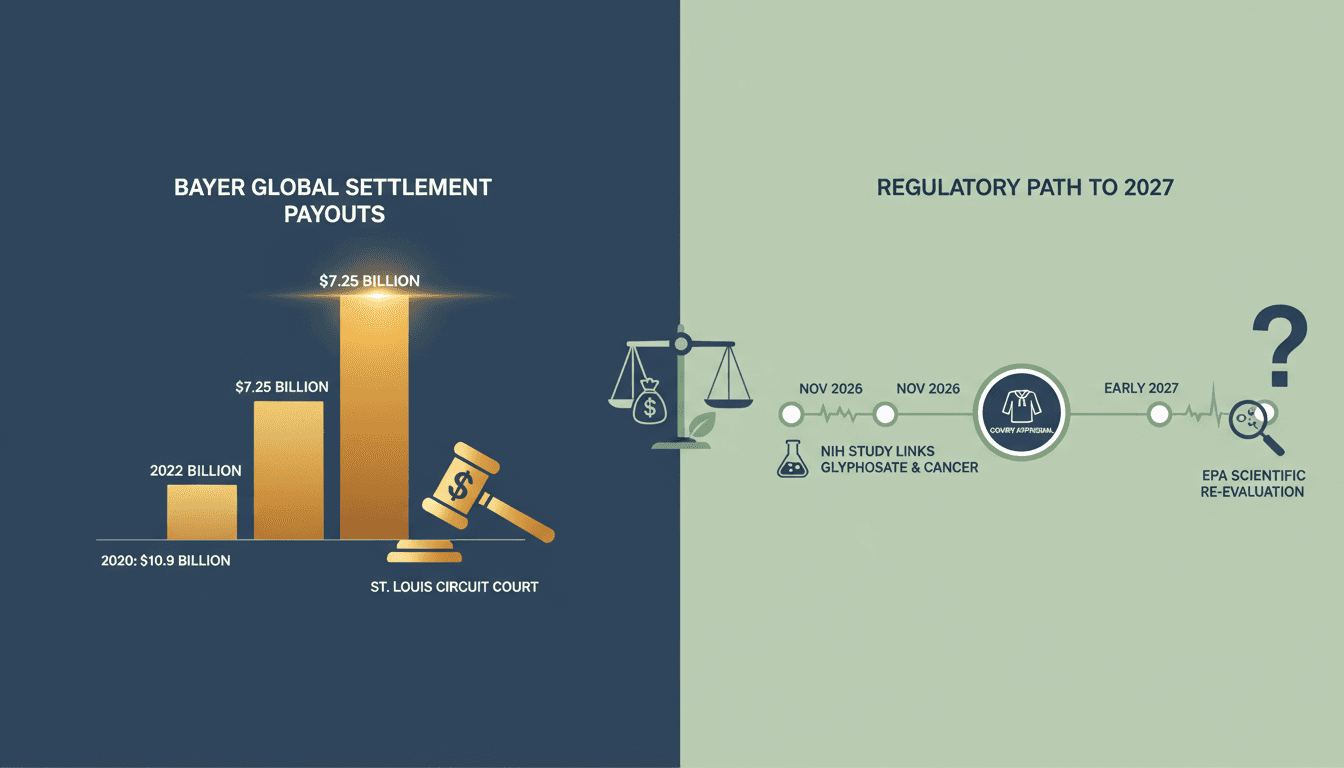
The formal court approval of a $7.25 billion settlement offers Bayer a pathway to cap a decade of litigation, but newly released federal data guarantees that chemical risk pricing remains an active variable across agricultural markets through 2027.
What happened (in 30 seconds)
- Judicial clearance granted: On November 20, 2026, Judge Timothy Boyer of the St. Louis Circuit Court approved Bayer AG’s $7.25 billion settlement to resolve pending and future U.S. Roundup personal injury claims.
- Science reopens the debate: Concurrently, a National Institutes of Health-funded study identified positive associations between glyphosate-based herbicides and lymphohematopoietic cancers in humans, alongside tumors in animal models.
- Regulatory clock running: The Environmental Protection Agency is continuing its formal registration review of glyphosate in coordination with the Department of Health and Human Services, targeting a conclusion by early 2027.
The context you actually need
- The acquisition inheritance: Bayer inherited an estimated 65,000 personal injury lawsuits when it acquired Monsanto in 2018, leading to over $10 billion in prior cumulative payouts across state and federal courts.
- The federal preemption shield: In June 2026, the U.S. Supreme Court affirmed that federal labeling laws preempt state-level failure-to-warn claims, establishing critical boundaries that enabled Bayer to structure this $7.25 billion exit.
- The agency divergence: The International Agency for Research on Cancer classified glyphosate as probably carcinogenic in 2015, while the EPA historically determined the compound is not likely to cause cancer when applied according to label specifications.
What's really happening
The mechanics behind Bayer’s $7.25 billion resolution reflect a calculated trade-off between closing balance-sheet volatility and absorbing stubborn regulatory exposure. By obtaining final judicial sign-off in Missouri state court, Bayer establishes an operational boundary around personal injury liabilities that have depressed its enterprise valuation since the 2018 Monsanto transaction. The legal structure, proposed in February 2026, aims to resolve the bulk of existing and anticipated claims alleging non-Hodgkin lymphoma.
However, the legal settlement does not operate in an operational vacuum. At the exact moment Bayer secured courtroom stability, public health research introduced technical complications. The systematic review funded by the National Institutes of Health delivered findings linking glyphosate-based formulations to blood-related cancers and laboratory animal tumors. This counter-narrative challenges the premise that product liability risk completely dissipates with financial payouts.
The regulatory incentives are straightforward. For the EPA, the pending 2027 registration review cannot disregard new research produced under federal auspices. Historically, the EPA maintained that glyphosate presented no direct cancer risk under directed application. Because the EPA is coordinating with the Department of Health and Human Services, any material shift in the agency's evaluation framework will alter operational guidelines for commercial agriculture.
For commercial enterprises, legal settlements resolve historical damage claims, but regulatory registrations dictate future revenue models. Bayer's payout establishes clear financial containment for legacy legal actions, yet chemical manufacturers and commercial growers now face an extended period of uncertainty regarding whether the EPA will alter application standards, require revised commercial formulations, or adjust allowable exposure limits when it issues its final determination in early 2027.
Who feels it first (and how)
- Agrochemical balance sheet managers: Corporate treasury and risk departments gain a definitive settlement figure ($7.25 billion) to close legacy balance-sheet provisions, shifting their focus toward ongoing compliance and defense costs.
- Commercial agricultural producers: Farms operating on thin operating margins face potential workflow adjustments if the EPA introduces new application mandates or label restrictions in 2027.
- Liability insurers and underwriters: Actuaries evaluating specialty environmental and casualty risk receive definitive market benchmarks for resolving mass tort exposures involving regulated agricultural inputs.
- Institutional agribusiness investors: Portfolios heavily weighted toward crop-science infrastructure must model potential shifts in product lifecycle duration as regulatory evaluations extend into 2027.
What to watch next
- The EPA Registration Determination: The joint review by the EPA and the Department of Health and Human Services scheduled for early 2027 will establish whether commercial glyphosate labels require administrative modifications.
- Corporate capital allocation: Bayer's financial execution of the $7.25 billion structure will clarify its available balance-sheet capacity for agricultural research and pipeline development.
- Appellate filings on class terms: Monitoring whether non-participating claimant groups pursue legal challenges against the Missouri state court approval will verify the finality of the litigation shield.
Judge Timothy Boyer granted final approval to Bayer’s $7.25 billion settlement in Missouri, establishing terms for resolving current and future U.S. Roundup personal injury claims.
Agrochemical producers will maintain standard commercial distribution of glyphosate products through 2026 while monitoring federal regulatory reviews.
Whether the NIH-funded study findings will compel the EPA to alter its long-held assessment that glyphosate is not likely to cause cancer when used as directed.
Frequently Asked Questions
- Why it matters?
- The formal court approval of a $7.25 billion settlement offers Bayer a pathway to cap a decade of litigation, but newly released federal data guarantees that chemical risk pricing remains an active variable across agricultural markets through 2027.
- What happened (in 30 seconds)?
- Judicial clearance granted: On November 20, 2026, Judge Timothy Boyer of the St. Louis Circuit Court approved Bayer AG’s $7.25 billion settlement to resolve pending and future U.S. Roundup personal injury claims. Science reopens the debate: Concurrently, a National Institutes of Health-funded study identified positive associations between glyphosate-based herbicides and lymphohematopoietic cancers in humans, alongside tumors in animal models. Regulatory clock running: The Environmental Protectio
- What's really happening?
- The mechanics behind Bayer’s $7.25 billion resolution reflect a calculated trade-off between closing balance-sheet volatility and absorbing stubborn regulatory exposure. By obtaining final judicial sign-off in Missouri state court, Bayer establishes an operational boundary around personal injury liabilities that have depressed its enterprise valuation since the 2018 Monsanto transaction. The legal structure, proposed in February 2026, aims to resolve the bulk of existing and anticipated claims a
- Who feels it first (and how)?
- Agrochemical balance sheet managers: Corporate treasury and risk departments gain a definitive settlement figure ($7.25 billion) to close legacy balance-sheet provisions, shifting their focus toward ongoing compliance and defense costs. Commercial agricultural producers: Farms operating on thin operating margins face potential workflow adjustments if the EPA introduces new application mandates or label restrictions in 2027. Liability insurers and underwriters: Actuaries evaluating specialty envi
- What to watch next?
- The EPA Registration Determination: The joint review by the EPA and the Department of Health and Human Services scheduled for early 2027 will establish whether commercial glyphosate labels require administrative modifications. Corporate capital allocation: Bayer's financial execution of the $7.25 billion structure will clarify its available balance-sheet capacity for agricultural research and pipeline development. Appellate filings on class terms: Monitoring whether non-participating claimant gr
Coverage of national news and issues shaping the United States, including politics, economy, and society.
"The Wall Street Journal is one of the most respected financial and news publications in the U.S., known for its rigorous reporting and center-right editorial perspective."
— A47 Editor
Bayer Clears Major Roundup Hurdle, but a New Study Raises Cancer Link Again
Bayer has cleared a major hurdle in Roundup litigation as a Missouri judge, Timothy Boyer, approved a $7.25 billion class settlement resolving cancer claims tied to the weedkiller, while a new U.S. government-funded study again links the product to c...
Medical reporting with scientific depth and public service tone.
"NPR is a nonprofit media organization offering thoughtful, in-depth journalism and storytelling, often with a liberal or progressive slant."
— A47 Editor
Bayer reaches Roundup settlement that could cost the company billions
Bayer has reached a settlement over claims that its Roundup weedkiller causes non-Hodgkin lymphoma, a blood cancer. The payments are directed to thousands of people who have been or will be diagnosed with the disease, and the deal could cost the Germ...
RT is a Russian state-funded network covering global events from a Russian perspective.
"RT is widely criticized for promoting pro-Kremlin narratives and is considered by many to be a state propaganda outlet."
— A47 Editor
US court greenlights Bayer’s $7.25 bn Roundup cancer deal
A US court has approved Bayer's $7.25 billion settlement resolving claims that its Roundup weedkiller causes cancer, a ruling that could bring years of costly litigation to a close.