
Agentic AI Agents Drive Record $1 Trillion US Black Friday Retail Season in 2026
Why it matters
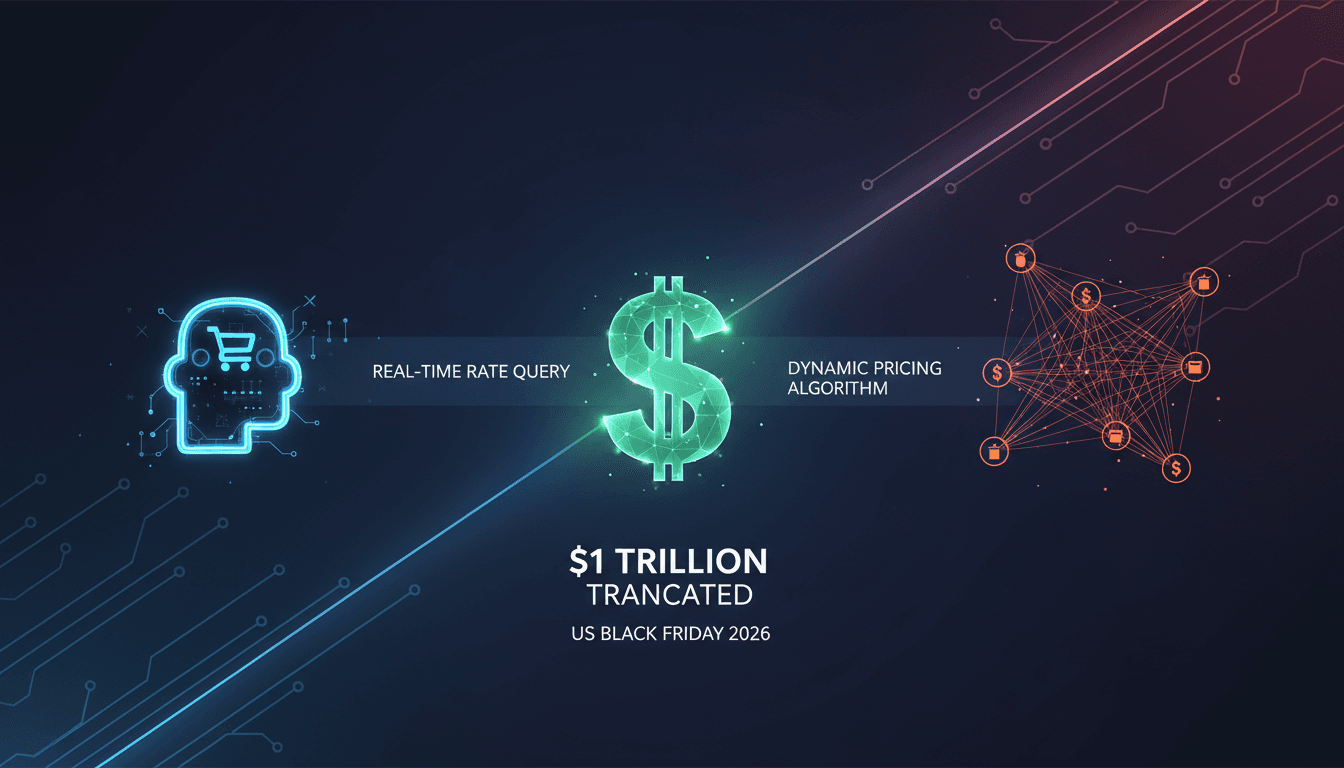
Holiday retail spending crossing $1 trillion under the steerage of autonomous AI agents fundamentally alters commercial distribution, shifting competitive leverage from customer attention to machine-read algorithmic pricing.
What happened (in 30 seconds)
* Agentic shopping debuted at scale: On November 27, 2026, Black Friday marked the first broad deployment of autonomous AI agents executing deal discovery, cross-merchant price comparisons, and purchases on behalf of US consumers. * Holiday sales crossed $1 trillion: Projections hit a record total of more than $1 trillion, driven by consumer spending and AI-assisted e-commerce site traffic that more than doubled year-over-year. * Retailers adjusted promotional strategies: Major brands deployed counter-balancing AI pricing engines to moderate discount depths and defend corporate margins while still capturing demand.
The context you actually need
* A rapid two-year baseline shift: Retail traffic driven by AI assistance expanded by 805% between 2024 and 2025, laying the behavioral foundation for full agent delegation in 2026. * Inflation accelerated programmatic defense: Merchants initially integrated machine learning to preserve margin through dynamic pricing and inventory management, preparing systems for high-frequency pricing adjustments. * Consumer delegation crossed the checkout line: Shopper behavior evolved from basic conversational queries via platforms like ChatGPT into assigning direct purchasing authority to software bots targeting specific price thresholds.
What's really happening
The crossing of the $1 trillion threshold on Black Friday 2026 demonstrates an institutional shift: retail is evolving from an attention economy into an algorithmic settlement layer.
Historically, holiday discounting relied on asymmetric information and human friction. Retailers deployed "loss leaders"—steeply discounted headline items—to capture human foot traffic or site visits, calculating that impulse purchases, visual merchandising, and search fatigue would generate margin-accretive basket sizes.
Agentic AI breaks this dynamic. When shoppers delegate deal discovery and checkout execution to software, friction drops to zero. Autonomous agents evaluate thousands of stock-keeping units in milliseconds, aggregate cross-platform data, bypass landing pages, and execute transactions only when strict parameters are met. Because an algorithm has no impulse-buying tendencies, traditional brand loyalty triggers and display ads lose utility. Adobe data showing AI-assisted traffic more than doubling year-over-year confirms that consumers are deliberately insulating themselves from promotional funnels.
In response, enterprise retailers are deploying their own automated countermeasures. Brands like Walmart, Amazon, and Gap are not using AI merely to manage stock levels; they are using algorithmic pricing engines to implement shallower, targeted discounts. By continuously parsing incoming programmatic queries from consumer bots, merchant algorithms can trim half a percentage point of margin reduction here or narrow a clearance window there. Retailers effectively preserve margin by offering precisely the minimum concession required to trigger a bot’s purchase threshold, counteracting consumer expectations of deep markdowns.
This creates an automated arms race between buyer-side optimization bots and seller-side margin preservation models. It also displaces the conventional digital advertising model. Search engines monetized pay-per-click links by charging brands to capture human intent. When an autonomous agent conducts the transaction, sponsored links and search engine optimization fail if the programmatic agent only ranks strictly by net cost, shipping time, and inventory certainty. The primary commercial surface area is no longer the digital storefront; it is the data feed exposed to autonomous buyers.
Who feels it first (and how)
* Retail frontline workers: Store-level employees face immediate point-of-sale friction from customers armed with AI-generated deal data that conflicts with physical store policies and localized dynamic pricing. * E-commerce brand managers: Marketing and merchandising teams must restructure campaigns away from visual design and ad-spend toward structured data feeds and algorithmic discovery pipelines. * Mid-market consumers: Shoppers leaning on bots secure fast transactions but encounter shallower net discounts as merchant pricing tools systematically counter deal-hunting algorithms. * Cross-border international buyers: Global consumers, including those in hubs like Dubai tracking US retail cycles, experience real-time fluctuations in cross-border product availability as domestic bot orders clear inventory instantly.
What to watch next
* Search engine revenue diversification: Watch how major search platforms alter fee structures as agentic software reduces human ad clicks across standard search surfaces. * Store-level price-matching policy updates: Monitor major chains for formal revisions to physical store price-match guarantees to manage disputes caused by real-time agentic recommendations. * Autonomous purchase liability protocols: Observe the emergence of merchant verification frameworks designed to authenticate autonomous checkouts and handle automated returns.
Retail projections for the 2026 holiday season passed $1 trillion, AI-assisted web traffic more than doubled compared to 2025, and consumer agents actively executed autonomous buying decisions.
Traditional paid search and banner advertising spend will decline as more retail transaction volume bypasses web browsers entirely in favor of direct machine-to-machine transactions.
Whether retail pricing algorithms will permanently out-maneuver consumer shopping bots to keep average discount depths shallow, or if bot aggregation will force a structural compression of retail gross margins.
Frequently Asked Questions
- Why it matters?
- Holiday retail spending crossing $1 trillion under the steerage of autonomous AI agents fundamentally alters commercial distribution, shifting competitive leverage from customer attention to machine-read algorithmic pricing.
- What happened (in 30 seconds)?
- Agentic shopping debuted at scale: On November 27, 2026, Black Friday marked the first broad deployment of autonomous AI agents executing deal discovery, cross-merchant price comparisons, and purchases on behalf of US consumers. Holiday sales crossed $1 trillion: Projections hit a record total of more than $1 trillion, driven by consumer spending and AI-assisted e-commerce site traffic that more than doubled year-over-year. Retailers adjusted promotional strategies: Major brands deployed counter
- What's really happening?
- The crossing of the $1 trillion threshold on Black Friday 2026 demonstrates an institutional shift: retail is evolving from an attention economy into an algorithmic settlement layer. Historically, holiday discounting relied on asymmetric information and human friction. Retailers deployed "loss leaders"—steeply discounted headline items—to capture human foot traffic or site visits, calculating that impulse purchases, visual merchandising, and search fatigue would generate margin-accretive baske
- Who feels it first (and how)?
- Retail frontline workers: Store-level employees face immediate point-of-sale friction from customers armed with AI-generated deal data that conflicts with physical store policies and localized dynamic pricing. E-commerce brand managers: Marketing and merchandising teams must restructure campaigns away from visual design and ad-spend toward structured data feeds and algorithmic discovery pipelines. Mid-market consumers: Shoppers leaning on bots secure fast transactions but encounter shallower net
- What to watch next?
- Search engine revenue diversification: Watch how major search platforms alter fee structures as agentic software reduces human ad clicks across standard search surfaces. Store-level price-matching policy updates: Monitor major chains for formal revisions to physical store price-match guarantees to manage disputes caused by real-time agentic recommendations. Autonomous purchase liability protocols: Observe the emergence of merchant verification frameworks designed to authenticate autonomous check
Global markets, investing, and macroeconomics from a premier financial newsroom.
"Bloomberg is respected for in-depth financial reporting and data-driven analysis."
— A47 Editor
AI Tools Reshape the Black Friday Experience
Retail sales are expected to top $1 trillion for the first time during the holiday season, with shoppers indicating they will spend more than last year and are expected to give AI tools greater influence over their purchases, according to Anjee Solan...
Technology business and AI-related headlines.
"Data-driven tech newsroom with global scope."
— A47 Editor
How AI Is Changing Black Friday
Matt Shay, president and CEO of the National Retail Federation, says AI may mark a step change in how consumers interact with retailers, as shoppers begin using AI tools differently during Black Friday.
Technology business news, market impacts, and innovation trends.
"Bloomberg is a premier financial and tech news provider, respected for its in-depth reporting and analytical rigor."
— A47 Editor
How AI Is Changing Black Friday
Matt Shay, president and CEO of the National Retail Federation, says AI may mark a step change in how consumers interact with retailers, as shoppers begin using AI tools differently during Black Friday.
Technology business and AI-related headlines.
"Data-driven tech newsroom with global scope."
— A47 Editor
Black Friday Shoppers Turn to AI Bots to Find Deals
Adobe data indicates that AI-assisted traffic to US retail sites this holiday season will more than double last year's, signaling that consumers are increasingly turning from traditional search engines to digital assistants to find Black Friday deals...
Technology business news, market impacts, and innovation trends.
"Bloomberg is a premier financial and tech news provider, respected for its in-depth reporting and analytical rigor."
— A47 Editor
Black Friday Shoppers Turn to AI Bots to Find Deals
Adobe data shows AI-assisted traffic to US retail sites this holiday season will more than double last year's, as shoppers increasingly turn from traditional search engines to digital assistants to find Black Friday deals, according to reporting by B...