
DeFi United Proposes Recovery Plan for Aave Following Kelp DAO Exploit
Here's what it means for you.
If you're involved in decentralized finance (DeFi), the recent exploit and recovery efforts could significantly impact your lending and borrowing options.
Why it matters
This proposal addresses systemic risks in the DeFi lending markets, which could affect liquidity and user confidence across platforms.
What happened (in 30 seconds)
- April 18, 2026: An exploit on Kelp DAO minted 116,500 unbacked rsETH tokens, valued at approximately $292 million.
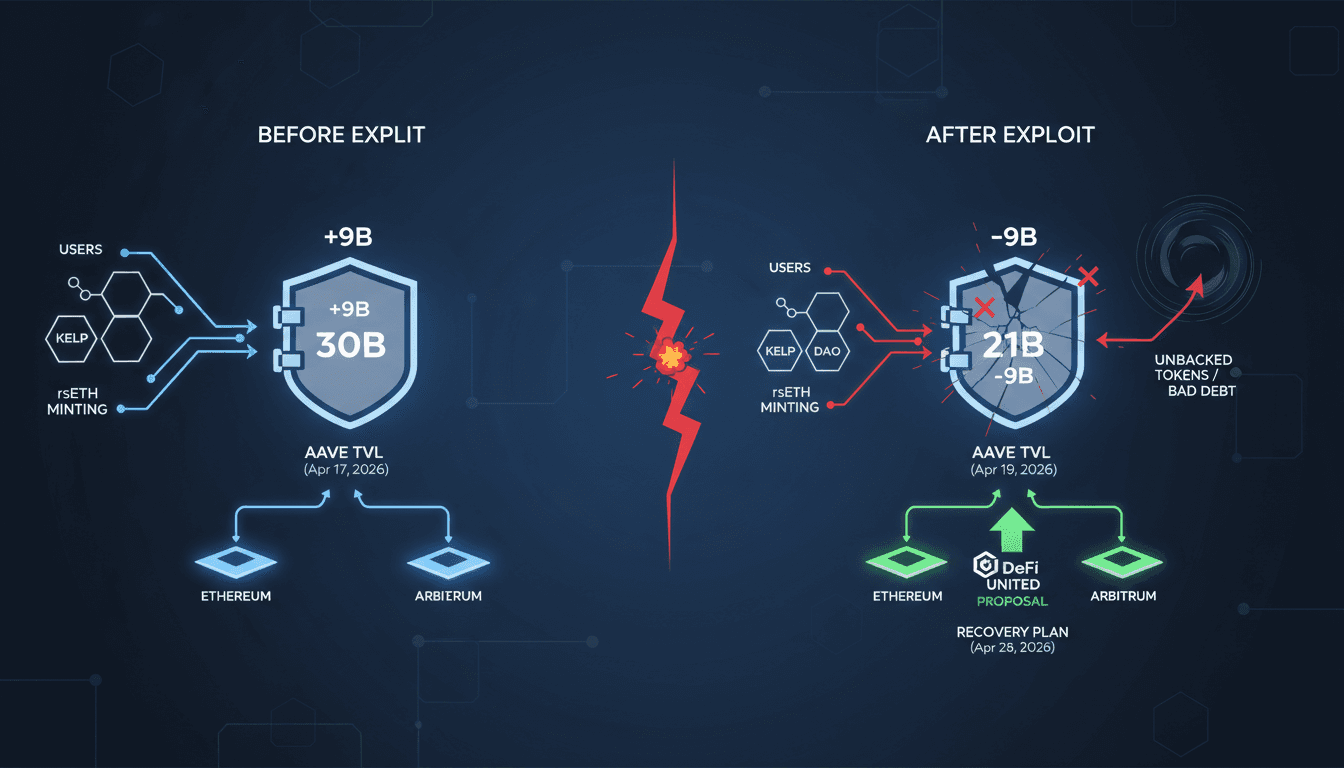
- April 19-21, 2026: Aave's total value locked (TVL) plummeted by $9 billion, leading to a liquidity crisis.
- April 28, 2026: DeFi United released a recovery proposal to re-collateralize rsETH and mitigate bad debt, gaining 99.9% support from Aave DAO.
The context you actually need
- Kelp DAO's exploit: The exploit involved a forged cross-chain message that allowed the minting of unbacked tokens, creating significant bad debt exposure.
- DeFi United's formation: In response to the exploit, DeFi United was formed to coordinate recovery efforts and secure ETH pledges from various stakeholders.
- Market implications: The exploit highlighted vulnerabilities in bridge dependencies and liquid restaking token (LRT) collateralization, raising concerns about the stability of DeFi platforms.
What's really happening
On April 18, 2026, the Kelp DAO exploit sent shockwaves through the DeFi ecosystem, minting 116,500 unbacked rsETH tokens. This incident not only created a staggering $292 million in uncollateralized debt but also triggered a liquidity crisis that saw Aave's total value locked (TVL) drop from $26.4 billion to $17.5 billion within days. The exploit's fallout raised alarms about the systemic risks associated with decentralized lending platforms, particularly those relying on cross-chain bridges and liquid restaking tokens.
In the wake of the exploit, DeFi United emerged as a coalition led by Aave, aiming to restore confidence in the market. The coalition's proposal involves re-collateralizing the unbacked rsETH tokens using over $300 million in pledged ETH from various stakeholders, including Aave, Lido, and Consensys. This coordinated effort is designed to mitigate the bad debt created by the exploit and stabilize the lending markets on Ethereum and Arbitrum.
The proposal outlines a plan for controlled liquidations of exploiter positions to recover nearly 30,000 ETH, further addressing the liquidity crisis. By adjusting oracle parameters for liquidations, the coalition aims to recover funds from both Aave and Compound, thereby restoring some level of trust among users. The overwhelming support for the proposal—99.9% approval from Aave DAO—indicates a strong consensus on the need for immediate action.
However, the situation remains fluid. While the proposal has garnered significant backing, the governance processes for Compound and Arbitrum are still pending, and the timeline for recovery remains uncertain. The exploit has not only affected the immediate stakeholders but has also raised broader questions about the security and reliability of DeFi protocols, particularly in light of the increasing complexity of cross-chain interactions.
As the DeFi landscape continues to evolve, the implications of this exploit and the subsequent recovery efforts will likely resonate throughout the ecosystem, influencing user behavior and investment strategies.
Who feels it first (and how)
- DeFi users: Those who rely on Aave and Compound for lending and borrowing will face immediate impacts on liquidity and access to funds.
- Investors in rsETH: Holders of rsETH tokens will experience volatility and uncertainty regarding the value of their assets.
- Developers and protocols: Teams building on Ethereum and Arbitrum may need to reassess their security measures and risk management strategies in light of the exploit.
What to watch next
- Aave DAO vote outcomes: The final results of the Aave DAO vote and subsequent proposals from Compound and Arbitrum will indicate the recovery trajectory.
- Market stabilization indicators: Watch for signs of liquidity recovery in Aave and Compound, which will reflect user confidence in the platforms.
- Regulatory responses: Any emerging regulatory frameworks addressing DeFi security could reshape the landscape and influence user participation.
The exploit resulted in a significant liquidity crisis, with Aave's TVL dropping by $9 billion.
The recovery proposal will gain traction, leading to a gradual restoration of confidence in Aave and Compound.
The long-term implications of the exploit on user behavior and regulatory responses remain uncertain.
Frequently Asked Questions
- Why it matters?
- This proposal addresses systemic risks in the DeFi lending markets, which could affect liquidity and user confidence across platforms.
- What happened (in 30 seconds)?
- April 18, 2026: An exploit on Kelp DAO minted 116,500 unbacked rsETH tokens, valued at approximately $292 million. April 19-21, 2026: Aave's total value locked (TVL) plummeted by $9 billion, leading to a liquidity crisis. April 28, 2026: DeFi United released a recovery proposal to re-collateralize rsETH and mitigate bad debt, gaining 99.9% support from Aave DAO.
- What's really happening?
- On April 18, 2026, the Kelp DAO exploit sent shockwaves through the DeFi ecosystem, minting 116,500 unbacked rsETH tokens. This incident not only created a staggering $292 million in uncollateralized debt but also triggered a liquidity crisis that saw Aave's total value locked (TVL) drop from $26.4 billion to $17.5 billion within days. The exploit's fallout raised alarms about the systemic risks associated with decentralized lending platforms, particularly those relying on cross-chain bridges an
- Who feels it first (and how)?
- DeFi users: Those who rely on Aave and Compound for lending and borrowing will face immediate impacts on liquidity and access to funds. Investors in rsETH: Holders of rsETH tokens will experience volatility and uncertainty regarding the value of their assets. Developers and protocols: Teams building on Ethereum and Arbitrum may need to reassess their security measures and risk management strategies in light of the exploit.
- What to watch next?
- Aave DAO vote outcomes: The final results of the Aave DAO vote and subsequent proposals from Compound and Arbitrum will indicate the recovery trajectory. Market stabilization indicators: Watch for signs of liquidity recovery in Aave and Compound, which will reflect user confidence in the platforms. Regulatory responses: Any emerging regulatory frameworks addressing DeFi security could reshape the landscape and influence user participation.
Covers blockchain, cryptocurrency news, project analysis, and market insights.
"CoinDesk is a well-established cryptocurrency and blockchain news provider, offering comprehensive insights, market data, and industry research."
— A47 Editor
A crypto coalition releases technical proposal to save Aave users from a massive token exploit
DeFi United, a coalition of various blockchain projects and individuals, has released a technical proposal aimed at restoring the backing of rsETH following a significant exploit of Kelp DAO that resulted in a loss of approximately $292 million. This...
Covers blockchain, cryptocurrency news, project analysis, and market insights.
"Cointelegraph is a leading crypto-focused media outlet known for timely news, analysis, and educational content related to blockchain and digital assets."
— A47 Editor
Aave-linked DeFi United unveils rsETH recovery plan after $293M Kelp exploit
DeFi United has announced a recovery plan for its rsETH token following a significant exploit of Kelp DAO that resulted in a loss of approximately $293 million. This incident has prompted the organization to devise a technical strategy aimed at resto...
Covers Bitcoin plus altcoin news, market updates, and educational resources.
"Bitcoin.com provides news, market data, and guides focused on Bitcoin and the wider crypto industry."
— A47 Editor
Aave Releases Technical Plan to Restore rsETH Backing as Defi United’s Coalition Expands
Aave has announced a technical plan to restore backing for its rsETH token, following a significant exploit that resulted in a loss of approximately $292 million. This initiative is part of a broader effort termed 'DeFi United,' which aims to stabili...
Real-time updates, analysis, and reports on the blockchain and cryptocurrency sectors.
"Crypto News delivers real-time updates, analysis, and reports on the blockchain and cryptocurrency sectors."
— A47 Editor
DeFi United plans rsETH recovery after $292 million Kelp DAO exploit
DeFi United is implementing a recovery plan for its rsETH token following a significant exploit of Kelp DAO that resulted in a loss of approximately $292 million. The recovery strategy involves utilizing ETH tranches, Aave liquidations, and governanc...
Research, news, and analysis on blockchain startups, DeFi, and regulations.
"Crypto Briefing provides research, news, and analysis on blockchain startups, DeFi, and crypto regulations with investor-focused coverage."
— A47 Editor
DeFi United reveals recovery plan for rsETH after $292M Kelp DAO exploit
DeFi United has announced a recovery plan for its rsETH token following a significant exploit of Kelp DAO that resulted in a loss of approximately $292 million. This incident highlights vulnerabilities within decentralized finance (DeFi) platforms, r...
Real-time updates, analysis, and reports on the blockchain and cryptocurrency sectors.
"Crypto News delivers real-time updates, analysis, and reports on the blockchain and cryptocurrency sectors."
— A47 Editor
Can Solana’s ‘DeFi United’ Aave bailout stop SOL drifting below the mid‑80s?
Solana has initiated a significant support effort for Aave by lending USDT and integrating AAVE into its ecosystem following the KelpDAO exploit, which resulted in substantial financial losses for Aave. Currently, SOL is trading in the mid-$80s, rais...
Real-time updates, analysis, and reports on the blockchain and cryptocurrency sectors.
"Crypto News delivers real-time updates, analysis, and reports on the blockchain and cryptocurrency sectors."
— A47 Editor
Aave DAO Governance Vote to Pause Buybacks — KelpDAO Fallout Continues
Aave DAO is preparing for a crucial governance vote to pause $AAVE buybacks in the aftermath of a $293 million exploit at KelpDAO, which has resulted in significant financial instability for the platform. This exploit has triggered approximately $236...
Real-time updates, analysis, and reports on the blockchain and cryptocurrency sectors.
"Crypto News delivers real-time updates, analysis, and reports on the blockchain and cryptocurrency sectors."
— A47 Editor
Circle quietly plugs Aave’s hole as DeFi’s Kelp shock tests USDC strategy
Circle Ventures has acquired AAVE tokens in response to a recent $293 million exploit of KelpDAO, which has caused significant financial distress for the decentralized finance platform Aave. This acquisition aims to stabilize Aave's operations amidst...