
Solana Validators Implement Falcon Post-Quantum Signatures to Enhance Network Security
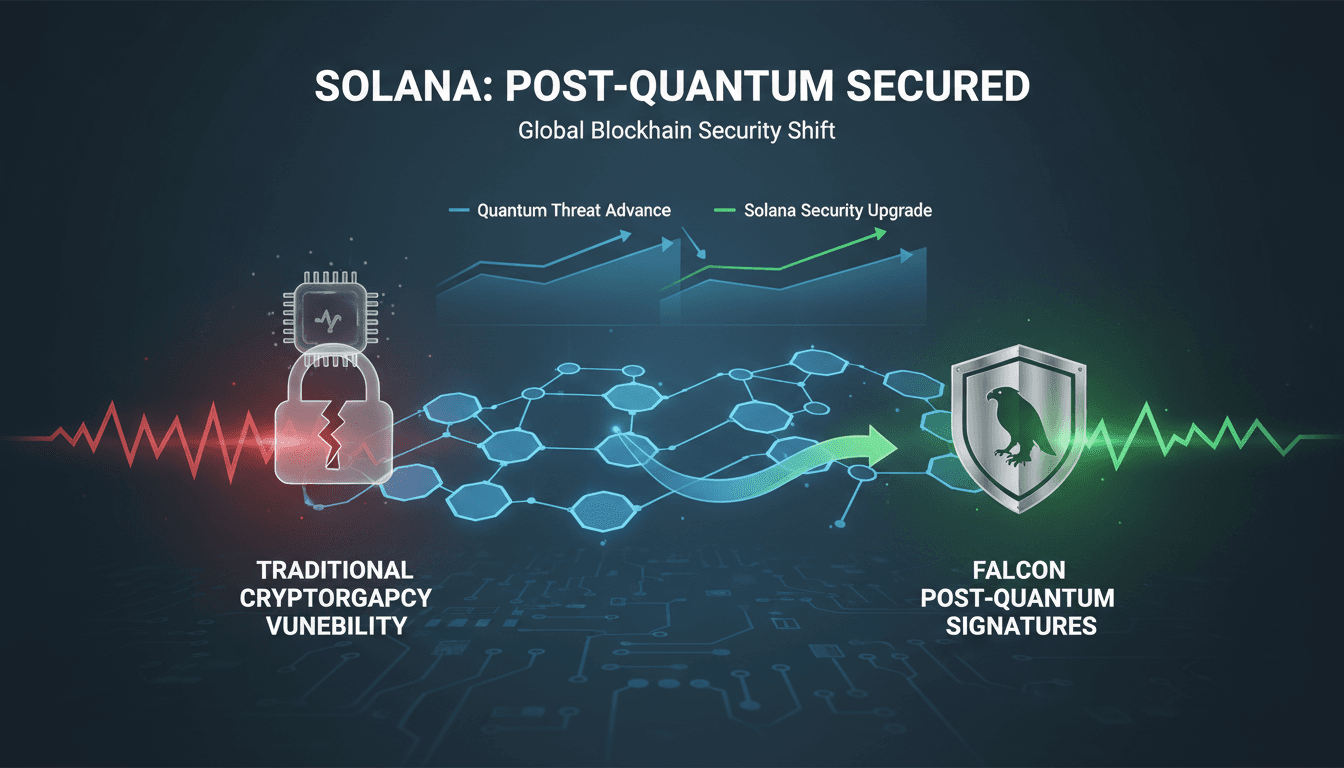
Here's what it means for you.
If you use the Solana network, your digital assets are becoming more secure against future quantum computing threats.
Why it matters
This proactive measure positions Solana as a leader in blockchain security, potentially influencing user trust and adoption.
What happened (in 30 seconds)
- On April 27, 2026, Solana validator clients Anza and Firedancer announced the implementation of the Falcon post-quantum digital signature scheme.
- The Solana Foundation revealed that these implementations are available on public GitHub repositories, allowing for future activation without immediate changes to the network.
- The initiative aims to address vulnerabilities in current cryptographic methods, ensuring compact signatures suitable for Solana's high-throughput architecture.
The context you actually need
- Quantum computers pose a significant threat to traditional cryptographic algorithms, particularly elliptic curve digital signature algorithms (ECDSA), which are widely used in blockchain technology.
- NIST standardized the Falcon post-quantum cryptography scheme in 2022, recognizing its compact signature size as ideal for bandwidth-constrained networks like Solana.
- Previous efforts to enhance Solana's security against quantum threats include Blueshift's Winternitz Vault, which began testing in January 2025, indicating a growing awareness of quantum risks.
What's really happening
The convergence of independent research by Anza and Firedancer on the Falcon-512 signature scheme marks a significant step in blockchain security. Both teams began their investigations into post-quantum cryptography in early 2026, driven by the rapid advancements in quantum computing capabilities from institutions like Google and Caltech. Their findings led to a collaborative announcement by the Solana Foundation, which highlighted the importance of preparing for potential quantum threats.
The Falcon-512 signature scheme, with a signature size of 666 bytes, is the smallest among NIST-approved post-quantum schemes, making it particularly suitable for Solana's architecture, which prioritizes high throughput and efficiency. The implementation of this scheme is not just a technical upgrade; it represents a strategic shift in how blockchain networks can adapt to emerging threats. By pushing test versions to public GitHub repositories, Solana allows for a phased approach to activation, ensuring that the network can transition smoothly without disrupting existing operations.
The roadmap outlined by the Solana Foundation consists of three phases: ongoing research into post-quantum schemes, the development of new wallets that incorporate these technologies upon the emergence of quantum threats, and the migration of existing wallets with minimal performance impact. This structured approach not only mitigates immediate risks but also sets a precedent for other blockchain networks to follow.
The Solana community has reacted positively to this initiative, recognizing it as a proactive measure that positions the network ahead of its peers in terms of security. Following the announcement, the price of SOL hovered around $84, reflecting a minor gain of 0.3% amid broader market fluctuations, indicating that investor sentiment remains cautiously optimistic. The increased trading volume suggests heightened interest in Solana's future prospects, particularly as it navigates the complexities of quantum-proofing.
Who feels it first (and how)
- Developers: Those building on the Solana network will need to adapt to new cryptographic standards.
- Investors: Increased security may enhance trust and investment in SOL, impacting market dynamics.
- Users: Everyday users of Solana will benefit from improved security for their digital assets.
- Competing networks: Other blockchain platforms may feel pressure to adopt similar measures to remain competitive.
What to watch next
- Adoption rates of Falcon: Monitoring how quickly developers integrate Falcon into their applications will indicate the network's readiness against quantum threats.
- Market response: Observing SOL's price movements and trading volume post-implementation will provide insights into investor confidence in Solana's security measures.
- Emerging quantum threats: Keeping an eye on advancements in quantum computing will help gauge the urgency of further cryptographic upgrades across blockchain networks.
Solana has initiated the implementation of post-quantum cryptography to enhance security.
Other blockchain networks will follow suit, adopting similar measures to protect against quantum threats.
The exact timeline for widespread adoption of quantum-resistant technologies across the industry remains uncertain.
Frequently Asked Questions
- Why it matters?
- This proactive measure positions Solana as a leader in blockchain security, potentially influencing user trust and adoption.
- What happened (in 30 seconds)?
- On April 27, 2026, Solana validator clients Anza and Firedancer announced the implementation of the Falcon post-quantum digital signature scheme. The Solana Foundation revealed that these implementations are available on public GitHub repositories, allowing for future activation without immediate changes to the network. The initiative aims to address vulnerabilities in current cryptographic methods, ensuring compact signatures suitable for Solana's high-throughput architecture.
- What's really happening?
- The convergence of independent research by Anza and Firedancer on the Falcon-512 signature scheme marks a significant step in blockchain security. Both teams began their investigations into post-quantum cryptography in early 2026, driven by the rapid advancements in quantum computing capabilities from institutions like Google and Caltech. Their findings led to a collaborative announcement by the Solana Foundation, which highlighted the importance of preparing for potential quantum threats. The
- Who feels it first (and how)?
- Developers: Those building on the Solana network will need to adapt to new cryptographic standards. Investors: Increased security may enhance trust and investment in SOL, impacting market dynamics. Users: Everyday users of Solana will benefit from improved security for their digital assets. Competing networks: Other blockchain platforms may feel pressure to adopt similar measures to remain competitive.
- What to watch next?
- Adoption rates of Falcon: Monitoring how quickly developers integrate Falcon into their applications will indicate the network's readiness against quantum threats. Market response: Observing SOL's price movements and trading volume post-implementation will provide insights into investor confidence in Solana's security measures. Emerging quantum threats: Keeping an eye on advancements in quantum computing will help gauge the urgency of further cryptographic upgrades across blockchain networks.
News and analysis on Bitcoin, altcoins, and blockchain innovation.
"Bitcoinist delivers news and analysis on Bitcoin, altcoins, and blockchain innovation with a focus on market trends and industry updates."
— A47 Editor
Quantum-Proofing Begins: Solana Validators Trial Falcon Tech
Solana has initiated trials of Falcon-512, a post-quantum digital signature technology, to enhance the security of its validators against potential quantum computing threats. This decision aligns with the US National Institute of Standards and Techno...
Bitcoin news, technical analysis, and forecasts across crypto markets.
"NewsBTC covers Bitcoin news, technical analysis, and forecasts across crypto markets and major blockchain projects."
— A47 Editor
Solana Prepares For The Quantum Era: Foundation Details Step-By-Step Transition
The Solana Foundation has outlined a comprehensive plan to address potential threats posed by quantum computing to blockchain security, detailing a step-by-step transition strategy in a recent blog post. This proactive approach emphasizes the importa...
Real-time updates, analysis, and reports on the blockchain and cryptocurrency sectors.
"Crypto News delivers real-time updates, analysis, and reports on the blockchain and cryptocurrency sectors."
— A47 Editor
Solana clients test Falcon as quantum security debate grows
Solana clients Anza and Firedancer are currently testing Falcon, a post-quantum signature tool designed to enhance the security of validators against potential quantum computing threats. This initiative is part of Solana's broader strategy to address...
Covers blockchain, cryptocurrency news, project analysis, and market insights.
"Cointelegraph is a leading crypto-focused media outlet known for timely news, analysis, and educational content related to blockchain and digital assets."
— A47 Editor
Solana clients Anza and Firedancer introduce post-quantum solution Falcon
Solana clients Anza and Firedancer have introduced Falcon, a post-quantum digital signature solution designed to enhance the security of the Solana network against potential quantum computing threats. This initiative is part of a broader effort to en...
Covers Bitcoin plus altcoin news, market updates, and educational resources.
"Bitcoin.com provides news, market data, and guides focused on Bitcoin and the wider crypto industry."
— A47 Editor
Solana Readies Quantum Defense With 3-Step Roadmap and Falcon Implementation
Solana has announced a three-step roadmap to enhance its defenses against potential quantum computing threats, implementing a new digital signature technology called Falcon. This initiative aims to secure the network and maintain its competitive edge...
Covers blockchain, cryptocurrency news, project analysis, and market insights.
"CoinDesk is a well-established cryptocurrency and blockchain news provider, offering comprehensive insights, market data, and industry research."
— A47 Editor
Solana developers outline plan to protect network from quantum threats
Solana developers, specifically teams from Anza and Jump Crypto's Firedancer, have proposed a new digital signature technology called Falcon to safeguard the network against potential quantum computing threats. This initiative aims to enhance the sec...