
BlackRock Report Highlights Bitcoin's Resilience as Portfolio Diversifier Post-Correction
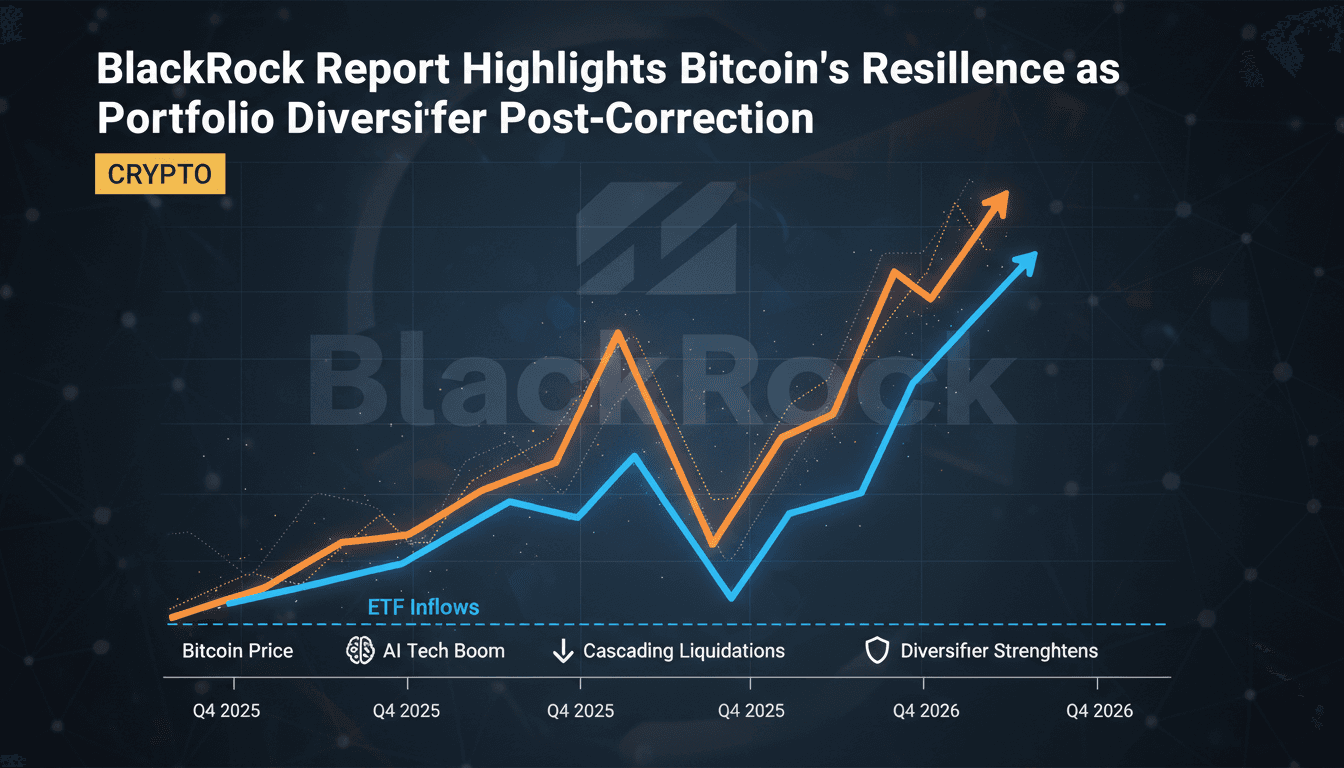
Here's what it means for you.
Understanding Bitcoin's role as a portfolio diversifier is crucial for navigating today's volatile markets.
Why it matters
Bitcoin's recent price correction highlights its potential as a low-correlation asset in diversified portfolios.
What happened (in 30 seconds)
- BlackRock's report confirms Bitcoin's resilience despite a 50% drop from its October 2025 peak of $126,200.
- Cascading liquidations from overleveraged positions and ETF outflows contributed to the decline below $60,000.
- Bitcoin is currently trading around $78,000, indicating a partial recovery amid broader market stabilization.
The context you actually need
- Bitcoin surged approximately 700% from late 2022 to October 2025, driven by institutional adoption and favorable regulatory developments.
- The market correction was triggered by macroeconomic factors, including U.S. tariffs on China and a shift in capital towards AI equities.
- BlackRock's analysis suggests that while short-term correlations with risk assets increased, Bitcoin's long-term low-correlation profile remains intact.
What's really happening
BlackRock's August 2026 report provides a detailed analysis of Bitcoin's recent price movements, framing the 50% correction as a necessary "positioning correction" rather than a fundamental shift in the asset's value. The report highlights that Bitcoin's price peaked at $126,200 in October 2025, fueled by a surge in speculative trading and institutional interest, particularly through U.S. spot ETFs. However, this speculative frenzy led to overleveraged positions in perpetual futures, with open interest exceeding $90 billion at its peak.
The initial catalyst for the decline was a macro risk-off event on October 10, 2025, when the U.S. imposed tariffs on China, triggering a wave of deleveraging. This was compounded by further ETF outflows exceeding $5 billion and a capital rotation towards AI-themed assets in early 2026. As a result, Bitcoin's price fell below $60,000, leading to cascading liquidations that exacerbated the decline.
Despite this volatility, BlackRock's report emphasizes that Bitcoin's core thesis as a low-correlation diversifier remains intact. The analysis notes that Bitcoin's 10-year rolling correlation with the S&P 500 is just 0.18, indicating its potential to act as a hedge against traditional market risks. Historical data shows that Bitcoin has often outperformed following macroeconomic shocks, such as the COVID-19 pandemic and the 2020 U.S. election.
The report also points out that speculative excess has largely been purged from the market, setting the stage for normalized lower correlations with risk assets. As positioning stabilizes, Bitcoin's volatility is expected to decrease, making it a more attractive option for institutional investors seeking diversification.
In summary, while the recent correction has raised concerns, BlackRock's analysis suggests that Bitcoin's long-term viability as a portfolio diversifier remains strong, particularly as market conditions normalize.
Who feels it first (and how)
- Institutional investors: They may reassess their strategies regarding Bitcoin as a diversifier.
- Retail traders: Those heavily invested in leveraged positions may experience significant losses.
- Crypto-focused funds: They will need to adapt to changing correlations and market dynamics.
- Geopolitical analysts: They will monitor how ongoing tensions affect market sentiment and asset flows.
What to watch next
- ETF inflows: Monitoring changes in ETF inflows will indicate renewed institutional interest in Bitcoin.
- Market volatility: Tracking Bitcoin's volatility compared to traditional assets will provide insights into its role as a diversifier.
- Geopolitical developments: Ongoing geopolitical tensions, particularly in the U.S.-Iran context, could impact market sentiment and Bitcoin's price.
Bitcoin's price correction was influenced by overleveraged positions and macroeconomic factors.
Bitcoin will continue to attract institutional interest as correlations normalize.
The long-term impact of geopolitical tensions on Bitcoin's price and market dynamics remains uncertain.
Frequently Asked Questions
- Why it matters?
- Bitcoin's recent price correction highlights its potential as a low-correlation asset in diversified portfolios.
- What happened (in 30 seconds)?
- BlackRock's report confirms Bitcoin's resilience despite a 50% drop from its October 2025 peak of $126,200. Cascading liquidations from overleveraged positions and ETF outflows contributed to the decline below $60,000. Bitcoin is currently trading around $78,000, indicating a partial recovery amid broader market stabilization.
- What's really happening?
- BlackRock's August 2026 report provides a detailed analysis of Bitcoin's recent price movements, framing the 50% correction as a necessary "positioning correction" rather than a fundamental shift in the asset's value. The report highlights that Bitcoin's price peaked at $126,200 in October 2025, fueled by a surge in speculative trading and institutional interest, particularly through U.S. spot ETFs. However, this speculative frenzy led to overleveraged positions in perpetual futures, with open i
- Who feels it first (and how)?
- Institutional investors: They may reassess their strategies regarding Bitcoin as a diversifier. Retail traders: Those heavily invested in leveraged positions may experience significant losses. Crypto-focused funds: They will need to adapt to changing correlations and market dynamics. Geopolitical analysts: They will monitor how ongoing tensions affect market sentiment and asset flows.
- What to watch next?
- ETF inflows: Monitoring changes in ETF inflows will indicate renewed institutional interest in Bitcoin. Market volatility: Tracking Bitcoin's volatility compared to traditional assets will provide insights into its role as a diversifier. Geopolitical developments: Ongoing geopolitical tensions, particularly in the U.S.-Iran context, could impact market sentiment and Bitcoin's price.
Covers blockchain, cryptocurrency news, project analysis, and market insights.
"Cointelegraph is a leading crypto-focused media outlet known for timely news, analysis, and educational content related to blockchain and digital assets."
— A47 Editor
Bitcoin has ‘largely purged’ froth that preceded 50% drop from $126K: BlackRock
A recent report from BlackRock indicates that Bitcoin has largely purged the speculative excess that contributed to its significant price drop of over 50% from its all-time high of $126,000. Despite this decline, Bitcoin continues to be viewed as a v...
Covers Bitcoin plus altcoin news, market updates, and educational resources.
"Bitcoin.com provides news, market data, and guides focused on Bitcoin and the wider crypto industry."
— A47 Editor
Blackrock Believes Bitcoin’s Investment Case Holds Despite 50% Drop
BlackRock has reaffirmed its belief in Bitcoin's investment potential despite a significant 50% price drop, attributing the decline to market leverage and weaker flows. The firm maintains a long-term view on Bitcoin as a viable asset class, suggestin...
Real-time updates, analysis, and reports on the blockchain and cryptocurrency sectors.
"Crypto News delivers real-time updates, analysis, and reports on the blockchain and cryptocurrency sectors."
— A47 Editor
Bitcoin falls 50%, but BlackRock keeps long term view
Bitcoin has experienced a significant 50% price pullback, which BlackRock attributes to leverage and weaker market flows, while maintaining its long-term view on Bitcoin as a viable investment.