
Binance Launches Agent OS Enabling AI Agents to Trade Directly on Platform
Here's what it means for you.
If you're involved in cryptocurrency trading, the introduction of AI agents could significantly alter your trading strategies and risk management.
Why it matters
The integration of AI agents into trading platforms marks a pivotal shift in how users interact with cryptocurrency markets, emphasizing user responsibility and risk management.
What happened (in 30 seconds)
- Binance launched Agent OS on August 20, 2026, allowing AI agents like ChatGPT and Claude to trade directly on the platform.
- Users manage risk through isolated sub-accounts that prevent external withdrawals, shifting liability for trading losses to them.
- Competitors are following suit, with five other platforms introducing similar AI trading capabilities in the month prior.
The context you actually need
- Rapid advancements in AI: The launch follows significant improvements in large language models and the adoption of open standards like the Model Context Protocol.
- User demand for automation: The crypto market's volatility has driven interest in automated trading solutions, prompting platforms to integrate AI agents.
- User responsibility emphasized: Binance's model places the onus of risk management on users, with no dedicated liability framework for losses incurred by AI agents.
What's really happening
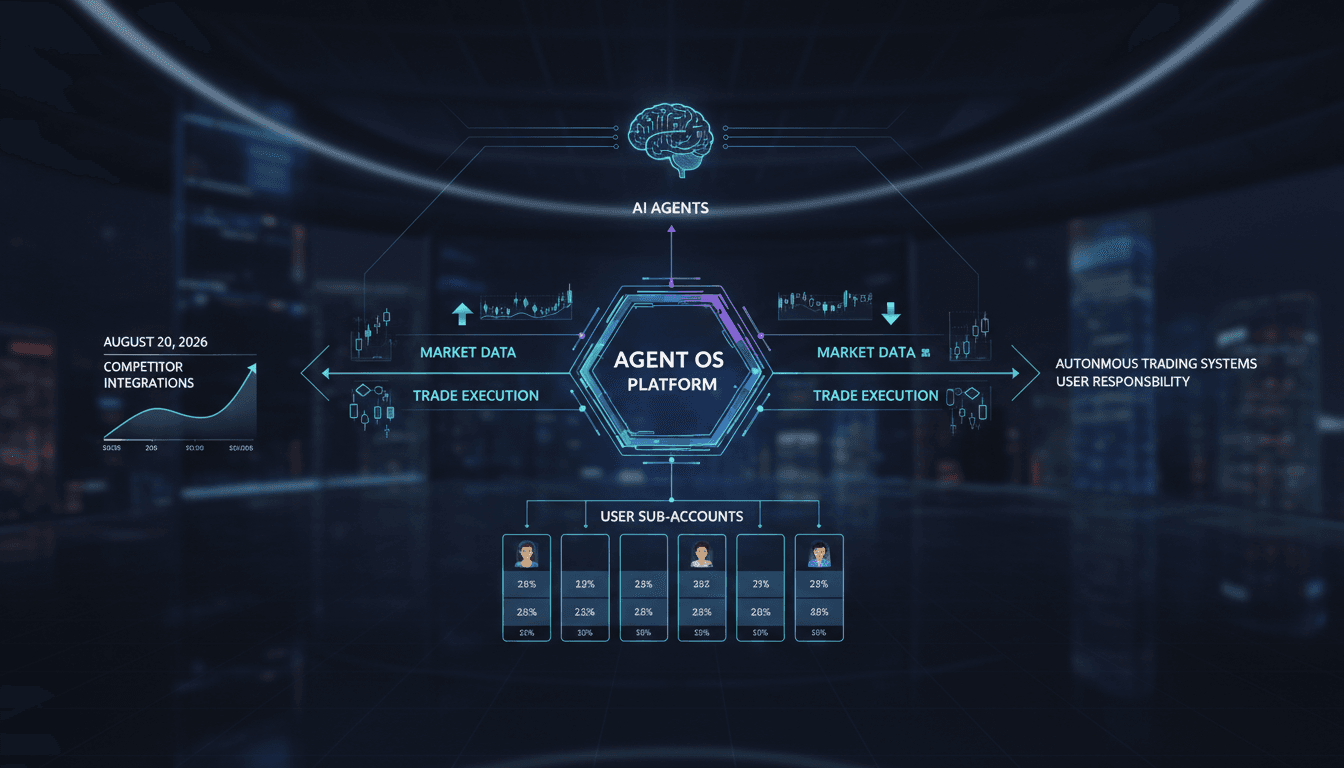
On August 20, 2026, Binance unveiled Agent OS, a comprehensive developer platform that allows AI agents to access market data and execute trades across various products, including spot and futures. This system is built around user-configured Agentic sub-accounts, which are designed to enhance security by restricting external withdrawal permissions. This means that while AI agents can trade on behalf of users, they cannot withdraw funds from these accounts, effectively containing potential theft and fraud risks.
The Agent OS integrates several components, including APIs, a Wallet Agentic Hub, a payment layer, and a skills marketplace, all operating under a Model Context Protocol server endpoint. Users can fund their Agentic sub-accounts manually and configure permissions to control what the AI agents can do. This includes setting emergency stops and the ability to revoke access at any time, which is crucial for maintaining control over trading activities.
However, the responsibility for any trading losses remains firmly with the users. Binance has made it clear that users are liable for losses resulting from the actions of AI agents, including those caused by errors or "hallucinations"—a term used to describe when AI generates incorrect or misleading information. This lack of a dedicated liability framework raises questions about the risks users are taking on when they allow AI to trade on their behalf.
The launch of Agent OS is part of a broader trend in the cryptocurrency industry, where several competitors, including Coinbase and Gemini, have also introduced AI trading tools in recent weeks. This competitive landscape is driven by the increasing demand for automated trading solutions in a market characterized by rapid price fluctuations and high volatility. As more platforms adopt similar technologies, the landscape of cryptocurrency trading is likely to evolve, with AI agents playing a central role in how trades are executed and managed.
Who feels it first (and how)
- Retail traders: Individuals trading small amounts may find AI agents helpful for executing trades more efficiently.
- Institutional investors: Larger players could leverage AI for complex trading strategies, but they must also manage increased risks.
- Developers: Those creating AI trading algorithms will need to adapt to new compliance and risk management frameworks.
- Regulators: Authorities may need to respond to the implications of AI trading on market stability and user protection.
What to watch next
- User adoption rates: Monitoring how quickly users embrace AI trading will indicate the technology's acceptance and effectiveness.
- Regulatory responses: Watch for any regulatory frameworks that may emerge as authorities assess the risks associated with AI trading.
- Market performance: Tracking the performance of trades executed by AI agents will provide insights into their impact on market dynamics.
Users are responsible for losses incurred by AI agents.
Increased competition among trading platforms will lead to further innovations in AI trading tools.
The long-term regulatory landscape surrounding AI trading in cryptocurrencies remains uncertain.
Frequently Asked Questions
- Why it matters?
- The integration of AI agents into trading platforms marks a pivotal shift in how users interact with cryptocurrency markets, emphasizing user responsibility and risk management.
- What happened (in 30 seconds)?
- Binance launched Agent OS on August 20, 2026, allowing AI agents like ChatGPT and Claude to trade directly on the platform. Users manage risk through isolated sub-accounts that prevent external withdrawals, shifting liability for trading losses to them. Competitors are following suit, with five other platforms introducing similar AI trading capabilities in the month prior.
- What's really happening?
- On August 20, 2026, Binance unveiled Agent OS, a comprehensive developer platform that allows AI agents to access market data and execute trades across various products, including spot and futures. This system is built around user-configured Agentic sub-accounts, which are designed to enhance security by restricting external withdrawal permissions. This means that while AI agents can trade on behalf of users, they cannot withdraw funds from these accounts, effectively containing potential theft
- Who feels it first (and how)?
- Retail traders: Individuals trading small amounts may find AI agents helpful for executing trades more efficiently. Institutional investors: Larger players could leverage AI for complex trading strategies, but they must also manage increased risks. Developers: Those creating AI trading algorithms will need to adapt to new compliance and risk management frameworks. Regulators: Authorities may need to respond to the implications of AI trading on market stability and user protection.
- What to watch next?
- User adoption rates: Monitoring how quickly users embrace AI trading will indicate the technology's acceptance and effectiveness. Regulatory responses: Watch for any regulatory frameworks that may emerge as authorities assess the risks associated with AI trading. Market performance: Tracking the performance of trades executed by AI agents will provide insights into their impact on market dynamics.
Real-time updates, analysis, and reports on the blockchain and cryptocurrency sectors.
"Crypto News delivers real-time updates, analysis, and reports on the blockchain and cryptocurrency sectors."
— A47 Editor
Binance just gave AI bots a trading license. The safeguards are thinner than they look.
Binance has launched its Agent OS, allowing AI bots like ChatGPT and Claude to execute trades across various cryptocurrency markets, including spot, margin, and futures, through a unified protocol. This development comes as five competitors have intr...
Covers blockchain, cryptocurrency news, project analysis, and market insights.
"Cointelegraph is a leading crypto-focused media outlet known for timely news, analysis, and educational content related to blockchain and digital assets."
— A47 Editor
Binance opens crypto trading to AI agents with user-set controls
Binance has launched its Agent OS, enabling AI agents to access market data, execute trades, and make payments while allowing users to set controls over permissions and account access. This innovative move marks a significant step in integrating arti...
Startup news with frequent AI coverage.
"Covers launches, funding, and product updates in AI."
— A47 Editor
Binance now lets AI agents trade, but keeping them in check is largely up to users
Binance has introduced its Agent OS, enabling AI agents to trade using tools such as ChatGPT, Claude Code, and Cursor. This development allows users to leverage advanced AI capabilities for trading, but it also places the responsibility of managing t...