
Blockstream Proposes SHRINCS for Post-Quantum Bitcoin Signatures
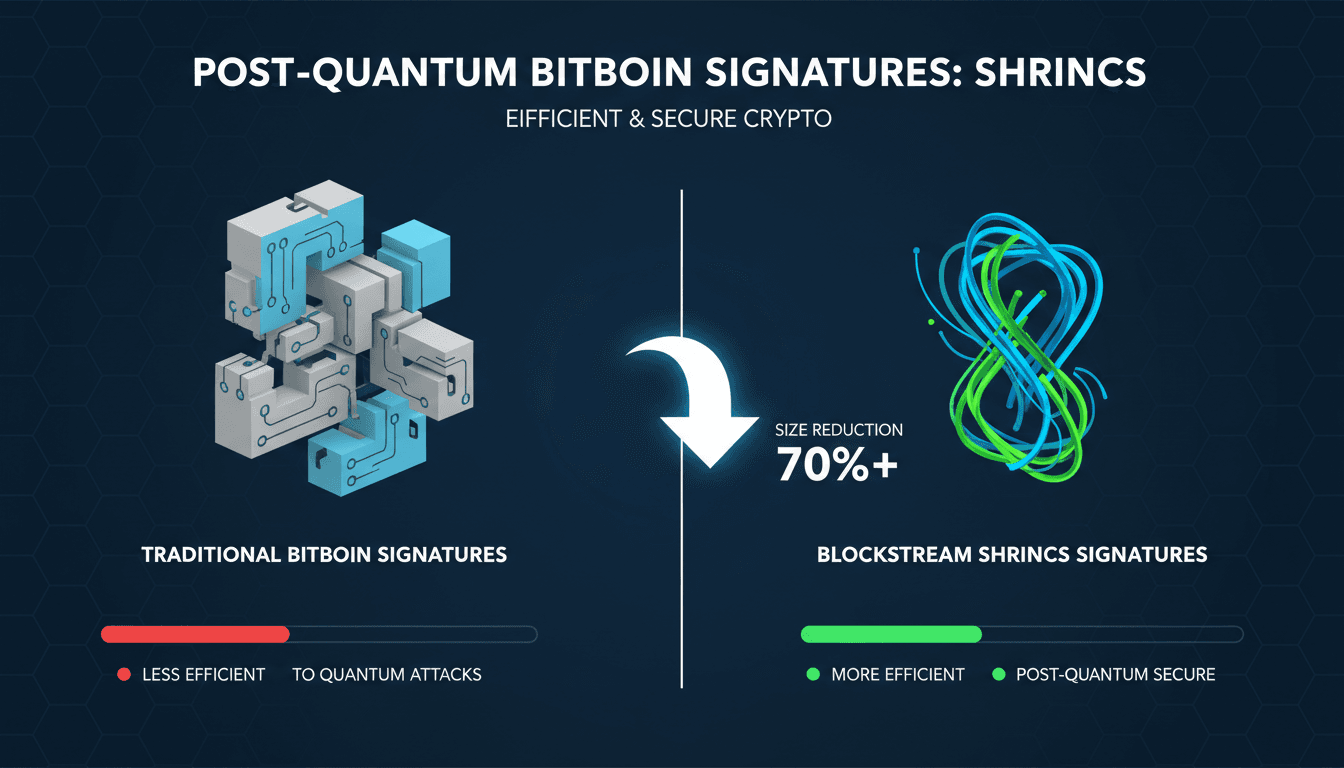
Here's what it means for you.
If you're involved in cryptocurrency, understanding SHRINCS could be crucial for future-proofing your digital assets against quantum threats.
Why it matters
The SHRINCS proposal represents a significant step in preparing Bitcoin for potential quantum computing vulnerabilities, impacting the security landscape of digital currencies.
What happened (in 30 seconds)
- On August 27, 2026, Blockstream researchers published a draft Bitcoin Improvement Proposal (BIP) for SHRINCS, a hybrid post-quantum signature scheme.
- SHRINCS combines a compact stateful signing path with a stateless fallback, enabling smaller signatures than existing NIST alternatives.
- The proposal addresses long-term quantum risks to Bitcoin's elliptic-curve signatures without requiring immediate protocol changes.
The context you actually need
- Elliptic-curve signatures used in Bitcoin are vulnerable to quantum attacks, particularly Shor's algorithm, which could expose private keys.
- SHRINCS builds on previous research from Blockstream, introducing a hybrid approach that maintains Bitcoin's existing security model.
- The draft BIP is currently at the research stage, requiring further review and a soft fork for integration into the Bitcoin mainnet.
What's really happening
The SHRINCS proposal is a response to the looming threat of quantum computing, which poses a risk to traditional cryptographic systems, including those used in Bitcoin. Current elliptic-curve signatures, such as ECDSA and Schnorr, are susceptible to quantum algorithms that could easily derive private keys from public keys. This vulnerability necessitates a proactive approach to cryptography in the cryptocurrency space.
Blockstream's SHRINCS aims to mitigate these risks by introducing a hybrid signature scheme that combines stateful and stateless components. The stateful signatures, which start at a minimum size of 324 bytes, are significantly smaller than the fixed 5,777-byte stateless option. This compactness is crucial for maintaining efficiency in transaction processing while enhancing security.
The proposal leverages SHA-256, a hashing algorithm already integral to Bitcoin's architecture, ensuring compatibility with existing systems. By relying on hash-based assumptions, SHRINCS avoids the complexities and potential pitfalls associated with transitioning to entirely new cryptographic frameworks. This conservative approach is designed to facilitate a smoother migration to post-quantum security without disrupting the current Bitcoin ecosystem.
However, the SHRINCS proposal is still in its infancy, with an incomplete security proof and the need for extensive testing and community consensus before it can be implemented on the Bitcoin mainnet. The proposal has been tested on the Liquid sidechain, which serves as a proving ground for innovations before they are adopted on the main Bitcoin network.
The industry response has been cautiously optimistic, recognizing the efficiency gains SHRINCS offers over NIST standards while also acknowledging the inherent risks of implementation. As the proposal is still a draft, there have been no significant market reactions or governmental responses, but the stability of Bitcoin's price around $78,700 suggests that the market is currently unfazed by this development.
Who feels it first (and how)
- Cryptocurrency developers: They will need to adapt their applications to incorporate SHRINCS if adopted.
- Investors in Bitcoin: They may experience changes in security perceptions and investment strategies based on the proposal's implications.
- Regulatory bodies: They will need to consider the evolving landscape of cryptocurrency security as quantum threats become more pronounced.
What to watch next
- Community consensus: Monitor discussions within the Bitcoin community regarding the adoption of SHRINCS and its implications for security.
- Testing outcomes: Keep an eye on the results from ongoing tests on the Liquid sidechain, which will inform the proposal's viability.
- Market reactions: Watch for any shifts in Bitcoin's price or trading volume that may indicate investor sentiment towards quantum security measures.
SHRINCS is a draft proposal aimed at enhancing Bitcoin's security against quantum threats.
The proposal will undergo extensive review and testing before any potential implementation.
The timeline for integration into the Bitcoin mainnet remains uncertain, as does the broader market's response to quantum security measures.
Frequently Asked Questions
- Why it matters?
- The SHRINCS proposal represents a significant step in preparing Bitcoin for potential quantum computing vulnerabilities, impacting the security landscape of digital currencies.
- What happened (in 30 seconds)?
- On August 27, 2026, Blockstream researchers published a draft Bitcoin Improvement Proposal (BIP) for SHRINCS, a hybrid post-quantum signature scheme. SHRINCS combines a compact stateful signing path with a stateless fallback, enabling smaller signatures than existing NIST alternatives. The proposal addresses long-term quantum risks to Bitcoin's elliptic-curve signatures without requiring immediate protocol changes.
- What's really happening?
- The SHRINCS proposal is a response to the looming threat of quantum computing, which poses a risk to traditional cryptographic systems, including those used in Bitcoin. Current elliptic-curve signatures, such as ECDSA and Schnorr, are susceptible to quantum algorithms that could easily derive private keys from public keys. This vulnerability necessitates a proactive approach to cryptography in the cryptocurrency space. Blockstream's SHRINCS aims to mitigate these risks by introducing a hybrid s
- Who feels it first (and how)?
- Cryptocurrency developers: They will need to adapt their applications to incorporate SHRINCS if adopted. Investors in Bitcoin: They may experience changes in security perceptions and investment strategies based on the proposal's implications. Regulatory bodies: They will need to consider the evolving landscape of cryptocurrency security as quantum threats become more pronounced.
- What to watch next?
- Community consensus: Monitor discussions within the Bitcoin community regarding the adoption of SHRINCS and its implications for security. Testing outcomes: Keep an eye on the results from ongoing tests on the Liquid sidechain, which will inform the proposal's viability. Market reactions: Watch for any shifts in Bitcoin's price or trading volume that may indicate investor sentiment towards quantum security measures.
Beginner-friendly crypto tutorials, guides, and news.
"99Bitcoins is a crypto education and news site known for easy-to-understand content and comprehensive guides."
— A47 Editor
SHRINCS Draft Targets Smaller Post-Quantum BTC Signatures: Is Bitcoin Now Quantum Proof?
The SHRINCS draft has been introduced to propose two hash-based signing paths for Bitcoin, aiming to reduce signature size while addressing potential quantum computing threats. This initiative is part of ongoing efforts to enhance Bitcoin's security ...
Covers blockchain, cryptocurrency news, project analysis, and market insights.
"CoinDesk is a well-established cryptocurrency and blockchain news provider, offering comprehensive insights, market data, and industry research."
— A47 Editor
Bitcoin researchers propose quantum fix that would not crowd out transactions
Researchers have proposed the SHRINCS signature scheme for Bitcoin, which aims to enhance transaction approvals with quantum-resistant technology while maintaining network capacity. This development is crucial as it addresses potential vulnerabilitie...
Covers blockchain, cryptocurrency news, project analysis, and market insights.
"Cointelegraph is a leading crypto-focused media outlet known for timely news, analysis, and educational content related to blockchain and digital assets."
— A47 Editor
SHRINCS BIP published: Quantum-secure Bitcoin comes with a catch
A new Bitcoin Improvement Proposal (BIP) has been published to implement the SHRINCS signature scheme, aimed at upgrading Bitcoin to be quantum secure. This development is crucial as it addresses the potential vulnerabilities of Bitcoin against futur...