
Blockstream Researchers Release Draft BIP for Post-Quantum Bitcoin Signatures
Here's what it means for you.
If you're involved in cryptocurrency, understanding the implications of post-quantum cryptography is crucial for future-proofing your investments and transactions.
Why it matters
The introduction of SHRINCS could redefine Bitcoin's security landscape, particularly in the face of emerging quantum computing threats.
What happened (in 30 seconds)
- On August 26-27, 2026, Blockstream researchers released a draft Bitcoin Improvement Proposal (BIP) for SHRINCS, a new post-quantum signature scheme.
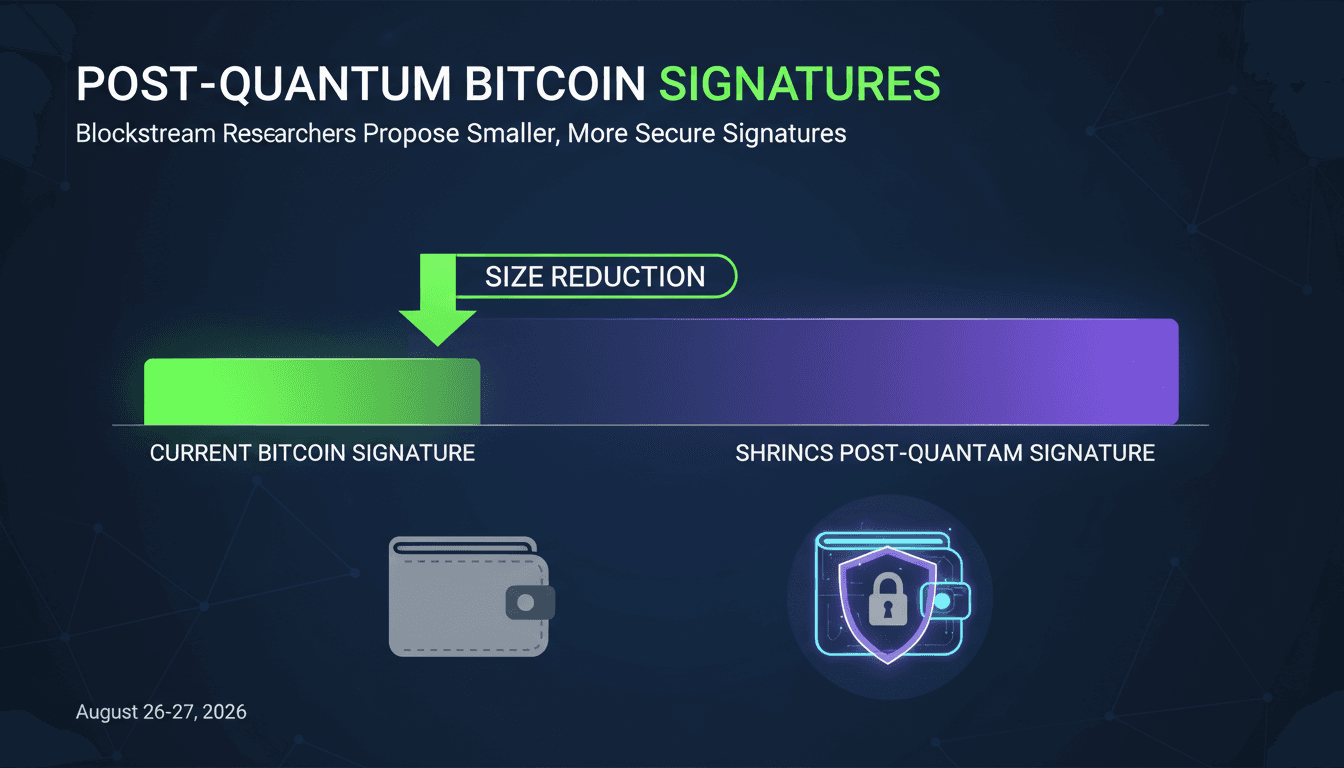
- SHRINCS aims to reduce signature sizes for Bitcoin transactions, making them more efficient while addressing vulnerabilities posed by quantum computing.
- The proposal is still in draft form, lacking complete security proofs and not yet implemented on the Bitcoin mainnet.
The context you actually need
- Current Bitcoin signatures rely on elliptic curve cryptography, which is susceptible to quantum attacks that could compromise private keys.
- Transitioning to post-quantum solutions like SHRINCS requires extensive consensus changes and updates across the Bitcoin ecosystem, which can take years.
- Previous attempts at post-quantum signatures produced large signatures that are incompatible with Bitcoin's block space, necessitating a more compact solution like SHRINCS.
What's really happening
The SHRINCS proposal represents a significant step in the ongoing evolution of Bitcoin's cryptographic framework. As quantum computing technology advances, the vulnerabilities of current elliptic curve signatures (ECDSA/Schnorr) become increasingly concerning. Shor's algorithm, a quantum algorithm, can efficiently derive private keys from public keys, posing a direct threat to Bitcoin's security.
Blockstream Research initiated the SHRINCS project in late 2025, focusing on hash-based alternatives that leverage SHA-256, the hashing algorithm already integral to Bitcoin. The draft BIP published in August 2026 outlines a hybrid stateful/stateless signature scheme that aims to balance security and efficiency. The stateful component, FXMSS, offers compact signatures starting at approximately 324 bytes, which is over seven times smaller than the previously proposed ML-DSA-44 and 24 times smaller than SLH-DSA. This compactness is crucial for maintaining Bitcoin's block space efficiency, which is a significant concern for miners and users alike.
The draft emphasizes conservative assumptions and static seed backups compatible with BIP-39, ensuring that users can securely manage their keys. However, the proposal is still in its infancy, with incomplete formal security proofs and no immediate plans for deployment on the Bitcoin mainnet. The Bitcoin community is currently engaged in discussions about the draft's prototype status and the necessity for additional BIPs to facilitate consensus integration.
While the immediate market reaction to the announcement was muted, with Bitcoin's price remaining relatively stable, the long-term implications of SHRINCS could be profound. As the cryptocurrency landscape evolves, the need for robust, future-proof security measures will only grow. The development of SHRINCS is a proactive step towards ensuring that Bitcoin remains resilient against the threats posed by quantum computing.
Who feels it first (and how)
- Cryptocurrency developers: They will need to adapt their applications and wallets to accommodate new signature schemes.
- Miners: Changes in transaction authorization methods could impact block validation processes and fees.
- Investors: Those holding Bitcoin must stay informed about security developments to protect their assets.
- Regulatory bodies: As quantum threats become more pronounced, regulators may need to establish guidelines for cryptocurrency security.
What to watch next
- Security proofs completion: The timeline for finalizing security proofs for SHRINCS will be critical in determining its viability for Bitcoin.
- Community consensus: Watch for discussions and proposals regarding the integration of SHRINCS into the Bitcoin protocol, as community support will be essential.
- Market reactions: Monitor Bitcoin's price movements and trading volume in response to developments in post-quantum cryptography.
The SHRINCS draft aims to address vulnerabilities in Bitcoin's current signature scheme.
The transition to post-quantum cryptography will require extensive community engagement and consensus-building.
The timeline for implementing SHRINCS on the Bitcoin mainnet remains uncertain.
Frequently Asked Questions
- Why it matters?
- The introduction of SHRINCS could redefine Bitcoin's security landscape, particularly in the face of emerging quantum computing threats.
- What happened (in 30 seconds)?
- On August 26-27, 2026, Blockstream researchers released a draft Bitcoin Improvement Proposal (BIP) for SHRINCS, a new post-quantum signature scheme. SHRINCS aims to reduce signature sizes for Bitcoin transactions, making them more efficient while addressing vulnerabilities posed by quantum computing. The proposal is still in draft form, lacking complete security proofs and not yet implemented on the Bitcoin mainnet.
- What's really happening?
- The SHRINCS proposal represents a significant step in the ongoing evolution of Bitcoin's cryptographic framework. As quantum computing technology advances, the vulnerabilities of current elliptic curve signatures (ECDSA/Schnorr) become increasingly concerning. Shor's algorithm, a quantum algorithm, can efficiently derive private keys from public keys, posing a direct threat to Bitcoin's security. Blockstream Research initiated the SHRINCS project in late 2025, focusing on hash-based alternative
- Who feels it first (and how)?
- Cryptocurrency developers: They will need to adapt their applications and wallets to accommodate new signature schemes. Miners: Changes in transaction authorization methods could impact block validation processes and fees. Investors: Those holding Bitcoin must stay informed about security developments to protect their assets. Regulatory bodies: As quantum threats become more pronounced, regulators may need to establish guidelines for cryptocurrency security.
- What to watch next?
- Security proofs completion: The timeline for finalizing security proofs for SHRINCS will be critical in determining its viability for Bitcoin. Community consensus: Watch for discussions and proposals regarding the integration of SHRINCS into the Bitcoin protocol, as community support will be essential. Market reactions: Monitor Bitcoin's price movements and trading volume in response to developments in post-quantum cryptography.
Beginner-friendly crypto tutorials, guides, and news.
"99Bitcoins is a crypto education and news site known for easy-to-understand content and comprehensive guides."
— A47 Editor
SHRINCS Draft Targets Smaller Post-Quantum BTC Signatures: Is Bitcoin Now Quantum Proof?
The SHRINCS draft has been introduced to propose two hash-based signing paths for Bitcoin, aiming to reduce signature size while addressing potential quantum computing threats. This initiative is part of ongoing efforts to enhance Bitcoin's security ...
Covers blockchain, cryptocurrency news, project analysis, and market insights.
"CoinDesk is a well-established cryptocurrency and blockchain news provider, offering comprehensive insights, market data, and industry research."
— A47 Editor
Bitcoin researchers propose quantum fix that would not crowd out transactions
Researchers have proposed the SHRINCS signature scheme for Bitcoin, which aims to enhance transaction approvals with quantum-resistant technology while maintaining network capacity. This development is crucial as it addresses potential vulnerabilitie...
Covers blockchain, cryptocurrency news, project analysis, and market insights.
"Cointelegraph is a leading crypto-focused media outlet known for timely news, analysis, and educational content related to blockchain and digital assets."
— A47 Editor
SHRINCS BIP published: Quantum-secure Bitcoin comes with a catch
A new Bitcoin Improvement Proposal (BIP) has been published to implement the SHRINCS signature scheme, aimed at upgrading Bitcoin to be quantum secure. This development is crucial as it addresses the potential vulnerabilities of Bitcoin against futur...