
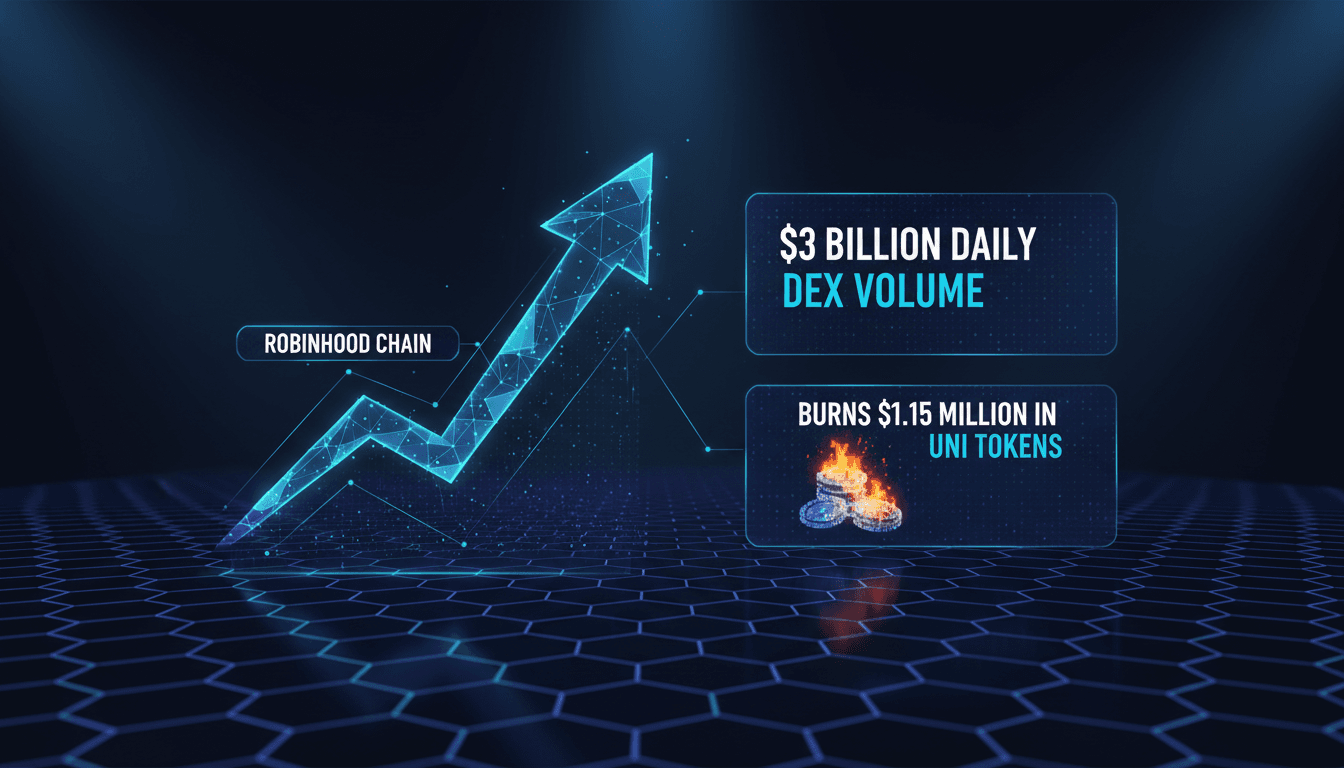
Robinhood Chain Reaches $3 Billion Daily DEX Volume and Burns $1.15 Million in UNI Tokens
Why it matters
This milestone reflects a significant shift in decentralized finance (DeFi) trading dynamics, indicating growing user engagement and market confidence.
What happened (in 30 seconds)
- Record volume: On September 4, 2026, Robinhood Chain achieved over $3 billion in daily DEX volume for the first time.
- UNI burn: This activity led to the burning of 184,000 UNI tokens, valued at approximately $1.15 million, marking a historic daily burn.
- Network congestion: A brief 14-minute interruption in blob submissions occurred due to Ethereum congestion but did not affect trading operations.
The context you actually need
- Launch and growth: Robinhood Chain, launched on July 1, 2026, quickly amassed $34.6 billion in cumulative DEX volume, primarily through tokenized stocks and memecoins.
- Uniswap's role: Uniswap's fee switch mechanism, implemented in December 2025, redirected a portion of fees to buy and burn UNI tokens, incentivizing trading on the platform.
- Market dynamics: The surge in trading volume indicates a shift in user preferences towards decentralized platforms, potentially reshaping the competitive landscape of crypto trading.
What's really happening
The record daily volume on Robinhood Chain is a culmination of several interrelated factors that highlight the evolving landscape of decentralized finance. Launched as an Arbitrum Nitro-based Ethereum Layer-2 solution, Robinhood Chain has positioned itself as a hub for trading tokenized equities and memecoins. This focus has attracted a diverse user base, leading to a rapid accumulation of trading volume.
On September 4, 2026, the chain surpassed $3 billion in daily DEX volume, a significant leap from $875 million just a week prior. This surge was largely driven by Uniswap, which captured up to 98% of the trading activity on the chain. The trading frenzy resulted in the burning of 184,000 UNI tokens, valued at approximately $1.15 million, marking the first time a daily burn exceeded $1 million. This burn is significant as it reflects the economic incentives built into the Uniswap protocol, where a portion of trading fees is used to buy and burn UNI tokens, thereby reducing supply and potentially increasing value for holders.
The brief 14-minute interruption in blob submissions due to Ethereum congestion highlights the challenges that come with rapid growth. However, the fact that trading operations continued without disruption indicates the resilience of the Robinhood Chain infrastructure. Post-event, trading volume normalized, but the structural reliance on Robinhood Chain for Uniswap's revenue became evident, suggesting that as more users migrate to decentralized platforms, the dynamics of fee generation and token economics will evolve.
This event underscores a broader trend in the DeFi space, where users are increasingly gravitating towards decentralized exchanges for their trading needs. The implications of this shift are profound, as it not only affects liquidity and transaction costs but also challenges traditional centralized exchanges. As more traders engage with DEXs, the competitive landscape will likely continue to shift, prompting centralized platforms to adapt or risk losing market share.
Who feels it first (and how)
- Traders: Increased trading volume may lead to lower transaction costs and improved liquidity for users engaging with tokenized assets.
- Investors: Those holding UNI tokens may see potential value appreciation due to the reduced supply from the burn mechanism.
- Developers: Increased activity on Robinhood Chain could attract more developers to build on the platform, enhancing its ecosystem.
- Market analysts: Analysts will closely monitor the implications of this volume surge on broader market trends and investor behavior.
What to watch next
- Volume trends: Monitor daily DEX volume on Robinhood Chain to assess whether this surge is sustainable or a temporary spike.
- UNI price movements: Watch for fluctuations in UNI token prices as the market reacts to the burn and trading activity, which could influence investor sentiment.
- Regulatory responses: Keep an eye on any regulatory developments that may arise as decentralized trading platforms gain traction, potentially impacting operational frameworks.
The Robinhood Chain achieved a record $3 billion in daily DEX volume on September 4, 2026.
Continued growth in decentralized trading platforms will challenge centralized exchanges and reshape market dynamics.
The long-term effects of this volume surge on UNI token value and the broader DeFi ecosystem remain to be seen.
Frequently Asked Questions
- Why it matters?
- This milestone reflects a significant shift in decentralized finance (DeFi) trading dynamics, indicating growing user engagement and market confidence.
- What happened (in 30 seconds)?
- Record volume: On September 4, 2026, Robinhood Chain achieved over $3 billion in daily DEX volume for the first time. UNI burn: This activity led to the burning of 184,000 UNI tokens, valued at approximately $1.15 million, marking a historic daily burn. Network congestion: A brief 14-minute interruption in blob submissions occurred due to Ethereum congestion but did not affect trading operations.
- What's really happening?
- The record daily volume on Robinhood Chain is a culmination of several interrelated factors that highlight the evolving landscape of decentralized finance. Launched as an Arbitrum Nitro-based Ethereum Layer-2 solution, Robinhood Chain has positioned itself as a hub for trading tokenized equities and memecoins. This focus has attracted a diverse user base, leading to a rapid accumulation of trading volume. On September 4, 2026, the chain surpassed $3 billion in daily DEX volume, a significant l
- Who feels it first (and how)?
- Traders: Increased trading volume may lead to lower transaction costs and improved liquidity for users engaging with tokenized assets. Investors: Those holding UNI tokens may see potential value appreciation due to the reduced supply from the burn mechanism. Developers: Increased activity on Robinhood Chain could attract more developers to build on the platform, enhancing its ecosystem. Market analysts: Analysts will closely monitor the implications of this volume surge on broader market t
- What to watch next?
- Volume trends: Monitor daily DEX volume on Robinhood Chain to assess whether this surge is sustainable or a temporary spike. UNI price movements: Watch for fluctuations in UNI token prices as the market reacts to the burn and trading activity, which could influence investor sentiment. Regulatory responses: Keep an eye on any regulatory developments that may arise as decentralized trading platforms gain traction, potentially impacting operational frameworks.
Covers Bitcoin plus altcoin news, market updates, and educational resources.
"Bitcoin.com provides news, market data, and guides focused on Bitcoin and the wider crypto industry."
— A47 Editor
Robinhood Chain Tops $3B Daily DEX Volume, Pushes UNI Burn Past $1M
Robinhood Chain has achieved a remarkable milestone by surpassing $3 billion in daily decentralized exchange (DEX) volume, which has also contributed to pushing the Uniswap (UNI) token burn past $1 million. This surge reflects the platform's growing ...
Real-time updates, analysis, and reports on the blockchain and cryptocurrency sectors.
"Crypto News delivers real-time updates, analysis, and reports on the blockchain and cryptocurrency sectors."
— A47 Editor
Robinhood Chain daily fees hit record $6 million
Robinhood Chain has achieved a record daily fee of $6.04 million, significantly boosting its seven-day annualized revenue rate to approximately $1.1 billion, driven by increased activity in memecoin trading and token launches. This surge in fees refl...
Real-time updates, analysis, and reports on the blockchain and cryptocurrency sectors.
"Crypto News delivers real-time updates, analysis, and reports on the blockchain and cryptocurrency sectors."
— A47 Editor
Robinhood Chain is two months old and already challenging Solana
Robinhood Chain, a newly launched Layer 2 blockchain, has rapidly gained traction in the cryptocurrency market, achieving $791 million in total value locked (TVL) within just two months of its launch. The platform has surpassed Base in daily active u...