
Solana Activates Transaction V1 Protocol Upgrade Expanding Transaction Size
Why it matters
The upgrade positions Solana to better compete with Ethereum by expanding transaction capabilities, which could attract more developers and users.
What happened (in 30 seconds)
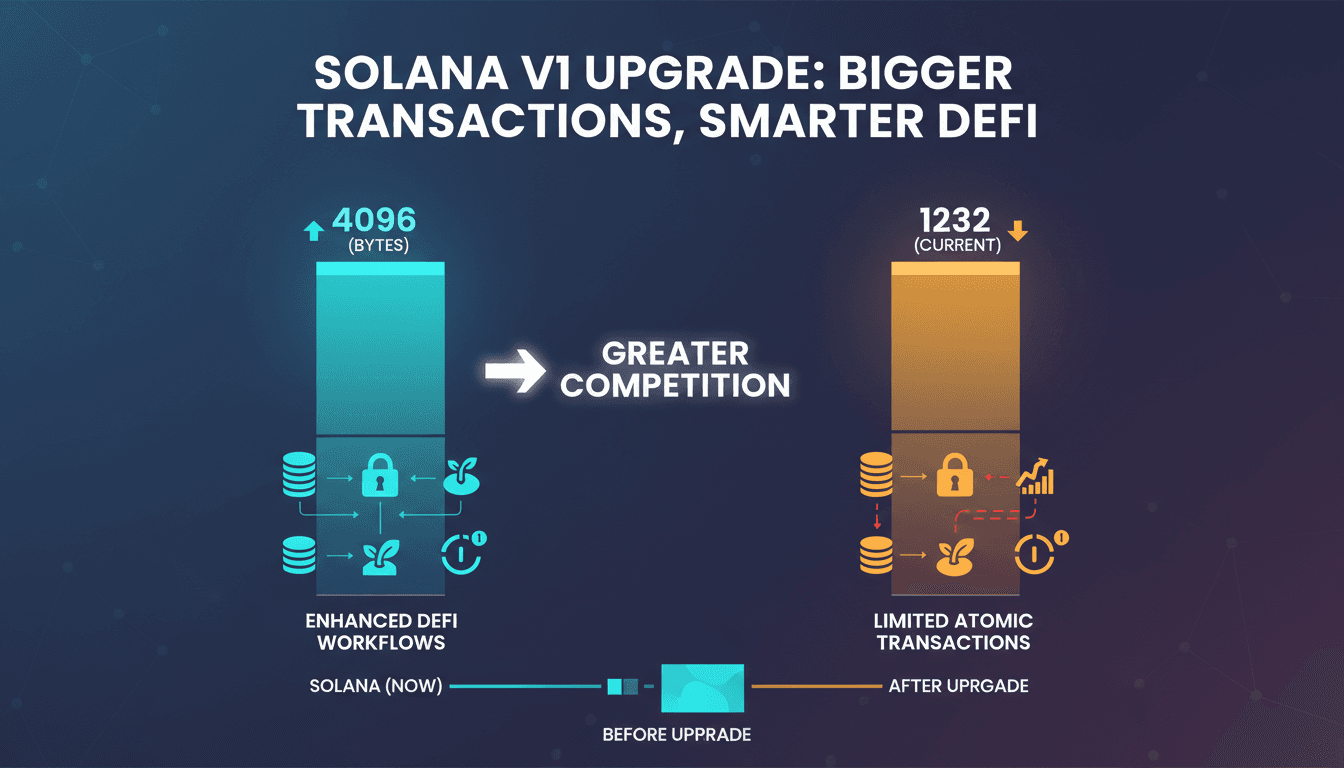
- Solana activated the Transaction V1 network upgrade on September 15, 2026, increasing the maximum transaction size from 1,232 bytes to 4,096 bytes.
- The upgrade supports larger atomic transactions for zero-knowledge proofs, multisignature operations, and complex DeFi workflows while maintaining compatibility with older formats.
- Infrastructure updates are ongoing, with no reported network outages, but providers must upgrade to handle the new transaction format.
The context you actually need
- Original constraints: Solana's previous transaction limit was based on IPv6 and early UDP packet considerations, which forced developers to split complex operations.
- Recent optimizations: Prior improvements included adopting QUIC for transaction ingestion and increasing block compute unit limits, enhancing overall network performance.
- Competitive landscape: This upgrade narrows the gap with Ethereum, which does not impose strict per-transaction byte limits, potentially attracting more developers to Solana.
What's really happening
The Transaction V1 upgrade represents a significant evolution in Solana's blockchain capabilities. By increasing the maximum transaction size from 1,232 bytes to 4,096 bytes—a 3.3x increase—developers can now execute more complex operations within a single transaction. This change is crucial for applications that rely on zero-knowledge proofs and multisignature wallets, which are becoming increasingly important in decentralized finance (DeFi) and privacy-preserving applications.
The upgrade was meticulously planned, with local testing occurring in August 2026, followed by a testnet activation on September 1, 2026. The mainnet activation on September 15, 2026, coincided with the start of epoch 1035, ensuring a smooth transition for users and developers. The new transaction format introduces a version byte (0x81) and relocates signatures, embedding compute and priority fee configurations in a transactionConfig header. This structural change allows for more efficient processing without sacrificing compatibility with legacy formats.
Infrastructure providers, including wallets and explorers, must update their systems to Agave v4.2.2 or later to handle the new transaction format effectively. This requirement underscores the importance of keeping infrastructure aligned with protocol upgrades to avoid request failures on v1 data. The Solana Foundation and Anza coordinated this upgrade, emphasizing the collaborative effort behind enhancing the network's capabilities.
Despite the upgrade's significance, SOL's price remained stable, trading near $100 with minor fluctuations post-activation. This stability suggests that while the upgrade is a critical step in Solana's scaling efforts, it did not trigger immediate market volatility. The ongoing infrastructure updates and the continued support for legacy formats indicate a well-managed transition, minimizing disruption for users.
Who feels it first (and how)
- Developers: Gain the ability to create more complex applications without splitting transactions, enhancing user experience.
- DeFi platforms: Benefit from improved transaction efficiency, potentially attracting more users and liquidity.
- Multisignature wallet users: Experience smoother operations with larger transaction sizes, increasing security and usability.
- Dubai-based entities: Access more efficient on-chain operations, enhancing their engagement with DeFi and privacy applications.
What to watch next
- Infrastructure updates: Monitor how quickly wallets and other infrastructure adapt to the new transaction format, as delays could impact user experience.
- Developer adoption: Watch for an increase in new projects and applications built on Solana, which could signal growing interest in the platform.
- Market response: Keep an eye on SOL's price movements in relation to the upgrade's impact on network activity and user engagement.
The maximum transaction size has increased to 4,096 bytes.
Increased developer interest in building on Solana due to enhanced capabilities.
The long-term impact on SOL's price and market position relative to Ethereum.
Frequently Asked Questions
- Why it matters?
- The upgrade positions Solana to better compete with Ethereum by expanding transaction capabilities, which could attract more developers and users.
- What happened (in 30 seconds)?
- Solana activated the Transaction V1 network upgrade on September 15, 2026, increasing the maximum transaction size from 1,232 bytes to 4,096 bytes. The upgrade supports larger atomic transactions for zero-knowledge proofs, multisignature operations, and complex DeFi workflows while maintaining compatibility with older formats. Infrastructure updates are ongoing, with no reported network outages, but providers must upgrade to handle the new transaction format.
- What's really happening?
- The Transaction V1 upgrade represents a significant evolution in Solana's blockchain capabilities. By increasing the maximum transaction size from 1,232 bytes to 4,096 bytes—a 3.3x increase—developers can now execute more complex operations within a single transaction. This change is crucial for applications that rely on zero-knowledge proofs and multisignature wallets, which are becoming increasingly important in decentralized finance (DeFi) and privacy-preserving applications. The upgrade was
- Who feels it first (and how)?
- Developers: Gain the ability to create more complex applications without splitting transactions, enhancing user experience. DeFi platforms: Benefit from improved transaction efficiency, potentially attracting more users and liquidity. Multisignature wallet users: Experience smoother operations with larger transaction sizes, increasing security and usability. Dubai-based entities: Access more efficient on-chain operations, enhancing their engagement with DeFi and privacy applications.
- What to watch next?
- Infrastructure updates: Monitor how quickly wallets and other infrastructure adapt to the new transaction format, as delays could impact user experience. Developer adoption: Watch for an increase in new projects and applications built on Solana, which could signal growing interest in the platform. Market response: Keep an eye on SOL's price movements in relation to the upgrade's impact on network activity and user engagement.
Beginner-friendly crypto tutorials, guides, and news.
"99Bitcoins is a crypto education and news site known for easy-to-understand content and comprehensive guides."
— A47 Editor
Solana Network Upgrade Makes it Faster and Cheaper: But Will it Move SOL Price?
Solana has upgraded its network with the launch of Transaction V1, increasing the transaction size limit from 1,232 bytes to 4,096 bytes. This enhancement allows for more complex operations, including larger DeFi applications and multisig transaction...
Covers blockchain, cryptocurrency news, project analysis, and market insights.
"Cointelegraph is a leading crypto-focused media outlet known for timely news, analysis, and educational content related to blockchain and digital assets."
— A47 Editor
Solana more than triples transaction size limit with mainnet upgrade
Solana has successfully upgraded its mainnet, increasing the transaction size limit from 1,232 bytes to 4,096 bytes. This enhancement allows developers to implement more complex operations, including zero-knowledge proofs and transactions with multip...
Covers blockchain, cryptocurrency news, project analysis, and market insights.
"CoinDesk is a well-established cryptocurrency and blockchain news provider, offering comprehensive insights, market data, and industry research."
— A47 Editor
Solana transactions just got more than 3 times bigger, narrowing the gap with Ethereum
Solana has successfully upgraded its transaction capacity with the launch of Transaction V1, increasing the size limit from 1,232 bytes to 4,096 bytes. This enhancement allows developers to execute more complex operations, such as multi-step trades a...