
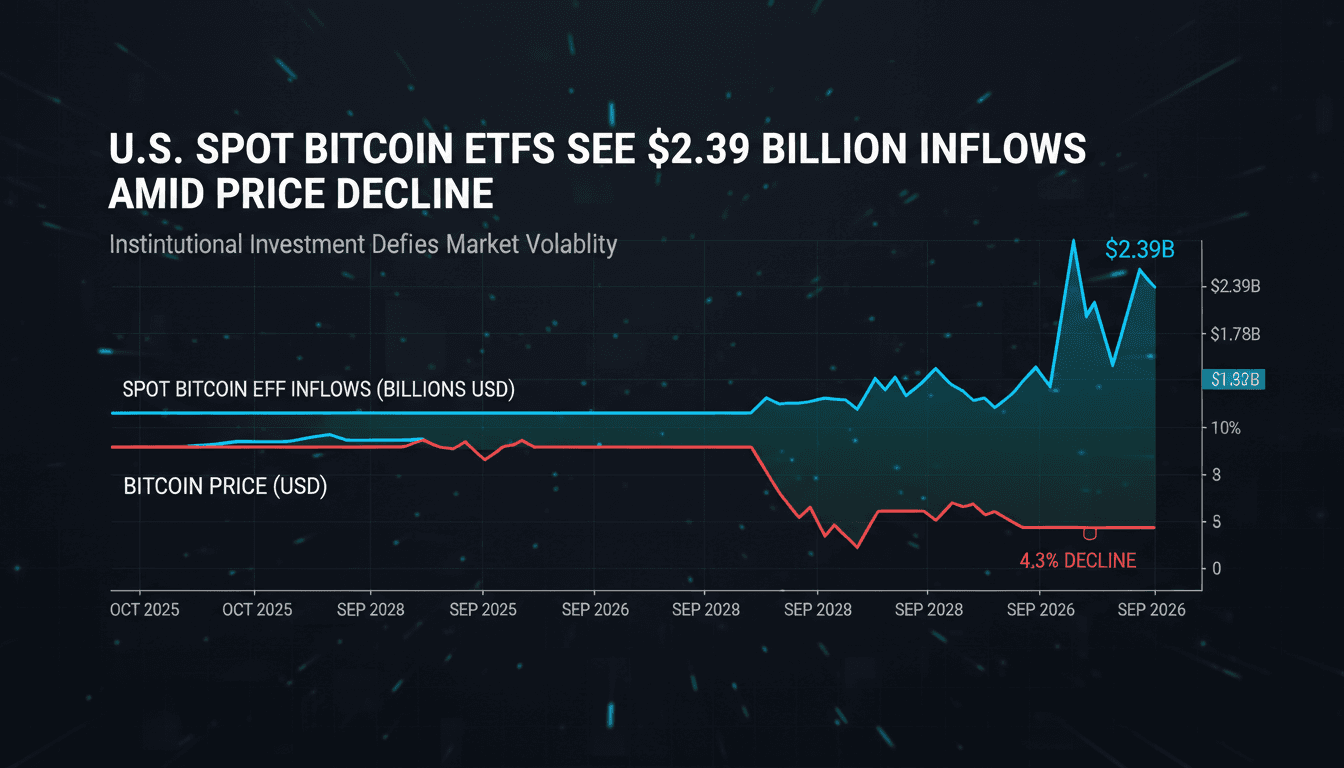
U.S. Spot Bitcoin ETFs See $2.39 Billion Inflows Amid Bitcoin Price Decline
Why it matters
This trend indicates a growing institutional appetite for Bitcoin, even amid macroeconomic pressures, which could influence market dynamics and investment strategies.
What happened (in 30 seconds)
- U.S. spot Bitcoin ETFs attracted $2.39 billion in net inflows for the week ending September 25, 2026, reversing earlier negative trends.
- Bitcoin prices fell 4.3% to $83,500 during the same period, coinciding with a rise in U.S. Treasury yields to 5.20%.
- Institutional investors led the charge, with major funds like BlackRock and Fidelity driving the inflows despite broader market volatility.
The context you actually need
- Earlier in 2026, U.S. Treasury announcements had initially supported risk assets, leading to strong ETF inflows exceeding $2 billion weekly.
- By mid-July, net flows turned negative by $5.8 billion, reflecting broader market dynamics and rising Treasury yields amid inflation concerns.
- Recent SEC guidance on crypto token rules has provided regulatory clarity, although political risks remain a concern for market participants.
What's really happening
The recent inflow of $2.39 billion into U.S. spot Bitcoin ETFs marks a significant rebound in institutional interest, particularly after a challenging summer where net flows had dipped into negative territory. This resurgence is noteworthy given the concurrent decline in Bitcoin prices and the rise in U.S. Treasury yields, which typically exert downward pressure on risk assets.
Institutional investors, including major players like BlackRock, Fidelity, and ARK 21Shares, have shown resilience in their demand for Bitcoin ETFs, indicating a strategic shift in how these entities view digital assets amidst macroeconomic uncertainties. The inflows during the week of September 21–25 were not just a one-off; they reflect a broader trend of institutional confidence that has been building despite the backdrop of rising inflation and fiscal sustainability concerns.
The rise in Treasury yields to 5.20% has raised questions about the sustainability of government debt and the potential for further monetary tightening by the Federal Reserve. However, this has not deterred institutional investors from allocating capital to Bitcoin ETFs. Analysts, including Jesse Marre from Hilbert Group, have pointed out that the demand for Bitcoin remains robust, with key price levels identified for potential breakout scenarios. The $89,000 mark is seen as a critical threshold that could lead Bitcoin toward $95,000, while support is noted at $80,000.
This dynamic suggests that institutional investors are not merely reacting to price movements but are instead making calculated decisions based on long-term views of Bitcoin's value proposition. The cumulative ETF inflows since their launch have reached approximately $57.6 billion, with net assets now totaling $108 billion, underscoring the growing acceptance of Bitcoin as a legitimate asset class.
As the market navigates these complexities, the interplay between rising Treasury yields and Bitcoin ETF inflows will be crucial to watch. The sustained interest from institutional players could signal a shift in market sentiment, potentially leading to increased liquidity and adoption of digital assets in the broader financial ecosystem.
Who feels it first (and how)
- Institutional investors: They are likely to benefit from increased liquidity and potential price appreciation in Bitcoin.
- Retail investors: Those holding Bitcoin or related assets may see volatility but also potential gains if institutional confidence translates into market stability.
- Financial advisors: They may need to adjust strategies based on changing market dynamics and client interests in digital assets.
- Regulatory bodies: Increased ETF activity may prompt further regulatory scrutiny and guidance on digital assets.
What to watch next
- Upcoming U.S. economic data: Key indicators like PCE, GDP, and nonfarm payrolls will influence Treasury yields and Fed policy, impacting market sentiment.
- Bitcoin price movements: Watch for how Bitcoin reacts to macroeconomic pressures and whether it can break through the identified resistance levels.
- Regulatory developments: Continued clarity from the SEC on crypto regulations could further influence institutional participation in the market.
U.S. spot Bitcoin ETFs have attracted significant inflows, reversing earlier negative trends.
Institutional demand for Bitcoin will continue to shape market dynamics, even amid macroeconomic pressures.
The long-term impact of rising Treasury yields on Bitcoin prices and ETF inflows remains uncertain.
Frequently Asked Questions
- Why it matters?
- This trend indicates a growing institutional appetite for Bitcoin, even amid macroeconomic pressures, which could influence market dynamics and investment strategies.
- What happened (in 30 seconds)?
- U.S. spot Bitcoin ETFs attracted $2.39 billion in net inflows for the week ending September 25, 2026, reversing earlier negative trends. Bitcoin prices fell 4.3% to $83,500 during the same period, coinciding with a rise in U.S. Treasury yields to 5.20%. Institutional investors led the charge, with major funds like BlackRock and Fidelity driving the inflows despite broader market volatility.
- What's really happening?
- The recent inflow of $2.39 billion into U.S. spot Bitcoin ETFs marks a significant rebound in institutional interest, particularly after a challenging summer where net flows had dipped into negative territory. This resurgence is noteworthy given the concurrent decline in Bitcoin prices and the rise in U.S. Treasury yields, which typically exert downward pressure on risk assets. Institutional investors, including major players like BlackRock, Fidelity, and ARK 21Shares, have shown resilience in
- Who feels it first (and how)?
- Institutional investors: They are likely to benefit from increased liquidity and potential price appreciation in Bitcoin. Retail investors: Those holding Bitcoin or related assets may see volatility but also potential gains if institutional confidence translates into market stability. Financial advisors: They may need to adjust strategies based on changing market dynamics and client interests in digital assets. Regulatory bodies: Increased ETF activity may prompt further regulatory scrutin
- What to watch next?
- Upcoming U.S. economic data: Key indicators like PCE, GDP, and nonfarm payrolls will influence Treasury yields and Fed policy, impacting market sentiment. Bitcoin price movements: Watch for how Bitcoin reacts to macroeconomic pressures and whether it can break through the identified resistance levels. Regulatory developments: Continued clarity from the SEC on crypto regulations could further influence institutional participation in the market.
Real-time updates, analysis, and reports on the blockchain and cryptocurrency sectors.
"Crypto News delivers real-time updates, analysis, and reports on the blockchain and cryptocurrency sectors."
— A47 Editor
Crypto ETFs draw $2.39 billion as Bitcoin retreats on Treasury yield surge
Crypto exchange-traded funds (ETFs) have seen a significant inflow of $2.39 billion in the week ending September 25, 2026, despite a 4.3% decline in Bitcoin's price as U.S. ten-year Treasury yields rose to 5.20%. This influx has pushed the net flows ...
Covers blockchain, cryptocurrency news, project analysis, and market insights.
"Cointelegraph is a leading crypto-focused media outlet known for timely news, analysis, and educational content related to blockchain and digital assets."
— A47 Editor
US crypto ETF inflows cool after $3.3B week but streaks hold
US spot crypto ETF inflows have significantly decreased, dropping approximately 80% from the previous week, with only $64.8 million attracted on Monday across Bitcoin, Ether, Solana, and XRP funds. This decline follows a remarkable week where Bitcoin...
News and analysis on Bitcoin, altcoins, and blockchain innovation.
"Bitcoinist delivers news and analysis on Bitcoin, altcoins, and blockchain innovation with a focus on market trends and industry updates."
— A47 Editor
Bitcoin ETFs Erase $5.8B 2026 Deficit As Annual Flows Turn Positive
U.S. spot Bitcoin exchange-traded funds (ETFs) have reversed a $5.8 billion deficit from earlier in the year, now reporting approximately $800 million in net inflows for 2026. This positive shift follows a significant influx of $2.84 billion over a r...