
SEC Clarifies Crypto Asset Treatment Under Securities Laws
Why it matters
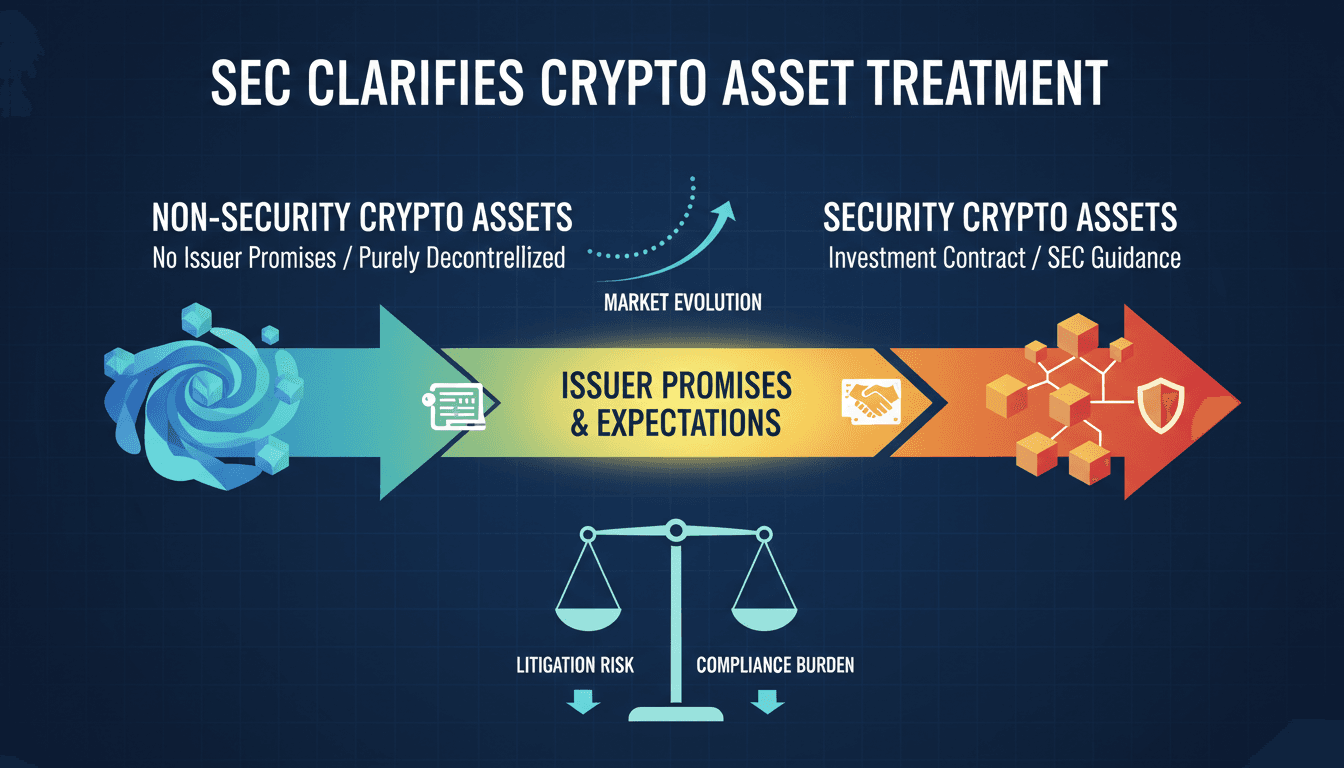
This guidance clarifies the regulatory framework for crypto assets, impacting how issuers communicate promises and manage investor expectations.
What happened (in 30 seconds)
- On March 2026, the SEC staff released interpretive guidance on how federal securities laws apply to certain crypto assets.
- The guidance specifies that issuer promises can trigger investment contract analysis under the Howey test, affecting non-security crypto assets.
- Subsequent FAQs issued in September 2026 provided further clarity on promotional communications and the conditions for separating investment contracts.
The context you actually need
- Prior uncertainty: Before this guidance, the application of the Howey test to crypto assets was inconsistent, leading to confusion over securities classification.
- Industry demand: Crypto issuers sought clearer boundaries to distinguish between non-security assets and those tied to issuer commitments, especially as networks evolved.
- Regulatory evolution: This release builds on earlier frameworks, reflecting a shift towards emphasizing specific issuer representations and their implications.
What's really happening
The SEC's interpretive release marks a significant shift in how crypto assets are treated under U.S. securities laws. At its core, the guidance clarifies that a non-security crypto asset can be classified as an investment contract if an issuer makes representations or promises regarding essential managerial efforts that lead purchasers to expect profits. This means that if an issuer actively promotes their asset by suggesting that their management efforts will enhance its value, they may inadvertently classify it as a security.
The guidance outlines that these promises must be made by or on behalf of the issuer and communicated before or at the time of the asset's sale. This is crucial because it establishes a clear timeline for when an asset transitions from a non-security to a security based on the issuer's actions. Furthermore, the guidance specifies that the investment contract ceases to exist once the issuer fulfills their promised efforts or when purchasers can no longer reasonably expect those efforts to be connected to the asset. This could occur if the issuer fails to deliver on their promises for an extended period or publicly abandons their commitments.
The FAQs released later in 2026 further elaborate on promotional communications, third-party assumptions, and functionality thresholds that issuers must meet. This additional detail is vital for issuers as it provides a framework for how they can communicate about their assets without crossing into securities territory. The clarity offered by this guidance is expected to reduce litigation risks for mature assets, as market participants now have a better understanding of the boundaries between securities and non-securities.
Moreover, the guidance indirectly benefits Dubai-based crypto entities or investors engaging in U.S. markets. By delineating when secondary transactions in non-security assets fall outside securities laws, it potentially reduces compliance burdens for cross-border activities. This is particularly relevant as Dubai continues to position itself as a global crypto hub, attracting international investments and fostering innovation in the crypto space.
Who feels it first (and how)
- Crypto issuers: They must adjust their promotional strategies to avoid inadvertently classifying their assets as securities.
- Investors: Those purchasing crypto assets will benefit from clearer expectations regarding the nature of their investments.
- Legal and compliance teams: They will need to reassess existing frameworks and ensure adherence to the new guidance.
- Market analysts: They will have to refine their assessments of crypto assets based on the updated regulatory landscape.
What to watch next
- Regulatory responses: Watch for any reactions from non-U.S. jurisdictions that may seek to align or differentiate their crypto regulations in light of the SEC's guidance.
- Market adaptations: Observe how crypto issuers modify their promotional strategies and communications to comply with the new standards.
- Litigation trends: Monitor any changes in litigation risk associated with crypto assets, particularly those that have previously faced scrutiny under the Howey test.
The SEC's guidance clarifies the treatment of certain crypto assets under U.S. securities laws.
Crypto issuers will adapt their communications to align with the new regulatory framework.
The long-term impact on global crypto regulations and how other jurisdictions will respond remains uncertain.
Frequently Asked Questions
- Why it matters?
- This guidance clarifies the regulatory framework for crypto assets, impacting how issuers communicate promises and manage investor expectations.
- What happened (in 30 seconds)?
- On March 2026, the SEC staff released interpretive guidance on how federal securities laws apply to certain crypto assets. The guidance specifies that issuer promises can trigger investment contract analysis under the Howey test, affecting non-security crypto assets. Subsequent FAQs issued in September 2026 provided further clarity on promotional communications and the conditions for separating investment contracts.
- What's really happening?
- The SEC's interpretive release marks a significant shift in how crypto assets are treated under U.S. securities laws. At its core, the guidance clarifies that a non-security crypto asset can be classified as an investment contract if an issuer makes representations or promises regarding essential managerial efforts that lead purchasers to expect profits. This means that if an issuer actively promotes their asset by suggesting that their management efforts will enhance its value, they may inadver
- Who feels it first (and how)?
- Crypto issuers: They must adjust their promotional strategies to avoid inadvertently classifying their assets as securities. Investors: Those purchasing crypto assets will benefit from clearer expectations regarding the nature of their investments. Legal and compliance teams: They will need to reassess existing frameworks and ensure adherence to the new guidance. Market analysts: They will have to refine their assessments of crypto assets based on the updated regulatory landscape.
- What to watch next?
- Regulatory responses: Watch for any reactions from non-U.S. jurisdictions that may seek to align or differentiate their crypto regulations in light of the SEC's guidance. Market adaptations: Observe how crypto issuers modify their promotional strategies and communications to comply with the new standards. Litigation trends: Monitor any changes in litigation risk associated with crypto assets, particularly those that have previously faced scrutiny under the Howey test.
Covers Bitcoin plus altcoin news, market updates, and educational resources.
"Bitcoin.com provides news, market data, and guides focused on Bitcoin and the wider crypto industry."
— A47 Editor
SEC Staff Clarifies How Crypto Promises Affect Securities Treatment
The U.S. Securities and Exchange Commission (SEC) has clarified how the promises made by cryptocurrency issuers can influence the classification of their tokens as securities. This clarification is part of ongoing efforts to establish a regulatory fr...
Bitcoin news, technical analysis, and forecasts across crypto markets.
"NewsBTC covers Bitcoin news, technical analysis, and forecasts across crypto markets and major blockchain projects."
— A47 Editor
SEC Clarifies When Crypto Buybacks And Network Upgrades Can Raise Securities Questions
The U.S. Securities and Exchange Commission (SEC) has released new FAQs clarifying how federal securities laws may apply to crypto-asset buybacks, network upgrades, and secondary-market activities. This guidance indicates that buybacks may be conside...
Real-time updates, analysis, and reports on the blockchain and cryptocurrency sectors.
"Crypto News delivers real-time updates, analysis, and reports on the blockchain and cryptocurrency sectors."
— A47 Editor
SEC staff clarifies when staking tokens may avoid securities rules
The U.S. Securities and Exchange Commission (SEC) staff has clarified the conditions under which staking receipt tokens may be classified as digital tools rather than securities, addressing key issues related to wrapped assets, token buybacks, and fu...