
Zano Blockchain Rolls Back to Block 3,833,000 Due to Gateway Address Exploit
Why it matters
This incident highlights vulnerabilities in blockchain technology that can affect market confidence and asset integrity.
What happened (in 30 seconds)
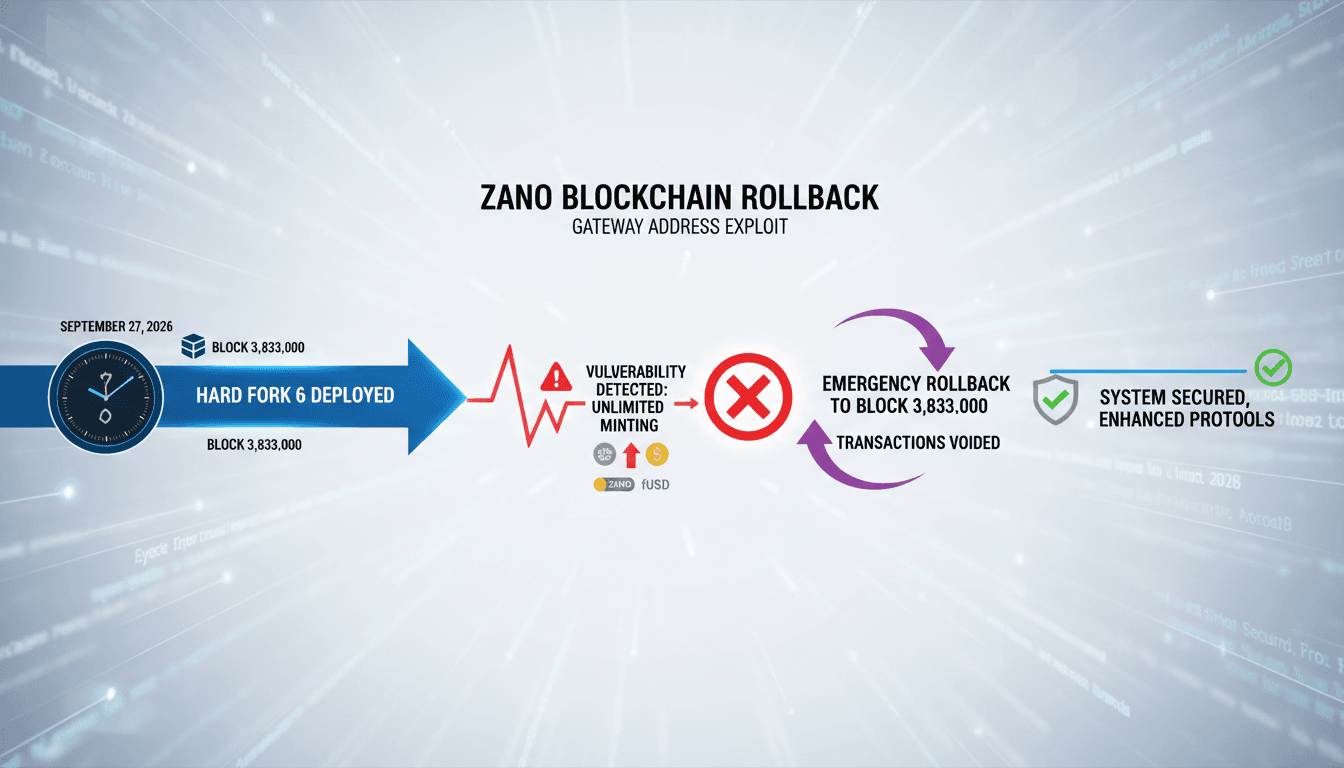
- Zano blockchain executed an emergency rollback to block 3,833,000 on September 27, 2026, due to a Gateway Address exploit.
- Approximately one month of ledger history was invalidated to eliminate unauthorized token issuance of ZANO and Freedom Dollar (fUSD).
- Network participants must upgrade to version 2.2.3.600 to adopt the recovered chain, with exchanges like MEXC pausing related transactions.
The context you actually need
- Hard Fork 6, activated in August 2026, introduced Gateway Addresses, simplifying integrations but also creating a vulnerability for unlimited token minting.
- The Zano core development team identified the exploit shortly before the rollback, determining that continued operation would lead to significant inflation of the token supply.
- No wallet keys were compromised, but the rollback removed both illicit tokens and legitimate transactions from the intervening period, requiring broad consensus for the emergency update.
What's really happening
The Zano blockchain's emergency rollback is a critical response to a significant vulnerability that emerged from its recent Hard Fork 6. This upgrade aimed to enhance usability by introducing Gateway Addresses, which replaced the traditional UTXO model with account-style balances. While this change was intended to streamline operations for exchanges and payment services, it inadvertently opened the door to a serious exploit that allowed for the unauthorized minting of ZANO and fUSD tokens.
Upon discovering the vulnerability, the Zano core development team acted swiftly to mitigate potential damage. They determined that if the network continued to operate under the compromised conditions, it could lead to an uncontrolled inflation of the token supply, undermining the integrity of the ZANO and fUSD assets. The decision to rollback to block 3,833,000 effectively erased approximately 30 days of blockchain history, which included both illicitly minted tokens and legitimate transactions. This drastic measure was necessary to restore trust in the network and protect the fixed supply of its assets.
The rollback required all network participants—including node operators, miners, stakers, and exchanges—to upgrade to the new software version (2.2.3.600). This coordinated effort was essential for the network to regain stability and security. However, it also meant that all transactions made during the rollback period were invalidated, which could lead to dissatisfaction among users who had conducted legitimate transactions.
The aftermath of this incident saw a decline in the ZANO token price by approximately 12%, reflecting market uncertainty and the potential loss of confidence among investors. Exchanges like MEXC responded by suspending deposits and withdrawals of ZANO and fUSD, further complicating the situation for users. The Zano team has announced plans for a reimbursement process funded by development reserves, which aims to address the concerns of affected users without resorting to new token issuance.
This incident serves as a reminder of the inherent risks associated with blockchain technology, particularly as networks evolve and introduce new features. The balance between innovation and security is delicate, and this rollback underscores the importance of rigorous testing and validation before implementing significant changes.
Who feels it first (and how)
- Zano token holders: They may experience immediate financial impacts due to price fluctuations and transaction invalidations.
- Exchanges: Platforms like MEXC that handle ZANO and fUSD transactions will face operational disruptions and potential loss of user trust.
- Developers and miners: They must adapt to the new software version and may experience downtime or loss of earnings during the transition.
What to watch next
- User sentiment: Monitor how ZANO holders react to the rollback and reimbursement process, as this will influence market confidence.
- Token price recovery: Watch for signs of price stabilization or recovery in ZANO and fUSD, which could indicate restored trust in the network.
- Regulatory responses: Keep an eye on any potential regulatory scrutiny that may arise from this incident, as it could impact future blockchain operations.
The rollback occurred to prevent unlimited token issuance due to a vulnerability.
User sentiment will be cautious as they await the reimbursement process and assess the impact on their holdings.
The long-term effects on ZANO's market position and user trust remain uncertain.
Frequently Asked Questions
- Why it matters?
- This incident highlights vulnerabilities in blockchain technology that can affect market confidence and asset integrity.
- What happened (in 30 seconds)?
- Zano blockchain executed an emergency rollback to block 3,833,000 on September 27, 2026, due to a Gateway Address exploit. Approximately one month of ledger history was invalidated to eliminate unauthorized token issuance of ZANO and Freedom Dollar (fUSD). Network participants must upgrade to version 2.2.3.600 to adopt the recovered chain, with exchanges like MEXC pausing related transactions.
- What's really happening?
- The Zano blockchain's emergency rollback is a critical response to a significant vulnerability that emerged from its recent Hard Fork 6. This upgrade aimed to enhance usability by introducing Gateway Addresses, which replaced the traditional UTXO model with account-style balances. While this change was intended to streamline operations for exchanges and payment services, it inadvertently opened the door to a serious exploit that allowed for the unauthorized minting of ZANO and fUSD tokens. Upon
- Who feels it first (and how)?
- Zano token holders: They may experience immediate financial impacts due to price fluctuations and transaction invalidations. Exchanges: Platforms like MEXC that handle ZANO and fUSD transactions will face operational disruptions and potential loss of user trust. Developers and miners: They must adapt to the new software version and may experience downtime or loss of earnings during the transition.
- What to watch next?
- User sentiment: Monitor how ZANO holders react to the rollback and reimbursement process, as this will influence market confidence. Token price recovery: Watch for signs of price stabilization or recovery in ZANO and fUSD, which could indicate restored trust in the network. Regulatory responses: Keep an eye on any potential regulatory scrutiny that may arise from this incident, as it could impact future blockchain operations.
Real-time updates, analysis, and reports on the blockchain and cryptocurrency sectors.
"Crypto News delivers real-time updates, analysis, and reports on the blockchain and cryptocurrency sectors."
— A47 Editor
Zano restarts chain at block 3,833,000 after exploit
Zano has restarted its blockchain at block 3,833,000 following a significant exploit related to Gateway Addresses, which resulted in the unauthorized creation of ZANO and fUSD, erasing one month of transaction history. This incident highlights vulner...
Covers blockchain, cryptocurrency news, project analysis, and market insights.
"Cointelegraph is a leading crypto-focused media outlet known for timely news, analysis, and educational content related to blockchain and digital assets."
— A47 Editor
Zano rolls blockchain back a month after Gateway Address exploit
The Zano blockchain has been rolled back to a block height prior to Hard Fork 6, which introduced Gateway Addresses, following a significant inflation bug that compromised its integrity. This rollback erases a month of transaction history, raising co...
Covers Bitcoin plus altcoin news, market updates, and educational resources.
"Bitcoin.com provides news, market data, and guides focused on Bitcoin and the wider crypto industry."
— A47 Editor
Zano Wipes 1 Month of History to Fix Massive Crypto Inflation Bug
The Zano team has announced a significant rollback of one month of transaction history to address a critical inflation bug that has affected its blockchain. This decision comes after a previous incident where an entire day of transaction history was ...