
Solana Foundation Unveils Open-Source DvP Standard for Instant Token Settlement
Why it matters
This initiative could redefine how financial institutions manage capital and risk in the trading of tokenized assets.
What happened (in 30 seconds)
- On October 6, 2026, the Solana Foundation launched an open-source Delivery-versus-Payment (DvP) program for atomic settlement.
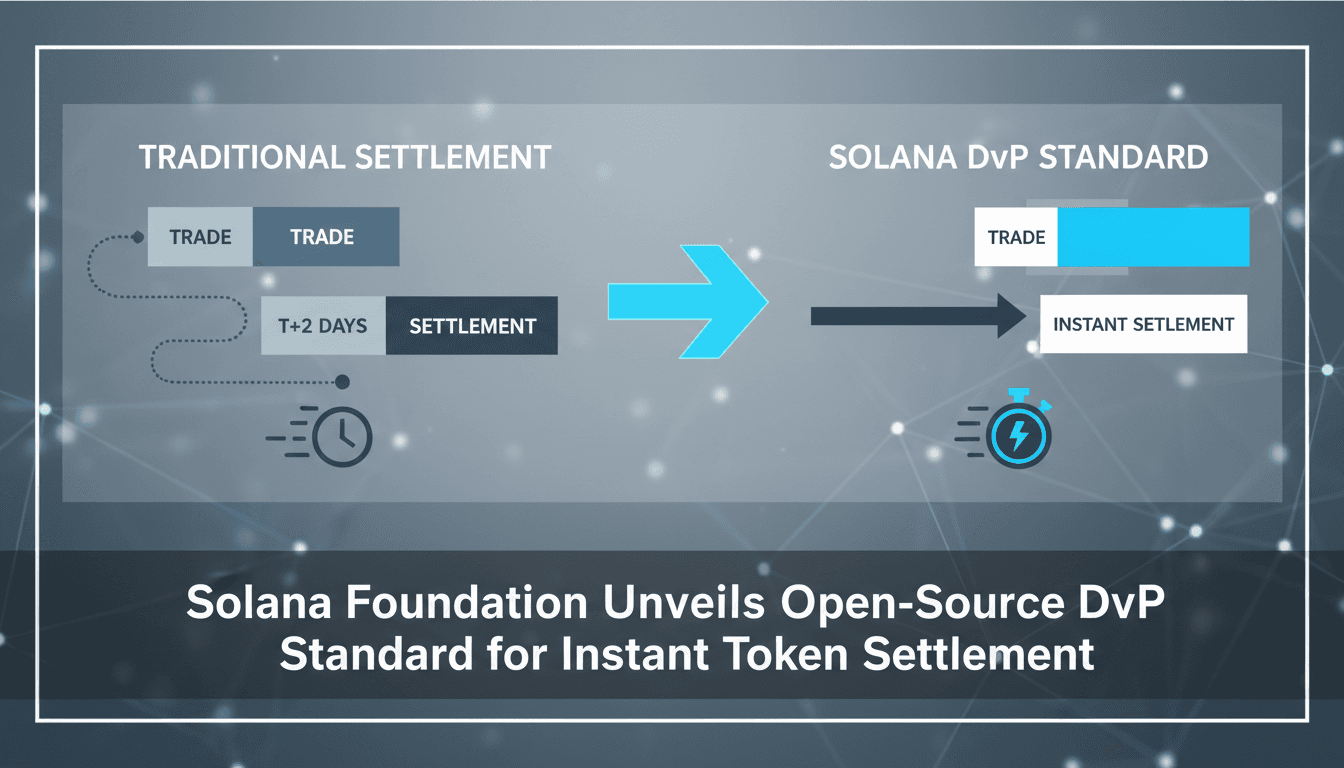
- The program enables financial institutions to execute trades in seconds, eliminating the multi-day settlement cycles typical in traditional finance.
- J.P. Morgan provided advisory input during development, although it did not endorse or operate the program.
The context you actually need
- Traditional settlement processes often involve multiple intermediaries, tying up capital for one to two days and exposing parties to principal risk if one leg of the trade fails.
- Institutions have previously relied on bespoke smart contracts for on-chain settlements, which can be inefficient and complex.
- The Solana DvP program offers a standardized, reusable framework that supports the growing interest in tokenized assets, making it easier for institutions to adopt blockchain technology.
What's really happening
The Solana Foundation's DvP program represents a significant shift in how financial transactions can be executed on blockchain technology. By enabling atomic settlement, the program allows both legs of a trade to be executed simultaneously in a single transaction. This is a departure from traditional methods that require multiple steps and can take one to two days to finalize.
The core mechanism of the DvP program involves recording trade terms on-chain and utilizing separate escrow accounts for funds. When a trade is initiated, the designated settlement authority can release both legs of the transaction atomically. If either leg fails to execute, the entire transaction is voided, effectively eliminating counterparty risk. This is particularly crucial for financial institutions that require certainty and speed in their operations.
The DvP program supports SPL Token and Token-2022 standards, which include features for regulated issuers, such as pausable tokens and transfer hooks. However, it does not include functionalities like matching or order books, nor does it integrate off-chain payment systems. This focus on a streamlined, efficient process is designed to cater specifically to institutional needs, as highlighted by Catherine Gu of the Solana Foundation and Rhodel D’Souza of J.P. Morgan.
The implications of this program extend beyond mere efficiency. By reducing the time and risk associated with settlements, the DvP standard could encourage more institutions to explore tokenized finance. As interest in real-world asset tokenization grows, having a reliable and fast settlement mechanism becomes increasingly important. The Solana DvP program positions itself as a solution to these challenges, potentially attracting a wider range of institutional participants to the blockchain ecosystem.
Moreover, the open-source nature of the DvP program under the MIT license allows for broader adoption and adaptation by other developers and institutions. This could lead to a more robust and interconnected financial ecosystem, where various platforms can leverage the DvP standard to enhance their own offerings.
As of now, the program has been deployed on both the mainnet and devnet, making it available for institutional use. However, the immediate market response has been muted, with no significant institutional settlement flows publicly announced as of October 9, 2026. This suggests that while the framework is in place, it may take time for institutions to fully integrate and utilize the new standard.
Who feels it first (and how)
- Financial institutions: Banks and trading firms will benefit from reduced settlement times and lower counterparty risk.
- Tokenized asset platforms: Companies involved in tokenizing real-world assets will find the DvP standard essential for efficient transactions.
- Developers: Blockchain developers can leverage the open-source framework to create new applications and services that utilize atomic settlement.
What to watch next
- Adoption rates: Monitor how quickly financial institutions begin to implement the DvP standard in their operations, as this will indicate its market acceptance.
- Institutional feedback: Pay attention to any feedback from institutions regarding the usability and effectiveness of the DvP program, which could lead to further refinements.
- Market shifts: Watch for any significant changes in trading volumes or settlement practices in the tokenized asset space, as these could signal the impact of the DvP standard.
The DvP program is open-source and has been deployed on the Solana blockchain.
Financial institutions will gradually adopt the DvP standard, leading to increased efficiency in tokenized asset trading.
The immediate market impact and institutional settlement flows remain uncertain as of now.
Frequently Asked Questions
- Why it matters?
- This initiative could redefine how financial institutions manage capital and risk in the trading of tokenized assets.
- What happened (in 30 seconds)?
- On October 6, 2026, the Solana Foundation launched an open-source Delivery-versus-Payment (DvP) program for atomic settlement. The program enables financial institutions to execute trades in seconds, eliminating the multi-day settlement cycles typical in traditional finance. J.P. Morgan provided advisory input during development, although it did not endorse or operate the program.
- What's really happening?
- The Solana Foundation's DvP program represents a significant shift in how financial transactions can be executed on blockchain technology. By enabling atomic settlement, the program allows both legs of a trade to be executed simultaneously in a single transaction. This is a departure from traditional methods that require multiple steps and can take one to two days to finalize. The core mechanism of the DvP program involves recording trade terms on-chain and utilizing separate escrow accounts f
- Who feels it first (and how)?
- Financial institutions: Banks and trading firms will benefit from reduced settlement times and lower counterparty risk. Tokenized asset platforms: Companies involved in tokenizing real-world assets will find the DvP standard essential for efficient transactions. Developers: Blockchain developers can leverage the open-source framework to create new applications and services that utilize atomic settlement.
- What to watch next?
- Adoption rates: Monitor how quickly financial institutions begin to implement the DvP standard in their operations, as this will indicate its market acceptance. Institutional feedback: Pay attention to any feedback from institutions regarding the usability and effectiveness of the DvP program, which could lead to further refinements. Market shifts: Watch for any significant changes in trading volumes or settlement practices in the tokenized asset space, as these could signal the impact of th
English-language digital publication covering business, politics, technology, and current affairs.
"The Arabian Post mixes original and syndicated-style coverage with a broad regional and global business-news orientation."
— A47 Editor
Solana introduces DvP standard for atomic settlement
The Solana Foundation has launched an open-source delivery-versus-payment (DvP) program, enabling financial institutions to settle tokenized assets and payments in a single atomic transaction on the Solana blockchain. Announced on October 6, this ini...
Bitcoin news, technical analysis, and forecasts across crypto markets.
"NewsBTC covers Bitcoin news, technical analysis, and forecasts across crypto markets and major blockchain projects."
— A47 Editor
Solana Foundation Launches Atomic DvP Settlement Tool With JPMorgan Input
The Solana Foundation has launched Solana DvP, an open-source delivery-versus-payment settlement tool designed for financial institutions, enabling the atomic settlement of asset and cash legs of transactions. Developed with input from JPMorgan, this...
Real-time updates, analysis, and reports on the blockchain and cryptocurrency sectors.
"Crypto News delivers real-time updates, analysis, and reports on the blockchain and cryptocurrency sectors."
— A47 Editor
Solana launches tool to settle bank trades in seconds
The Solana Foundation has launched an open-source Delivery versus Payment (DvP) program that enables the simultaneous settlement of asset and payment legs, significantly reducing transaction times from days to mere seconds. This initiative was develo...
Covers blockchain, cryptocurrency news, project analysis, and market insights.
"Cointelegraph is a leading crypto-focused media outlet known for timely news, analysis, and educational content related to blockchain and digital assets."
— A47 Editor
Solana Foundation targets settlement in seconds with DvP launch
The Solana Foundation has launched its new Delivery versus Payment (DvP) program, designed to facilitate asset transfers and payments for financial institutions in mere seconds. This open-source settlement solution aims to enhance transaction efficie...
Covers blockchain, cryptocurrency news, project analysis, and market insights.
"CoinDesk is a well-established cryptocurrency and blockchain news provider, offering comprehensive insights, market data, and industry research."
— A47 Editor
Solana Foundation unveils a program to settle institutional trades in seconds. JPMorgan gave input
The Solana Foundation has launched an open-source program enabling institutions to settle trades in seconds, significantly reducing the time from days to mere seconds. This initiative, developed with input from JPMorgan, aims to enhance transaction e...