
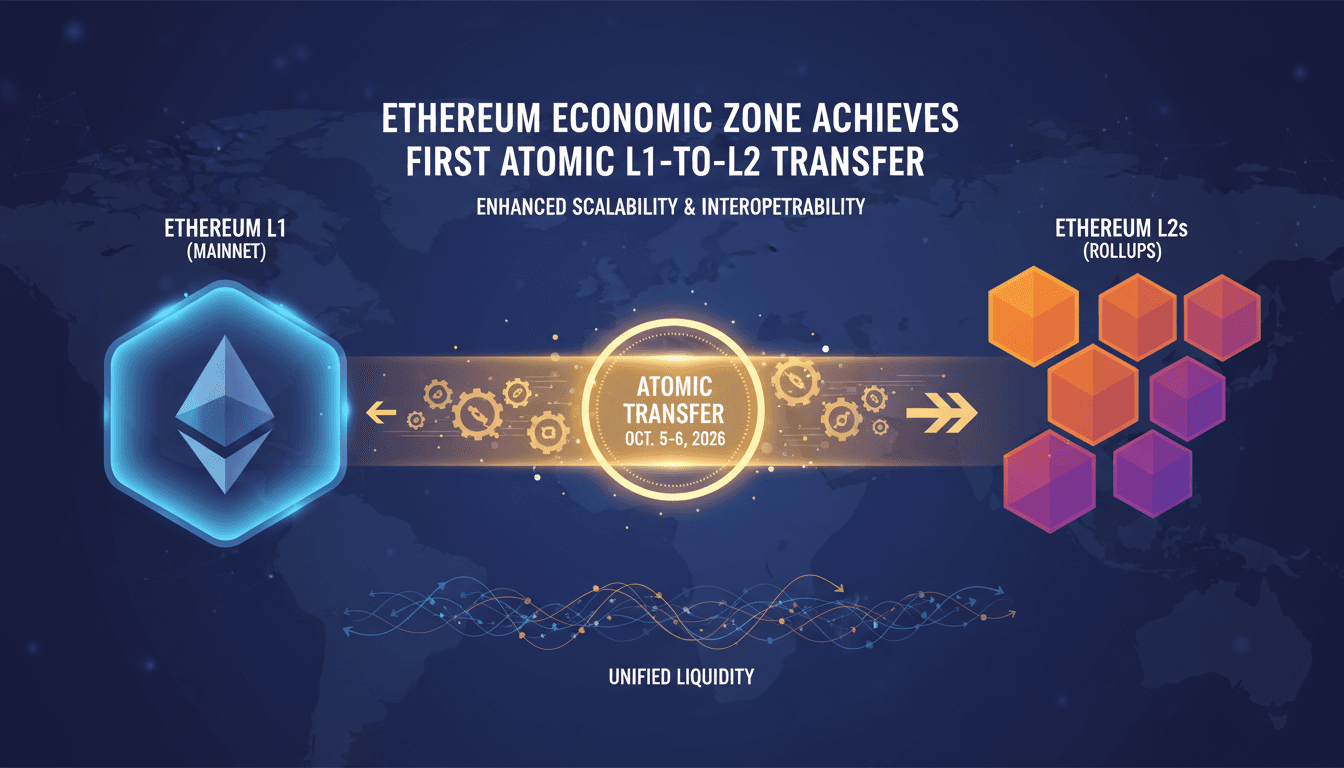
Ethereum Economic Zone Achieves First Atomic L1-to-L2 Transfer on Mainnet
Why it matters
This demonstration marks a significant step toward resolving Ethereum's Layer 2 fragmentation, potentially transforming how assets move across the network.
What happened (in 30 seconds)
- On October 5-6, 2026, the Ethereum Economic Zone executed the first atomic Layer 1 to Layer 2 transfer on Ethereum mainnet.
- Eduardo Antuña Díez, a core contributor, led the demonstration, moving 0.001 ETH in a single operation.
- The event showcased atomic synchronous composability, eliminating the need for traditional bridging mechanisms.
The context you actually need
- Ethereum's ecosystem has faced fragmentation due to the rise of independent Layer 2 rollups, leading to isolated liquidity pools.
- The Ethereum Economic Zone (EEZ) initiative, launched in early 2026, aims to unify capital and execution across L1 and L2 environments.
- Preparatory work included audits and testing against applications like CoW Swap and Uniswap v4, setting the stage for this milestone.
What's really happening
The successful execution of the first atomic Layer 1 to Layer 2 transfer on Ethereum mainnet represents a pivotal moment in blockchain interoperability. This operation, which involved transferring 0.001 ETH from Ethereum's Layer 1 to a Layer 2 rollup, was executed atomically within a single Ethereum block. The transaction utilized a proxy-and-bundle pattern submitted via the postAndVerifyBatch function, showcasing the potential for synchronous composability across different layers of the Ethereum network.
The significance of this achievement lies in its ability to address the fragmentation that has plagued Ethereum's ecosystem. As various Layer 2 solutions have emerged, they often operate in isolation, creating separate liquidity pools and complicating cross-layer interactions. Traditional bridging mechanisms, while functional, introduce risks and inefficiencies that can hinder user experience and capital flow. The EEZ initiative, backed by the Ethereum Foundation and led by key players like Gnosis and Zisk, aims to create a more cohesive environment where assets can move seamlessly between layers.
Community reactions to this demonstration have been largely optimistic, with developers recognizing the milestone's potential to enhance Ethereum's scalability. However, it's important to note that this implementation is still in its early stages. Further development is planned throughout 2027, including the introduction of two-way calls and real-time proving, which will expand the capabilities of this framework.
The implications of this advancement extend beyond technical specifications. By enabling unified liquidity and synchronous cross-layer interactions, Ethereum could attract more users and developers to its ecosystem. This could lead to increased adoption of decentralized applications (dApps) and further innovation within the blockchain space. As Ethereum continues to evolve, the successful execution of atomic transfers may serve as a catalyst for broader acceptance and integration of Layer 2 solutions.
Who feels it first (and how)
- Developers: They will benefit from enhanced tools for building dApps that can interact seamlessly across layers.
- Traders and investors: Improved liquidity and faster transactions could lead to better trading experiences and opportunities.
- Blockchain enthusiasts: Increased functionality may attract more users to the Ethereum ecosystem, fostering community growth.
What to watch next
- Further development updates: Keep an eye on announcements regarding two-way calls and real-time proving, as these will enhance the framework's capabilities.
- Adoption rates of Layer 2 solutions: Monitor how quickly developers and users embrace this new interoperability feature, as it could indicate Ethereum's future scalability.
- Market reactions: Watch for shifts in trading volumes and liquidity pools as the implications of this atomic transfer unfold in real-time.
The first atomic L1-to-L2 transfer has been successfully executed on Ethereum mainnet.
Further developments and enhancements to the EEZ framework will occur throughout 2027.
The long-term impact on Ethereum's market position and user adoption remains to be seen.
Frequently Asked Questions
- Why it matters?
- This demonstration marks a significant step toward resolving Ethereum's Layer 2 fragmentation, potentially transforming how assets move across the network.
- What happened (in 30 seconds)?
- On October 5-6, 2026, the Ethereum Economic Zone executed the first atomic Layer 1 to Layer 2 transfer on Ethereum mainnet. Eduardo Antuña Díez, a core contributor, led the demonstration, moving 0.001 ETH in a single operation. The event showcased atomic synchronous composability, eliminating the need for traditional bridging mechanisms.
- What's really happening?
- The successful execution of the first atomic Layer 1 to Layer 2 transfer on Ethereum mainnet represents a pivotal moment in blockchain interoperability. This operation, which involved transferring 0.001 ETH from Ethereum's Layer 1 to a Layer 2 rollup, was executed atomically within a single Ethereum block. The transaction utilized a proxy-and-bundle pattern submitted via the postAndVerifyBatch function, showcasing the potential for synchronous composability across different layers of the Ethereu
- Who feels it first (and how)?
- Developers: They will benefit from enhanced tools for building dApps that can interact seamlessly across layers. Traders and investors: Improved liquidity and faster transactions could lead to better trading experiences and opportunities. Blockchain enthusiasts: Increased functionality may attract more users to the Ethereum ecosystem, fostering community growth.
- What to watch next?
- Further development updates: Keep an eye on announcements regarding two-way calls and real-time proving, as these will enhance the framework's capabilities. Adoption rates of Layer 2 solutions: Monitor how quickly developers and users embrace this new interoperability feature, as it could indicate Ethereum's future scalability. Market reactions: Watch for shifts in trading volumes and liquidity pools as the implications of this atomic transfer unfold in real-time.
Covers Bitcoin plus altcoin news, market updates, and educational resources.
"Bitcoin.com provides news, market data, and guides focused on Bitcoin and the wider crypto industry."
— A47 Editor
Ethereum Economic Zone Runs Atomic L1-L2 Transfer on Mainnet
The Ethereum Economic Zone has successfully executed an atomic Layer 1 to Layer 2 transfer on the Ethereum mainnet, marking a significant milestone in the blockchain's operational capabilities. This transfer involved moving a small amount of 0.001 ET...
Real-time updates, analysis, and reports on the blockchain and cryptocurrency sectors.
"Crypto News delivers real-time updates, analysis, and reports on the blockchain and cryptocurrency sectors."
— A47 Editor
Ethereum could make moving between L1 and L2 much easier
Ethereum's EEZ has successfully completed an atomic L1-to-L2 mainnet test involving a transaction of 0.001 ETH, allowing for linked actions to either succeed or fail together. This test represents a significant step towards enhancing interoperability...
Covers blockchain, cryptocurrency news, project analysis, and market insights.
"Cointelegraph is a leading crypto-focused media outlet known for timely news, analysis, and educational content related to blockchain and digital assets."
— A47 Editor
EEZ tests atomic L1-to-L2 transaction in push to unify Ethereum
EEZ has conducted a cross-chain test involving a 0.001 ETH transaction, aiming to establish a framework that connects Ethereum's mainnet with its rollups, which is a significant step towards unifying the Ethereum ecosystem.