
Over 6 million Bitcoin exposed to potential quantum and AI threats
Why it matters
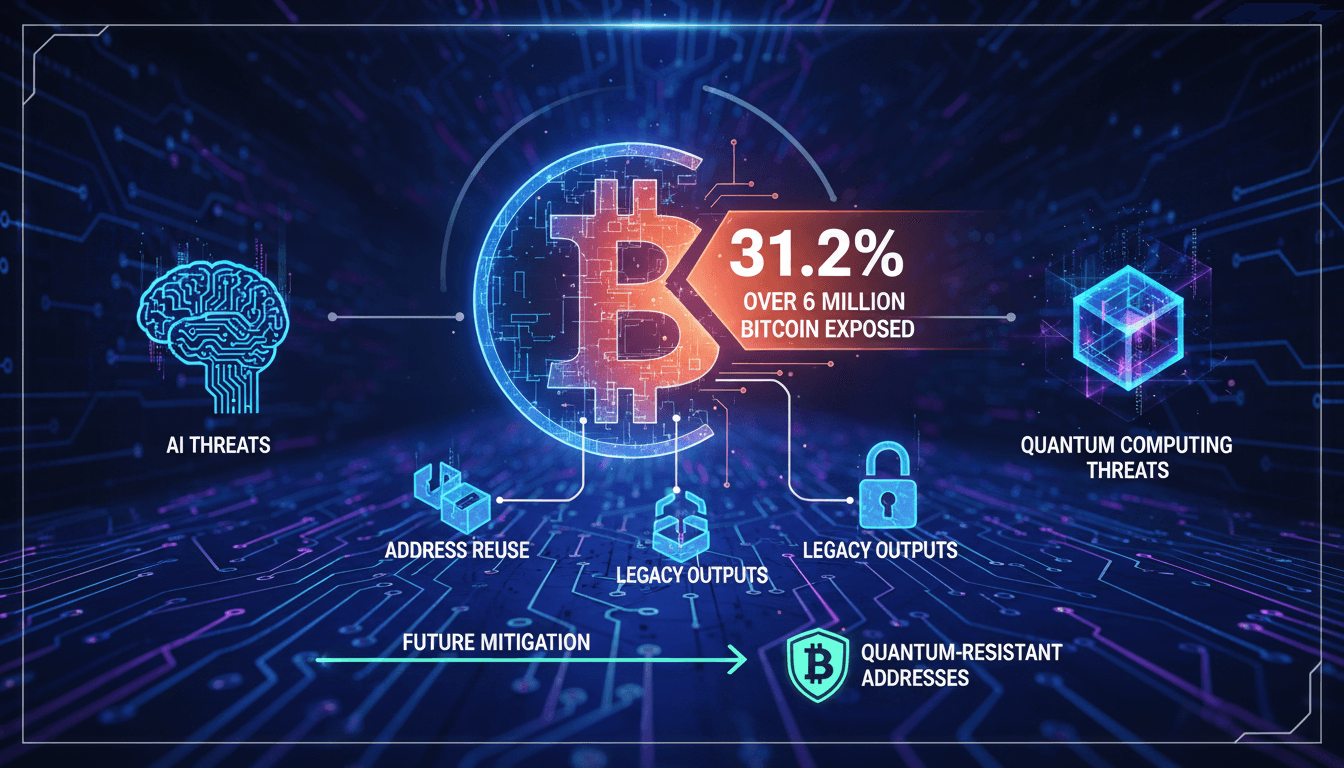
The exposure of over 6 million BTC could undermine the foundational security of Bitcoin, impacting investor confidence and market stability.
What happened (in 30 seconds)
- Over 6 million BTC are now linked to exposed public keys, representing 31.2% of the total supply.
- 222,000 BTC were added to this exposed category since May 2026, surpassing overall supply growth.
- Industry experts are warning about potential vulnerabilities from quantum computing and AI, urging proactive measures.
The context you actually need
- Bitcoin's cryptography relies on ECDSA, which is theoretically vulnerable to quantum computing breakthroughs.
- Address reuse and legacy outputs have contributed to the rising exposure, particularly with the adoption of Taproot.
- Institutional holdings have increased, with exchanges like Coinbase and Binance holding significant amounts of exposed BTC.
What's really happening
On October 8, 2026, CoinDesk reported a significant increase in Bitcoin's exposure due to public key visibility, with Glassnode's analysis revealing that over 6 million BTC are now at risk. This figure represents 31.2% of the circulating supply, a concerning statistic for investors and stakeholders in the cryptocurrency market. The increase of 222,000 BTC since May 2026 is particularly alarming, as it exceeds the overall supply growth of just 64,000 BTC during the same period.
The primary contributors to this exposure are exchanges, which accounted for 123,000 BTC of the increase. Notably, Coinbase has approximately 10% of its holdings exposed, while Binance has a staggering 83%. Other platforms like Grayscale and Revolut also show significant exposure rates, with Revolut at 99% and Robinhood at 100%. This raises questions about the security protocols in place at these exchanges and the potential risks for retail investors.
Experts like Justin Drake, an Ethereum researcher, have highlighted the urgency of addressing these vulnerabilities, particularly in light of advancements in AI that could compress attack timelines from years to mere months. The warnings suggest that the industry must prepare for "bunker mode" scenarios, where proactive measures are taken to migrate to quantum-resistant addresses.
The structural vulnerabilities in Bitcoin's legacy addresses and the operational risks from address reuse have been documented in earlier analyses, including a May 2026 report from Glassnode. As institutional holdings grow and Taproot adoption increases, the exposure rates have trended upward, raising alarms about the long-term security of Bitcoin.
Despite these warnings, there have been no confirmed attacks exploiting this exposure, and market reactions have been limited to discussions about migration strategies. Vitalik Buterin has cautioned against panic-driven moves, emphasizing the need for measured responses rather than hasty actions that could destabilize the market further.
Who feels it first (and how)
- Retail investors: Those holding Bitcoin on exchanges with high exposure rates may face increased risk.
- Institutional investors: Firms with significant Bitcoin holdings must reassess their security measures.
- Cryptocurrency exchanges: Platforms with high levels of exposed BTC could see a loss of user trust and potential withdrawals.
- Regulatory bodies: Governments may need to intervene to ensure consumer protection and market stability.
What to watch next
- Migration strategies: Watch for announcements from exchanges regarding plans to transition to quantum-resistant addresses, as this will indicate the industry's response to the threat.
- Market sentiment: Monitor investor confidence and trading volumes, as increased awareness of these vulnerabilities could lead to market fluctuations.
- Technological advancements: Keep an eye on developments in quantum computing and AI, as breakthroughs could accelerate the timeline for potential attacks.
Over 6 million BTC are exposed due to public key visibility.
Increased discussions and strategies around migrating to quantum-resistant addresses will emerge.
The timeline for any potential attacks exploiting these vulnerabilities remains uncertain.
Frequently Asked Questions
- Why it matters?
- The exposure of over 6 million BTC could undermine the foundational security of Bitcoin, impacting investor confidence and market stability.
- What happened (in 30 seconds)?
- Over 6 million BTC are now linked to exposed public keys, representing 31.2% of the total supply. 222,000 BTC were added to this exposed category since May 2026, surpassing overall supply growth. Industry experts are warning about potential vulnerabilities from quantum computing and AI, urging proactive measures.
- What's really happening?
- On October 8, 2026, CoinDesk reported a significant increase in Bitcoin's exposure due to public key visibility, with Glassnode's analysis revealing that over 6 million BTC are now at risk. This figure represents 31.2% of the circulating supply, a concerning statistic for investors and stakeholders in the cryptocurrency market. The increase of 222,000 BTC since May 2026 is particularly alarming, as it exceeds the overall supply growth of just 64,000 BTC during the same period. The primary cont
- Who feels it first (and how)?
- Retail investors: Those holding Bitcoin on exchanges with high exposure rates may face increased risk. Institutional investors: Firms with significant Bitcoin holdings must reassess their security measures. Cryptocurrency exchanges: Platforms with high levels of exposed BTC could see a loss of user trust and potential withdrawals. Regulatory bodies: Governments may need to intervene to ensure consumer protection and market stability.
- What to watch next?
- Migration strategies: Watch for announcements from exchanges regarding plans to transition to quantum-resistant addresses, as this will indicate the industry's response to the threat. Market sentiment: Monitor investor confidence and trading volumes, as increased awareness of these vulnerabilities could lead to market fluctuations. Technological advancements: Keep an eye on developments in quantum computing and AI, as breakthroughs could accelerate the timeline for potential attacks.
Covers blockchain, cryptocurrency news, project analysis, and market insights.
"CoinDesk is a well-established cryptocurrency and blockchain news provider, offering comprehensive insights, market data, and industry research."
— A47 Editor
Over 6 million bitcoin sit behind exposed public keys as AI warnings mount
Over 6 million bitcoins are currently at risk due to exposed public keys, as highlighted by Glassnode's co-founder. Justin Drake has raised alarms regarding the potential for AI-driven attacks on wallet cryptography, urging the cryptocurrency communi...
Daily AI news: models, tools, and policy.
"Independent outlet tracking the fast pace of AI."
— A47 Editor
AI math breakthroughs have Ethereum researchers debating how fast wallet security could collapse
Ethereum researcher Justin Drake has called for the crypto industry to adopt a 'bunker mode' in anticipation of potential vulnerabilities in wallet signature schemes due to advancements in AI-powered mathematics. Vitalik Buterin supports this caution...
Covers blockchain, cryptocurrency news, project analysis, and market insights.
"CoinDesk is a well-established cryptocurrency and blockchain news provider, offering comprehensive insights, market data, and industry research."
— A47 Editor
Bitcoin and ether holders urged to enter ‘bunker mode’ against possible AI attacks
Ethereum researchers have issued a warning that advancements in artificial intelligence (AI) could potentially compromise the cryptographic signatures that secure Bitcoin and Ether within months, raising alarms about the vulnerability of these crypto...
Covers blockchain, cryptocurrency news, project analysis, and market insights.
"CoinDesk is a well-established cryptocurrency and blockchain news provider, offering comprehensive insights, market data, and industry research."
— A47 Editor
Bitcoin slips below $83,000 as Ethereum researcher's 'bunker mode' call divides crypto
Bitcoin's price has slipped below $83,000 following a warning from Ethereum researcher Justin Drake, who suggested that advancements in artificial intelligence could soon compromise the cryptographic security of Bitcoin and Ether. This call for a 'bu...
Real-time updates, analysis, and reports on the blockchain and cryptocurrency sectors.
"Crypto News delivers real-time updates, analysis, and reports on the blockchain and cryptocurrency sectors."
— A47 Editor
Ethereum researcher warns AI could crack crypto wallets
Ethereum researcher Justin Drake has issued a warning that advancements in artificial intelligence (AI) could soon compromise the security of crypto wallets, particularly those using the Elliptic Curve Digital Signature Algorithm (ECDSA). He advises ...
Research, news, and analysis on blockchain startups, DeFi, and regulations.
"Crypto Briefing provides research, news, and analysis on blockchain startups, DeFi, and crypto regulations with investor-focused coverage."
— A47 Editor
Vitalik Buterin says there’s a ‘good chance’ AI could break lattice cryptography within two years
Vitalik Buterin has warned that advancements in artificial intelligence (AI) could lead to the breaking of lattice cryptography within two years, which is crucial for blockchain security. This statement highlights the potential vulnerabilities in cry...
Covers blockchain, cryptocurrency news, project analysis, and market insights.
"Cointelegraph is a leading crypto-focused media outlet known for timely news, analysis, and educational content related to blockchain and digital assets."
— A47 Editor
Vitalik Buterin backs crypto ‘bunker mode’ amid rapid AI math advances
<p style="float:right; margin:0 0 10px 15px; width:240px;"><img src="https://s3-images.ctmedia.io/media/article-covers/2026/10/01M4CCZ9950ZZBPSK7VXWX6DJ3/ai-hack-3.jpg" alt="Vitalik Buterin backs crypto ‘bunker mode’ amid rapid AI math advances" clas...