
Ripple Prime Challenges Wall Street Banks in Leveraged ETF Financing
Why it matters
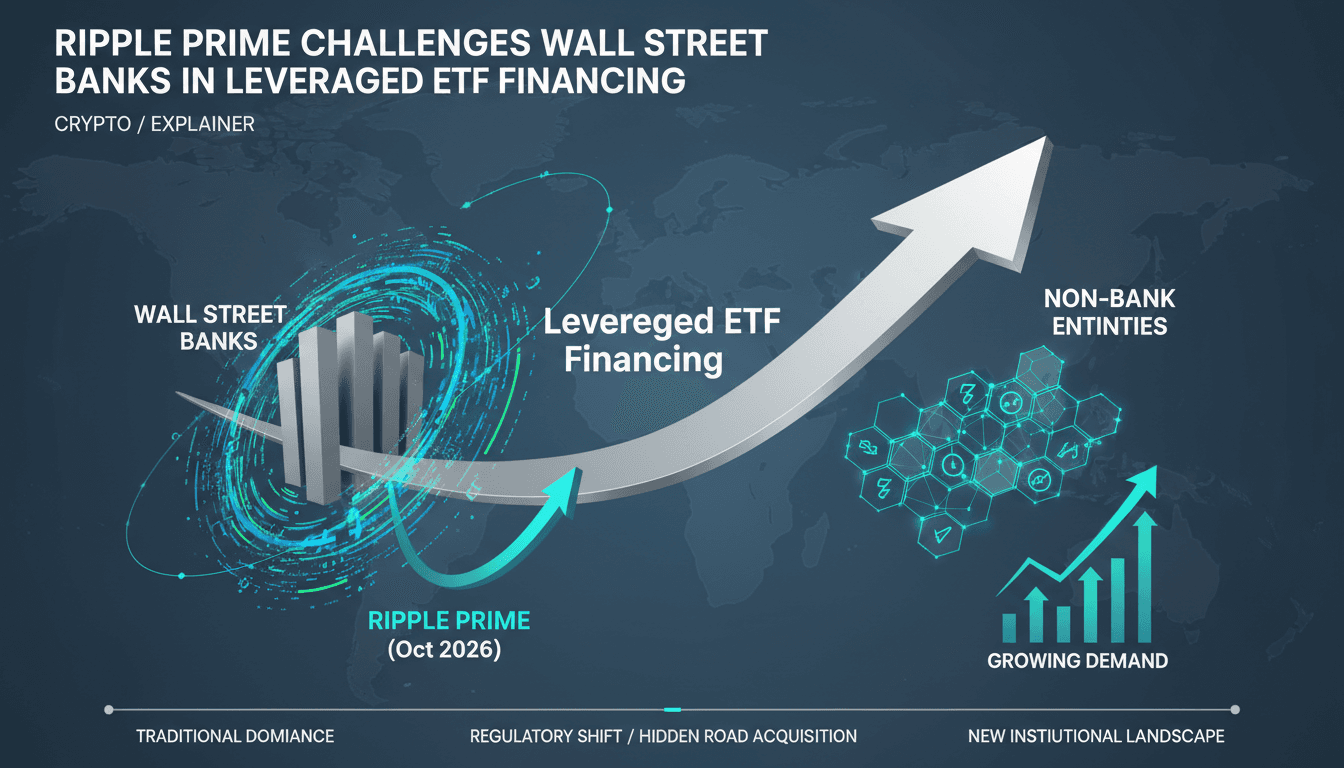
Ripple Prime's entry into the leveraged ETF financing market challenges traditional banking dominance, potentially lowering costs and increasing competition.
What happened (in 30 seconds)
- Ripple Prime launched its leveraged ETF financing services on October 7, 2026, positioning itself against major Wall Street banks.
- The firm expanded its offerings after acquiring Hidden Road in 2025, now providing total return swaps for equity derivatives.
- Regulatory constraints on banks have opened the door for non-bank entities like Ripple to capture market share in institutional finance.
The context you actually need
- Ripple's acquisition of Hidden Road for $1.25 billion in 2025 established its prime brokerage operation, which now handles digital assets and derivatives.
- The leveraged ETF market has seen significant growth, with $256 billion in assets under management across 593 U.S. leveraged ETFs, according to Morningstar Direct.
- Tighter capital rules for banks are creating opportunities for non-bank firms to enter lucrative financing markets, particularly in leveraged products.
What's really happening
Ripple Prime's foray into the leveraged ETF financing market is a strategic move that capitalizes on both regulatory changes and market demand. Following its acquisition of Hidden Road, Ripple rebranded the firm and expanded its services to include equity derivatives financing, specifically targeting leveraged ETFs. This segment has been traditionally dominated by Wall Street banks, which have faced increasing regulatory scrutiny and capital requirements, limiting their ability to engage in riskier financing activities.
The leveraged ETF sector has been growing rapidly, driven by investor appetite for amplified exposure to market movements. As of the latest data, there are 593 U.S. leveraged ETFs managing a total of $256 billion in assets. This growth presents a lucrative opportunity for firms like Ripple Prime, which can offer competitive financing solutions through total return swaps. These swaps allow investors to gain leveraged exposure without directly owning the underlying assets, making them an attractive option for institutional clients.
Ripple Prime's financing model, which includes a recent agreement with Brevan Howard, a $35 billion hedge fund, highlights its ambition to capture a significant share of this market. The financing terms for products like the Tradr 2X Long SNDK Daily ETF, which pays financing at the overnight bank funding rate plus four percentage points, illustrate how Ripple is positioning itself as a cost-effective alternative to traditional banks.
As banks continue to navigate tighter capital and risk rules, non-bank entities like Ripple Prime, Jane Street, and Clear Street are emerging as formidable competitors in the leveraged ETF financing landscape. This shift not only democratizes access to leveraged products but also introduces new pricing dynamics that could benefit institutional investors.
Who feels it first (and how)
- Institutional investors: They may benefit from lower financing costs and more options in leveraged ETFs.
- Hedge funds: Firms like Brevan Howard could leverage Ripple Prime's services for enhanced trading strategies.
- Traditional banks: They may face increased competition and pressure to adapt their pricing and service offerings.
What to watch next
- Market response: Monitor how traditional banks adjust their strategies in response to Ripple Prime's entry.
- Regulatory developments: Keep an eye on any changes in regulations that could further impact non-bank entities in the financial sector.
- Client growth: Watch for announcements regarding Ripple Prime's expansion of institutional clients and capital raises.
Ripple Prime has successfully entered the leveraged ETF financing market.
Increased competition will lead to lower costs for institutional investors in leveraged products.
The long-term impact on traditional banks and their market share in the leveraged ETF sector remains to be seen.
Frequently Asked Questions
- Why it matters?
- Ripple Prime's entry into the leveraged ETF financing market challenges traditional banking dominance, potentially lowering costs and increasing competition.
- What happened (in 30 seconds)?
- Ripple Prime launched its leveraged ETF financing services on October 7, 2026, positioning itself against major Wall Street banks. The firm expanded its offerings after acquiring Hidden Road in 2025, now providing total return swaps for equity derivatives. Regulatory constraints on banks have opened the door for non-bank entities like Ripple to capture market share in institutional finance.
- What's really happening?
- Ripple Prime's foray into the leveraged ETF financing market is a strategic move that capitalizes on both regulatory changes and market demand. Following its acquisition of Hidden Road, Ripple rebranded the firm and expanded its services to include equity derivatives financing, specifically targeting leveraged ETFs. This segment has been traditionally dominated by Wall Street banks, which have faced increasing regulatory scrutiny and capital requirements, limiting their ability to engage in risk
- Who feels it first (and how)?
- Institutional investors: They may benefit from lower financing costs and more options in leveraged ETFs. Hedge funds: Firms like Brevan Howard could leverage Ripple Prime's services for enhanced trading strategies. Traditional banks: They may face increased competition and pressure to adapt their pricing and service offerings.
- What to watch next?
- Market response: Monitor how traditional banks adjust their strategies in response to Ripple Prime's entry. Regulatory developments: Keep an eye on any changes in regulations that could further impact non-bank entities in the financial sector. Client growth: Watch for announcements regarding Ripple Prime's expansion of institutional clients and capital raises.
Real-time updates, analysis, and reports on the blockchain and cryptocurrency sectors.
"Crypto News delivers real-time updates, analysis, and reports on the blockchain and cryptocurrency sectors."
— A47 Editor
Ripple challenges Wall Street banks with leveraged ETF financing push
Ripple has entered the leveraged exchange-traded fund financing sector through its subsidiary, Ripple Prime, which provides funding for investment products aiming to amplify the daily performance of individual stocks and market indexes. This strategi...
Covers blockchain, cryptocurrency news, project analysis, and market insights.
"CoinDesk is a well-established cryptocurrency and blockchain news provider, offering comprehensive insights, market data, and industry research."
— A47 Editor
Ripple is earning fees financing leveraged stock bets, a business long run by banks
Ripple has made a significant move in the financial sector by acquiring Hidden Road for $1.25 billion, enabling the crypto company to facilitate leveraged stock bets on major stocks like Nvidia and Sandisk. This acquisition marks Ripple's entry into ...
Markets desk coverage, trading insights, and investor updates.
"WSJ’s markets reporting provides in-depth analysis and context for investors."
— A47 Editor
Ripple, Crypto’s Payments Giant, Breaks Into Wall Street
Ripple, a prominent player in the cryptocurrency sector, is making significant strides by entering the leveraged exchange-traded fund (ETF) financing market, traditionally controlled by major banks. This move marks a pivotal moment for the firm as it...