
Australia Proposes Legislation for OECD Crypto-Asset Reporting Framework
If you’re involved in crypto transactions in Australia, expect new reporting requirements that could impact your tax obligations.
Why it matters
This legislation represents a significant step in global efforts to standardize crypto-asset reporting and combat tax evasion.
What happened (in 30 seconds)
- Australia released draft legislation on October 15, 2026, to adopt the OECD’s Crypto-Asset Reporting Framework (CARF).
- Crypto service providers will be required to report transactions involving Australian residents, starting in 2027.
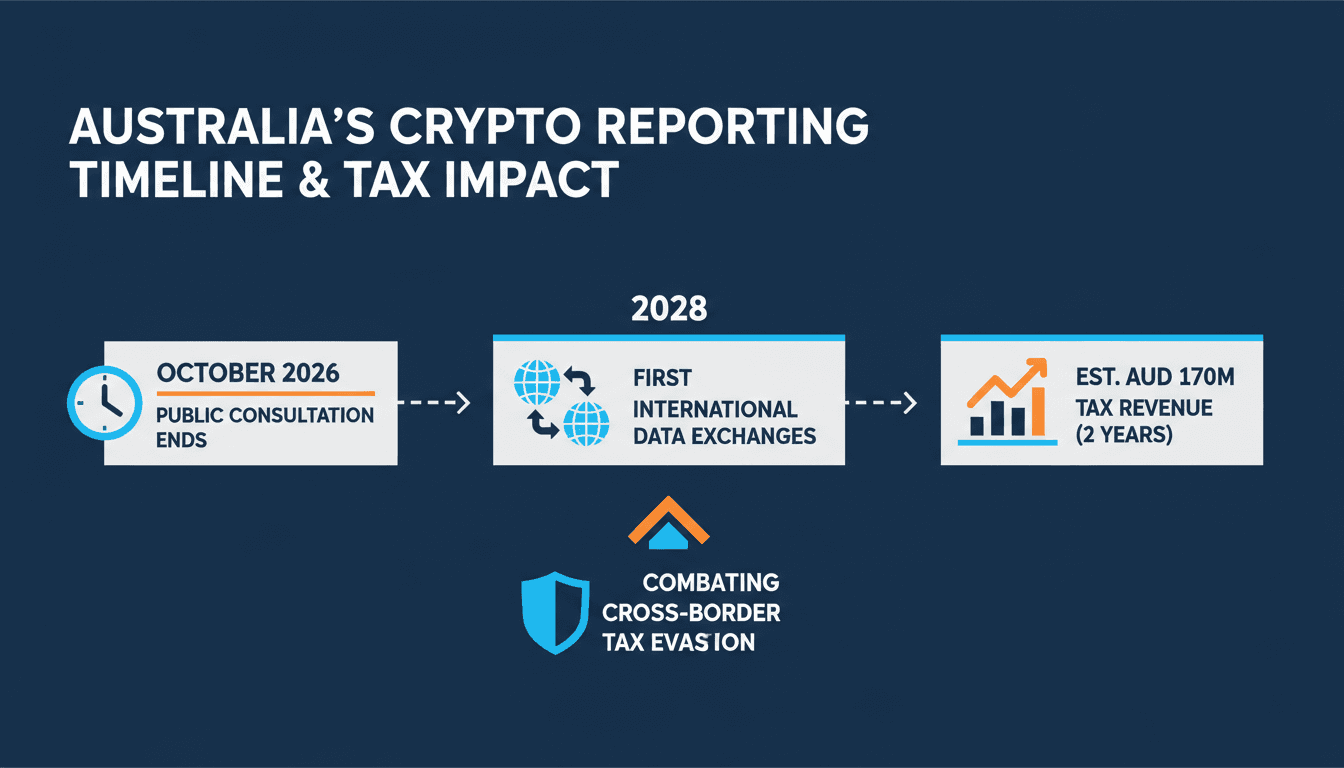
- International data exchanges under CARF are scheduled to begin in 2028, enhancing cross-border tax transparency.
The context you actually need
- The OECD developed CARF to address challenges in tracking digital assets held or traded through foreign providers, with input from G20 nations.
- Australia committed to CARF in November 2023, following a prior consultation in late 2024, indicating a proactive approach to tax transparency.
- The draft legislation aims to generate an estimated AUD 170 million in additional tax revenue across the 2027-28 and 2028-29 financial years.
What's really happening
On October 15, 2026, the Australian Treasury unveiled a draft bill to implement the OECD’s Crypto-Asset Reporting Framework (CARF) domestically. This initiative is part of a broader tax transparency program aimed at enhancing the Australian Taxation Office's (ATO) ability to monitor and collect taxes on crypto transactions. The proposed legislation mandates that crypto service providers collect and report user identification and transaction data for exchanges involving both crypto assets and fiat currencies, as well as transfers between different crypto assets.
The domestic reporting obligations for Australian residents are set to commence in 2027, with the ATO receiving this information to ensure compliance and tax collection. This move aligns with the OECD's global strategy to standardize crypto reporting across 77 jurisdictions, which is crucial for combating cross-border tax evasion. The first international data exchanges under CARF are planned for 2028, marking a significant milestone in global tax cooperation.
The draft legislation is currently open for public consultation until October 28, 2026, allowing stakeholders to provide feedback before any formal parliamentary introduction. This consultation period is critical, as it will shape the final version of the legislation and its implementation timeline. The Australian government anticipates that the new reporting requirements will not only enhance tax compliance but also generate substantial additional revenue, estimated at AUD 170 million over the next two financial years.
While the draft legislation is a proactive step towards transparency, it also raises questions about the operational burden on crypto service providers and the potential impact on users. As the framework evolves, it will be essential for stakeholders to stay informed about compliance requirements and any changes that may arise from the consultation process.
Who feels it first (and how)
- Crypto service providers: They will need to adapt their systems to comply with new reporting requirements.
- Australian residents engaged in crypto transactions: They will face new tax obligations and potential scrutiny from the ATO.
- International jurisdictions: Countries participating in CARF will need to align their regulations with Australia’s framework.
What to watch next
- Public consultation outcomes: The feedback received by October 28, 2026, will influence the final legislation and its implementation timeline.
- International responses: Monitor how other jurisdictions react to Australia’s draft legislation and whether they will adopt similar frameworks.
- Market adjustments: Watch for any shifts in crypto service provider operations and user behavior as compliance deadlines approach.
The draft legislation is currently under public consultation and has not yet been enacted.
The ATO will enhance its monitoring capabilities and increase scrutiny on crypto transactions starting in 2027.
The full impact on the crypto market and user behavior remains to be seen as the legislation is finalized.
Frequently Asked Questions
- Why it matters?
- This legislation represents a significant step in global efforts to standardize crypto-asset reporting and combat tax evasion.
- What happened (in 30 seconds)?
- Australia released draft legislation on October 15, 2026, to adopt the OECD’s Crypto-Asset Reporting Framework (CARF). Crypto service providers will be required to report transactions involving Australian residents, starting in 2027. International data exchanges under CARF are scheduled to begin in 2028, enhancing cross-border tax transparency.
- What's really happening?
- On October 15, 2026, the Australian Treasury unveiled a draft bill to implement the OECD’s Crypto-Asset Reporting Framework (CARF) domestically. This initiative is part of a broader tax transparency program aimed at enhancing the Australian Taxation Office's (ATO) ability to monitor and collect taxes on crypto transactions. The proposed legislation mandates that crypto service providers collect and report user identification and transaction data for exchanges involving both crypto assets and fia
- Who feels it first (and how)?
- Crypto service providers: They will need to adapt their systems to comply with new reporting requirements. Australian residents engaged in crypto transactions: They will face new tax obligations and potential scrutiny from the ATO. International jurisdictions: Countries participating in CARF will need to align their regulations with Australia’s framework.
- What to watch next?
- Public consultation outcomes: The feedback received by October 28, 2026, will influence the final legislation and its implementation timeline. International responses: Monitor how other jurisdictions react to Australia’s draft legislation and whether they will adopt similar frameworks. Market adjustments: Watch for any shifts in crypto service provider operations and user behavior as compliance deadlines approach.
Real-time updates, analysis, and reports on the blockchain and cryptocurrency sectors.
"Crypto News delivers real-time updates, analysis, and reports on the blockchain and cryptocurrency sectors."
— A47 Editor
Australia moves to share crypto tax data globally by 2028
Australia has proposed new crypto tax reporting rules under the OECD framework, with public feedback due by October 28, and plans to exchange data globally by 2028. This initiative aligns Australia with 77 jurisdictions committed to the OECD's Crypto...
Covers blockchain, cryptocurrency news, project analysis, and market insights.
"Cointelegraph is a leading crypto-focused media outlet known for timely news, analysis, and educational content related to blockchain and digital assets."
— A47 Editor
Australia releases draft bill to adopt OECD crypto tax reporting framework
Australia has released a draft bill to adopt the OECD's Crypto-Asset Reporting Framework (CARF), joining 77 jurisdictions committed to this international standard, with the first exchanges of crypto tax data expected in 2028.
English-language digital publication covering business, politics, technology, and current affairs.
"The Arabian Post mixes original and syndicated-style coverage with a broad regional and global business-news orientation."
— A47 Editor
Australia proposes mandatory crypto tax reporting from 2027
Australia has proposed draft legislation that mandates cryptocurrency platforms to report transactions involving Australian residents to tax authorities starting in July 2027. The Treasury announced this proposal on October 15, 2026, and is currently...