
DTCC Launches Tokenization Service Enabling Regulated Digital Representations of DTC-Custodied Securities
Why it matters
The Depository Trust Company (DTC), which safeguards more than $114 trillion in custody, has shifted tokenization from proof-of-concept sandboxes into institutional production across 34 securities representing $30 trillion in market value.
What happened (in 30 seconds)
- Production deployment: On October 28, 2026, DTC officially launched the DTCC Tokenization Service (DTS), establishing regulated technical infrastructure that permits authorized participants to mint digital twins of traditional assets held in DTC custody.
- Initial network support: The service operates simultaneously across the Canton Network and DTCC’s private Besu deployment, targeting cross-network collateral mobility with additional distributed ledger integrations planned for 2027.
- Participant roster: Twenty financial institutions—including J.P. Morgan, Citi, Bank of America, Barclays, Citadel Securities, State Street, and Morgan Stanley—executed access agreements to initiate production minting and bilateral transfers.
The context you actually need
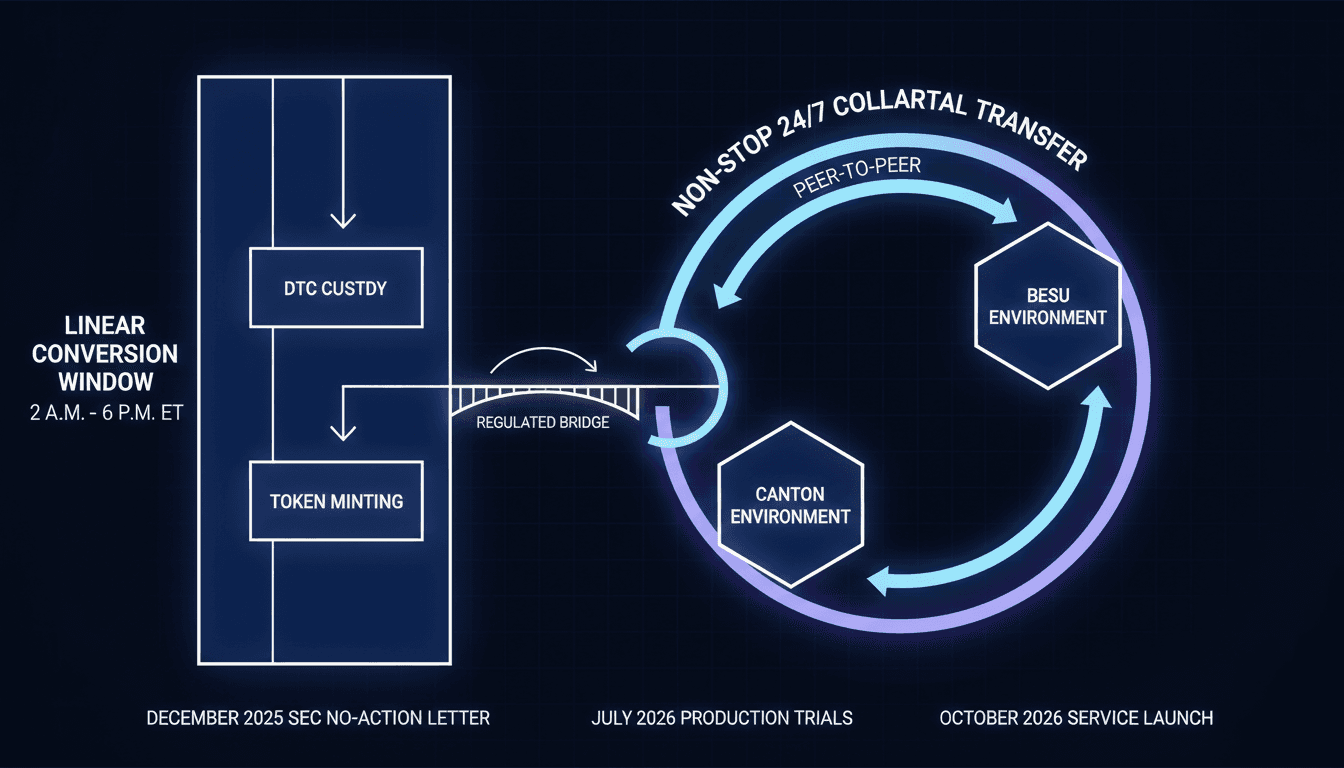
- The regulatory bridge: The operational launch stems directly from a December 11, 2025 SEC No-Action Letter that granted DTC a three-year window to operate tokenization mechanisms on pre-approved blockchains without altering the underlying statutory status of custodied assets.
- Validated testing rails: DTS follows July 2026 production pilots involving more than 30 institutions, which tested token conversion workflows using Russell 1000 equities, exchange-traded funds, and U.S. Treasuries across Besu and Canton environments.
- Preserved rights: Digital tokens minted via DTS do not function as independent digital assets; they maintain the identical economic entitlements, voting mechanisms, and legal protections tied to the underlying physical or book-entry securities custodied at DTC.
What's really happening
The deployment of the DTCC Tokenization Service addresses a structural friction point inside global post-trade clearing: capital lockup driven by fixed settlement cutoffs.
Historically, moving securities to cover margin or settle financing transactions required adhering to strict depository operating hours and sequential messaging systems. Under the new model, DTC acts as the central anchor for a twin-ledger system. The original security remains immobilized in DTC’s custody vault, which oversees more than $114 trillion in total market assets. Simultaneously, an identical digital representation is minted on either the private Besu environment or the Canton Network.
The technical design introduces a specific trade-off between minting boundaries and secondary transfer mobility. Authorized participants cannot mint or burn tokens continuously; conversion between conventional book-entry shares and tokenized representations is restricted to standard business-day windows between 2:00 a.m. and 6:00 p.m. ET, with a target turnaround latency of 15 minutes. However, once the tokens exist on-ledger, participants can execute peer-to-peer transfers between registered, whitelisted wallets 24 hours a day, seven days a week, provided both counterparties operate on the same chain.
This architecture deliberately circumvents the volatility and settlement ambiguities of public permissionless networks. By enforcing strict identification controls through DTC membership agreements, the service eliminates counterparty anonymity and counterparty asset freezes. Twenty institutional participants—spanning broker-dealers, commercial custodians, and proprietary market makers such as Alpaca, Apex Clearing, Fidelity Investments, Marex, and UBS—now hold direct rails to post tokenized collateral bilaterally outside traditional clearing hours.
The initial footprint is heavily concentrated: only 34 securities are currently eligible, though they cover an estimated $30 trillion in aggregate market capitalization. This selective eligibility allows clearing institutions to optimize balance-sheet utilization across the most liquid sovereign debt, major index components, and large-cap equities without introducing balance-sheet fragmentation into smaller, less liquid issues. Rather than disintermediating the central securities depository, DTS integrates tokenization directly into the existing post-trade core, turning distributed ledger technology into an internal efficiency protocol for institutional liquidity.
Who feels it first (and how)
- Institutional Treasury and Collateral Desks: Treasury teams at tier-one clearing banks can now reallocate U.S. asset collateral over weekends and overnight trading sessions without relying on uncollateralized credit lines.
- Custody and Settlement Operations Teams: Post-trade teams at the 20 participating institutions must now manage dual reconciliation workflows—tracking positions inside legacy DTC accounts while monitoring state changes on Besu and Canton ledger addresses.
- Prime Brokers and Clearing Firms: Mid-tier clearing houses like Clear Street and Apex Clearing gain capital-efficiency mechanisms to support high-volume institutional clients requiring intraday margin optimization.
- Global Institutional Trading Entities: Offshore market participants operating from financial hubs like London, Singapore, and Hong Kong can interact with tokenized U.S. paper inside their own time zones, provided they clear through an authorized DTC member firm.
What to watch next
- The 2027 Multi-Chain Expansion: DTC's scheduled integration of additional distributed ledger networks will reveal whether Wall Street establishes a single interoperability standard or fragments tokenized liquidity across competing vendor ecosystems.
- Expansion of Eligible CUSIPs Beyond the Initial 34: The pace at which DTC expands eligibility past the current $30 trillion pool into lower-tier equities and corporate bonds will indicate institutional balance-sheet demand for non-benchmark collateral.
- The December 2028 SEC Expiration Cliff: The three-year runway established by the SEC's December 2025 No-Action Letter sets an explicit deadline for market participants to prove operational resilience or lobby for formal, permanent codification into federal clearing rules.
DTS launched on October 28, 2026, supporting 34 securities across Canton Network and private Besu rails for 20 authorized institutional members, backed by DTC’s $114 trillion custody infrastructure.
Initial transaction volume will concentrate heavily on overnight repo transactions, collateralized lending, and automated margin calls rather than outright secondary equity trading.
Whether cross-chain liquidity bridges will mature sufficiently to allow seamless transfers between Canton and Besu without requiring participants to burn and re-mint through DTC’s central ledger.
Frequently Asked Questions
- Why it matters?
- The Depository Trust Company (DTC), which safeguards more than $114 trillion in custody, has shifted tokenization from proof-of-concept sandboxes into institutional production across 34 securities representing $30 trillion in market value.
- What happened (in 30 seconds)?
- Production deployment: On October 28, 2026, DTC officially launched the DTCC Tokenization Service (DTS), establishing regulated technical infrastructure that permits authorized participants to mint digital twins of traditional assets held in DTC custody. Initial network support: The service operates simultaneously across the Canton Network and DTCC’s private Besu deployment, targeting cross-network collateral mobility with additional distributed ledger integrations planned for 2027. Participant
- What's really happening?
- The deployment of the DTCC Tokenization Service addresses a structural friction point inside global post-trade clearing: capital lockup driven by fixed settlement cutoffs. Historically, moving securities to cover margin or settle financing transactions required adhering to strict depository operating hours and sequential messaging systems. Under the new model, DTC acts as the central anchor for a twin-ledger system. The original security remains immobilized in DTC’s custody vault, which overse
- Who feels it first (and how)?
- Institutional Treasury and Collateral Desks: Treasury teams at tier-one clearing banks can now reallocate U.S. asset collateral over weekends and overnight trading sessions without relying on uncollateralized credit lines. Custody and Settlement Operations Teams: Post-trade teams at the 20 participating institutions must now manage dual reconciliation workflows—tracking positions inside legacy DTC accounts while monitoring state changes on Besu and Canton ledger addresses. Prime Brokers and Clea
- What to watch next?
- The 2027 Multi-Chain Expansion: DTC's scheduled integration of additional distributed ledger networks will reveal whether Wall Street establishes a single interoperability standard or fragments tokenized liquidity across competing vendor ecosystems. Expansion of Eligible CUSIPs Beyond the Initial 34: The pace at which DTC expands eligibility past the current $30 trillion pool into lower-tier equities and corporate bonds will indicate institutional balance-sheet demand for non-benchmark collatera
Bitcoin news, technical analysis, and forecasts across crypto markets.
"NewsBTC covers Bitcoin news, technical analysis, and forecasts across crypto markets and major blockchain projects."
— A47 Editor
DTCC Launches Tokenized Securities Service as Wall Street Tests New Settlement Rails
The Depository Trust & Clearing Corporation (DTCC), a major U.S. post-trade market infrastructure provider, launched a tokenized securities service on October 28, 2026, as Wall Street institutions test new settlement rails. Reports indicate the servi...
Real-time updates, analysis, and reports on the blockchain and cryptocurrency sectors.
"Crypto News delivers real-time updates, analysis, and reports on the blockchain and cryptocurrency sectors."
— A47 Editor
DTCC launches tokenization service with 20 major firms
The Depository Trust & Clearing Corporation (DTCC) has launched a tokenization service for securities held in custody, with 20 major firms signing on, and plans to bring the service to Stellar as its first public blockchain integration in the next ph...
Covers Bitcoin plus altcoin news, market updates, and educational resources.
"Bitcoin.com provides news, market data, and guides focused on Bitcoin and the wider crypto industry."
— A47 Editor
Major Banks Sign on as DTCC Launches Tokenized Securities Service
Major banks have signed on to a tokenized securities service launched by the Depository Trust & Clearing Corporation (DTCC), according to a Bitcoin.com report published October 28, 2026. The initiative brings traditional Wall Street institutions into...
Covers blockchain, cryptocurrency news, project analysis, and market insights.
"Cointelegraph is a leading crypto-focused media outlet known for timely news, analysis, and educational content related to blockchain and digital assets."
— A47 Editor
DTCC unit launches tokenization services
The Depository Trust & Clearing Corporation (DTCC), a major post-trade market infrastructure provider, has launched tokenization services that it says will create a "practical path" for the adoption of tokenized securities, according to a Cointelegra...