
Binance Resumes Phased Withdrawals After Covering 95 Percent of 6.3 Billion Dollar Theft Attributed to North Korea
Why it matters
The incident represents the largest recorded cryptocurrency theft in history, testing whether systemic private balance sheets can absorb multi-billion-dollar operational failures without triggering permanent liquidity runs.
What happened (in 30 seconds)
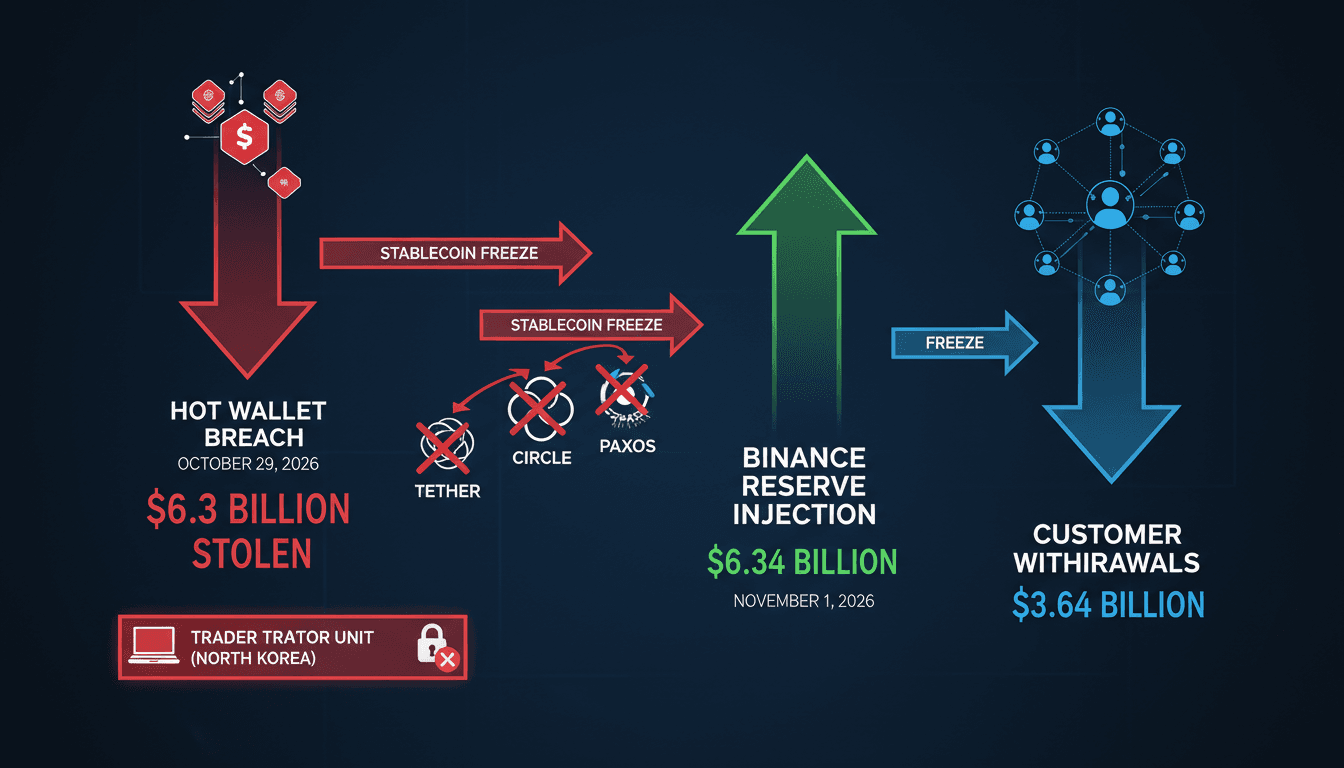
- The breach drained $6.3 billion across multiple networks: On October 29, 2026, malicious actors targeted Binance hot wallets across 9 to 11 blockchains, including Ethereum, Bitcoin, and Tron, siphoning between $6.3 billion and $6.36 billion in under 60 minutes.
- The exchange covered 95% of stolen funds immediately: Binance deployed approximately $6.34 billion of its own capital, utilizing internal reserves, the SAFU fund, and futures insurance to cover 90% to 95% of client losses while committing to absorb the full deficit.
- Phased withdrawals triggered $3.64 billion in immediate outflows: Operations resumed on November 1, 2026, for 15 primary tokens—including BTC, ETH, USDT, USDC, and DOGE—with clients withdrawing $3.64 billion upon reopening before platform activity stabilized.
The context you actually need
- State-linked cyber groups have escalated target sizes: The FBI and blockchain intelligence firms attributed the attack to North Korea's TraderTraitor unit, a group tied to previous cyber operations, including a $1.5 billion theft from Bybit in 2025.
- Hot wallet architecture creates single points of administrative failure: Investigators traced the compromise to a DevOps engineer's work laptop, granting unauthorized entry into automated withdrawal systems without requiring direct exposure of master private keys.
- Asset recovery relies on centralized stablecoin blacklists: Approximately $3 billion of the dispersed funds were located and partially frozen through coordinated actions involving stablecoin issuers like Tether and Circle alongside forensic blockchain tracking partners.
What's really happening
The mechanics of this breach expose the structural tension at the core of centralized exchanges: liquidity velocity versus cold-storage security. To service institutional high-frequency traders and millions of retail users, exchanges keep billions of dollars in internet-connected hot wallets. These hot wallets rely on automated authorization protocols to approve transactions instantly. When an attacker compromised a single DevOps engineer's computer, they bypassed external chain security, hijacking internal withdrawal pipelines to trigger thousands of automated approvals in 30 to 60 minutes.
The recovery mechanism demonstrates how centralized market structures respond to catastrophic insolvency risks. Binance chose to backstop the entire $6.3 billion loss directly from internal reserves, using a mix of corporate capital, the platform's self-funded SAFU (Secure Asset Fund for Users), and futures insurance pools. By deploying $6.34 billion to replace 95% of the missing tokens, the exchange effectively acted as its own lender of last resort. In doing so, it altered the incentive structure of exchange survival: preserving systemic confidence and halting runaway bank runs took precedence over short-term balance-sheet preservation.
When withdrawals reopened, the immediate outflow of $3.64 billion tested the platform's actual liquidity depth. Under standard fractional-reserve or under-collateralized arrangements, an immediate draw of that size following a security compromise risks cascading platform halts. Binance absorbed the outflow while processing parallel incoming deposits, demonstrating sufficient operational reserves to stabilize customer flow.
At the market level, the containment strategy relied on third-party centralization. The freezing of approximately $3 billion in assets depended heavily on centralized entities—specifically Tether and Circle—blacklisting smart contract addresses before tokens could enter decentralized mixing protocols. As stolen assets moved rapidly into Ethereum-based routing networks, the coordination between private issuers, analytical firms like TRM Labs, and law enforcement agencies revealed that cryptocurrency containment currently depends on centralized intervention points rather than purely decentralized software guarantees.
Who feels it first (and how)
- Centralized crypto exchange treasury leads: Operational managers face urgent technical audits to isolate DevOps privileged access environments, alongside higher reserve allocation requirements for self-insurance pools.
- Institutional liquidity providers and market makers: Desks operating cross-exchange arbitrage confront widening bid-ask spreads during security-related withdrawal pauses, forcing a reassessment of platform counterparty limits.
- Crypto-asset holders and retail depositors: Users experience temporary asset lockups and processing delays during tiered withdrawal restarts, alongside increased exposure to spot market volatility in major tokens like BNB, BTC, and ETH.
- Decentralized finance protocol operators: On-chain lending and liquidity pools face sudden supply shocks and regulatory scrutiny as blacklisted assets attempt to cross bridges into automated market makers.
What to watch next
- Proof-of-reserves independent verification: Watch for the publication of updated cryptographic proof-of-reserves audits from Binance, which will confirm the exact impact on its liquid corporate balance sheet after distributing $6.34 billion in compensation.
- Tether and Circle address-level blacklisting reports: Monitor secondary tracking data to evaluate how effectively centralized issuers isolate the remaining unrecovered funds as North Korean laundering networks route capital through decentralized mixing contracts.
- Regulatory enforcement filings in major trading hubs: Track whether market conduct supervisors mandate separate legal trusts for customer deposits, which would eliminate an exchange's ability to co-mingle insurance, operational capital, and client custody.
Hackers siphoned between $6.3 billion and $6.36 billion from Binance hot wallets on October 29, 2026, via a compromised DevOps workstation; Binance replaced 95% of the assets using $6.34 billion in reserves; initial post-reopening outflows reached $3.64 billion.
The operational absorption of the loss will prompt other centralized platforms to expand formal self-insurance reserves, while reducing the proportion of funds held in automated hot-wallet liquidity tiers.
The final recovery percentage of the roughly $3.3 billion not yet frozen remains uncertain, particularly as asset laundering operations progress through cross-chain privacy infrastructure.
Frequently Asked Questions
- Why it matters?
- The incident represents the largest recorded cryptocurrency theft in history, testing whether systemic private balance sheets can absorb multi-billion-dollar operational failures without triggering permanent liquidity runs.
- What happened (in 30 seconds)?
- The breach drained $6.3 billion across multiple networks: On October 29, 2026, malicious actors targeted Binance hot wallets across 9 to 11 blockchains, including Ethereum, Bitcoin, and Tron, siphoning between $6.3 billion and $6.36 billion in under 60 minutes. The exchange covered 95% of stolen funds immediately: Binance deployed approximately $6.34 billion of its own capital, utilizing internal reserves, the SAFU fund, and futures insurance to cover 90% to 95% of client losses while committing
- What's really happening?
- The mechanics of this breach expose the structural tension at the core of centralized exchanges: liquidity velocity versus cold-storage security. To service institutional high-frequency traders and millions of retail users, exchanges keep billions of dollars in internet-connected hot wallets. These hot wallets rely on automated authorization protocols to approve transactions instantly. When an attacker compromised a single DevOps engineer's computer, they bypassed external chain security, hijack
- Who feels it first (and how)?
- Centralized crypto exchange treasury leads: Operational managers face urgent technical audits to isolate DevOps privileged access environments, alongside higher reserve allocation requirements for self-insurance pools. Institutional liquidity providers and market makers: Desks operating cross-exchange arbitrage confront widening bid-ask spreads during security-related withdrawal pauses, forcing a reassessment of platform counterparty limits. Crypto-asset holders and retail depositors: Users expe
- What to watch next?
- Proof-of-reserves independent verification: Watch for the publication of updated cryptographic proof-of-reserves audits from Binance, which will confirm the exact impact on its liquid corporate balance sheet after distributing $6.34 billion in compensation. Tether and Circle address-level blacklisting reports: Monitor secondary tracking data to evaluate how effectively centralized issuers isolate the remaining unrecovered funds as North Korean laundering networks route capital through decentrali
Arabic-language coverage of international news and geopolitics.
"RT Arabic is a Russian state-funded outlet often criticized for promoting Kremlin-aligned narratives."
— A47 Editor
"بينانس" تعلن تزايد السحوبات مع عودة المنصة للعمل بعد سرقة 6.3 مليار دولار
Binance customers withdrew about $3.64 billion as the world's largest cryptocurrency exchange resumed operations on Sunday, following a hack in which attackers stole $6.3 billion in digital assets the previous week.
Arabic-language economic and business reporting with strong UAE market relevance.
"Emarat Al Youm business coverage often centers UAE property, banking, consumer issues, and economic policy."
— A47 Editor
بعد اختراق بمليارات الدولارات.. بينانس تعوض 90% من الأصول المسروقة بعد اختراق بمليارات الدولارات.. بينانس تعوض 90% من الأصول المسروقة
Binance, the world's largest cryptocurrency exchange, said it was hit by a security breach estimated to have affected about $6.3 billion in assets, potentially the largest crypto theft on record. The exchange froze deposits and withdrawals while inve...
Arabic-language reporting on global and regional news.
"BBC Arabic is part of the BBC, generally regarded for editorial standards and broad international coverage."
— A47 Editor
اختراق بينانس.. ما تفاصيل أكبر سرقة في تاريخ العملات المشفرة؟
Binance, the world's largest cryptocurrency exchange, was hit by a cyber incident affecting digital assets valued at about $6.3 billion, which reports describe as potentially the largest breach in the history of the crypto sector.
Pan-Arab political news and analysis.
"Al-Quds Al-Arabi is a London-based Arabic newspaper known for political coverage."
— A47 Editor
منصة العملات المشفّرة “باينانس” تؤكد تعرّضها لاختراق طال 6,3 مليارات دولار
Binance, one of the world's largest cryptocurrency trading platforms by daily trading volume, has confirmed that it suffered a wide-scale breach affecting funds worth approximately $6.3 billion, with roughly half of that amount frozen to prevent a ma...
Jordanian news and regional updates.
"Roya News is a Jordanian outlet focused on breaking news and local affairs."
— A47 Editor
بينانس تستأنف عمليات الإيداع وتبقي السحب معلقاً وتتوقع استئنافه خلال 48 ساعة
Binance has resumed deposit operations while keeping withdrawals suspended, with the exchange expecting withdrawals to resume within 48 hours, according to the base report published by Royanews on October 30, 2026. The article's summary notes a possi...
Arabic-language economic and business reporting with strong UAE market relevance.
"Emarat Al Youm business coverage often centers UAE property, banking, consumer issues, and economic policy."
— A47 Editor
«بينانس» تجمّد أصولاً رقمية عقب اختراق خلّف خسائر بـ6.3 مليار دولار «بينانس» تجمّد أصولاً رقمية عقب اختراق خلّف خسائر بـ6.3 مليار دولار
Binance, the world's largest cryptocurrency exchange, said it was hit by a security breach estimated to have affected about $6.3 billion in assets, potentially the largest crypto theft on record, and has frozen deposits and withdrawals while investig...
Sports reporting with a focus on Saudi and regional competitions.
"Okaz sports coverage is broad and audience-friendly, with strong attention to Saudi teams and leagues."
— A47 Editor
منصة «بينانس» تؤكد تعرضها لاختراق وتجمد 3 مليارات دولار
Binance, the world's largest cryptocurrency exchange by daily trading volume, announced on Thursday that it had suffered a major hack, prompting it to freeze digital assets worth $3 billion to prevent their theft, and suspended trading on some produc...