
Bitcoin Rebounds Above $77,000 After Record $6.3 Billion Binance Hack Triggers Market Sell-Off
Why it matters
The event demonstrates that systemic leverage in digital asset markets remains vulnerable to single-point custody failures, even as corporate balance sheets step in to prevent cascading institutional insolvencies.
What happened (in 30 seconds)
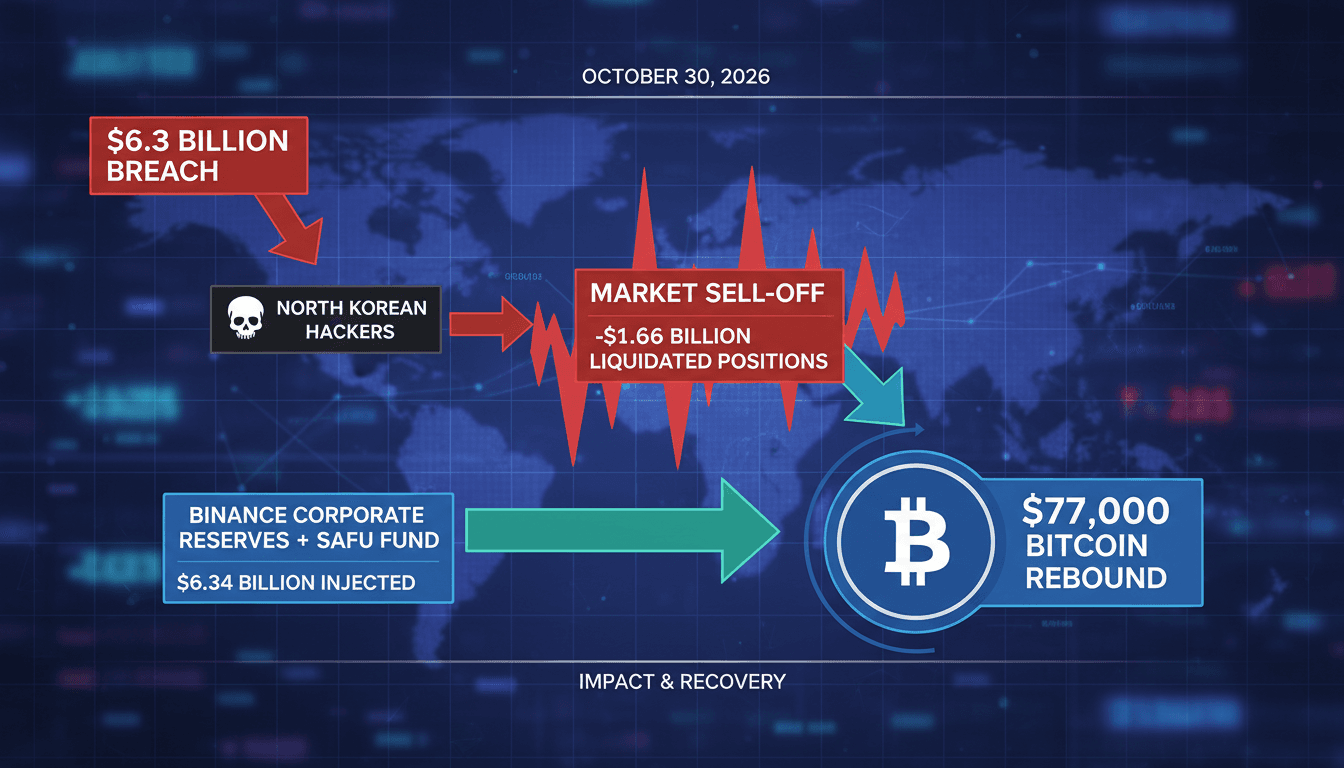
* The breach occurred on October 30, 2026: Unauthorized actors tied to North Korea’s TraderTraitor group extracted $6.3 billion from Binance, marking the largest nominal theft in digital asset history. * The market experienced rapid deleveraging: The disclosure forced Bitcoin down from near $82,000 to an intraday low of $76,320, triggering more than $1.66 billion in automated derivative liquidations concentrated in long positions. * The exchange absorbed the initial loss: Binance committed over $6.34 billion from corporate reserves and its SAFU fund, covering roughly 95% of the shortfall, initiating phased withdrawal restarts, and stabilizing Bitcoin back above $77,000.
The context you actually need
* Macro conditions had created elevated leverage: Bitcoin was testing $82,000 before the incident, supported by strong U.S. GDP figures that encouraged traders to expand long positions on derivative platforms. * Exchange infrastructure remains distinct from network layers: The security failure occurred within centralized custodial operations rather than the underlying Bitcoin blockchain, which operated without disruption throughout the volatility window. * Institutional frameworks are shifting toward segregated custody: In established crypto jurisdictions like Dubai, regulatory frameworks overseen by bodies like VARA have consistently pushed operators toward verifiable, third-party custody protocols to isolate client capital from exchange operational risks.
What's really happening
The mechanics of the October 30 liquidation spiral expose the structural fault lines between centralized custody and leveraged derivative markets. When the $6.3 billion breach was disclosed, market participants faced immediate uncertainty regarding Binance's solvency and short-term withdrawal capacity. Because Binance operates as the primary liquidity hub for spot and derivative trading pairs globally, any threat to its reserve backing triggers instantaneous defensive behavior across execution venues.
Traders looking to hedge exposure or de-risk offloaded spot assets, initiating a rapid decline in Bitcoin’s spot price from the $82,000 range down to $76,320. This downward price velocity immediately crossed liquidation thresholds on leveraged derivative contracts tracked by platforms like Coinglass. The resulting margin calls triggered automated market sells, compounding the order book pressure. In total, the drop forced $1.66 billion in liquidated positions—predominantly leveraged longs entered during the macro rally following recent U.S. GDP prints.
The stabilizing factor was not market buying from retail participants, but the rapid deployment of corporate capital. Binance utilized its internal corporate reserves and its dedicated SAFU (Secure Asset Fund for Users) balance to backstop roughly 95% of the $6.3 billion shortfall, committing over $6.34 billion in total corporate capital. This action prevented a run on the platform’s broader reserve base and enabled the exchange to institute phased withdrawal rollouts instead of a blanket halt.
By afternoon trading, Bitcoin recovered above $77,000, bringing its net daily decline to approximately 4.7% and leaving total market capitalization at $1.55 trillion. Analysts, including institutional desks at Cantor Fitzgerald, framed the event as an isolated operational breakdown of exchange custody rather than an economic impairment of the asset itself. This distinction drove buying interest near the $76,320 floor. However, the incentive structure revealed by the incident highlights an ongoing trade-off: market participants still trade execution speed and internal liquidity on centralized exchanges at the expense of non-segregated custody risk.
Who feels it first (and how)
* Centralized derivative traders: Over $1.66 billion in margin accounts was systematically liquidated within hours as stop orders and automated margin calls triggered on falling spot prices. * Exchange infrastructure and security heads: Operations and risk teams face immediate audits regarding automated asset withdrawal limits, AI-enhanced intrusion detection, and the structure of emergency reserve funds. * Institutional allocators and family offices: Capital managers in hubs like Dubai and Singapore must balance the convenience of exchange liquidity against local regulatory requirements (such as VARA frameworks) demanding third-party segregated custody. * Retail platform depositors: Users facing phased withdrawal schedules must manage temporary liquidity friction while Binance executes planned proof-of-reserves updates.
What to watch next
* Proof-of-reserves verification: Watch for the publication of Binance’s updated reserve attestations; failure to demonstrate a full 1:1 asset backing after deploying $6.34 billion from corporate funds will delay normal withdrawal timelines. * Withdrawal velocity following phased restarts: Track the net outflow volume across centralized exchanges; sustained capital flight into cold storage indicates a structural shift away from exchange-hosted order books. * Regulatory custody mandates: Monitor whether regional authorities accelerate deadlines requiring centralized exchanges to separate trading functions from asset custody.
Attackers associated with the North Korean TraderTraitor network stole $6.3 billion from Binance; liquidations exceeded $1.66 billion; Bitcoin closed the intraday session down roughly 4.7% around $77,000 after reaching a low of $76,320.
The deployment of over $6.34 billion in corporate reserves will prevent an exchange-level liquidity freeze, but will constrain Binance’s capital availability for subsequent operational expansion or risk coverage.
The exact timeline for a full return to unphased withdrawal operations across all tokens, and the degree to which institutional desks permanently redirect trading volume to non-custodial or independent custodian venues.
Frequently Asked Questions
- Why it matters?
- The event demonstrates that systemic leverage in digital asset markets remains vulnerable to single-point custody failures, even as corporate balance sheets step in to prevent cascading institutional insolvencies.
- What happened (in 30 seconds)?
- The breach occurred on October 30, 2026: Unauthorized actors tied to North Korea’s TraderTraitor group extracted $6.3 billion from Binance, marking the largest nominal theft in digital asset history. The market experienced rapid deleveraging: The disclosure forced Bitcoin down from near $82,000 to an intraday low of $76,320, triggering more than $1.66 billion in automated derivative liquidations concentrated in long positions. The exchange absorbed the initial loss: Binance committed over $6.34
- What's really happening?
- The mechanics of the October 30 liquidation spiral expose the structural fault lines between centralized custody and leveraged derivative markets. When the $6.3 billion breach was disclosed, market participants faced immediate uncertainty regarding Binance's solvency and short-term withdrawal capacity. Because Binance operates as the primary liquidity hub for spot and derivative trading pairs globally, any threat to its reserve backing triggers instantaneous defensive behavior across execution v
- Who feels it first (and how)?
- Centralized derivative traders: Over $1.66 billion in margin accounts was systematically liquidated within hours as stop orders and automated margin calls triggered on falling spot prices. Exchange infrastructure and security heads: Operations and risk teams face immediate audits regarding automated asset withdrawal limits, AI-enhanced intrusion detection, and the structure of emergency reserve funds. Institutional allocators and family offices: Capital managers in hubs like Dubai and Singapore
- What to watch next?
- Proof-of-reserves verification: Watch for the publication of Binance’s updated reserve attestations; failure to demonstrate a full 1:1 asset backing after deploying $6.34 billion from corporate funds will delay normal withdrawal timelines. Withdrawal velocity following phased restarts: Track the net outflow volume across centralized exchanges; sustained capital flight into cold storage indicates a structural shift away from exchange-hosted order books. Regulatory custody mandates: Monitor whethe
Covers Bitcoin plus altcoin news, market updates, and educational resources.
"Bitcoin.com provides news, market data, and guides focused on Bitcoin and the wider crypto industry."
— A47 Editor
Bitcoin Price Rebounds Above $77K, but Binance Hack Keeps Traders on Edge
Bitcoin rebounded above $77,000 on October 30, 2026, but traders remain on edge after a reported multibillion-dollar hack at Binance, with the exchange stating roughly $6.3 billion in assets were involved and about $2.54 to $3 billion had been frozen...
Real-time updates, analysis, and reports on the blockchain and cryptocurrency sectors.
"Crypto News delivers real-time updates, analysis, and reports on the blockchain and cryptocurrency sectors."
— A47 Editor
Crypto stocks tumble as Coinbase loses 12.5% after Binance hack
Crypto stocks fell as much as 12.54% on October 30, with Coinbase leading the losses following its quarterly earnings release and the reported Binance security breach estimated at $6.3 billion in assets; Binance has said roughly $2.54 to $3 billion h...
Real-time updates, analysis, and reports on the blockchain and cryptocurrency sectors.
"Crypto News delivers real-time updates, analysis, and reports on the blockchain and cryptocurrency sectors."
— A47 Editor
Bitcoin falls below $77,000 after Binance hack, can $80,000 return?
Bitcoin fell below $77,000 during an October 30 sell-off following Binance's estimated $6.3 billion security breach, with Binance market data placing Bitcoin at $76,944 shortly after the decline. Analysts are watching support near $76,000 and the con...
Markets desk coverage, trading insights, and investor updates.
"WSJ’s markets reporting provides in-depth analysis and context for investors."
— A47 Editor
Cryptocurrencies Pare Losses After $6.3 Billion Hack Spooks Markets
Bitcoin and Ethereum pared early losses after a reported $6.3 billion hack at the world's largest crypto exchange, Binance, spooked markets. Both cryptocurrencies had fallen more than 3% on the news before recovering some ground, according to The Wal...
Covers blockchain, cryptocurrency news, project analysis, and market insights.
"Cointelegraph is a leading crypto-focused media outlet known for timely news, analysis, and educational content related to blockchain and digital assets."
— A47 Editor
Bitcoin price metrics hint at rebound as $1.6B liquidations follow Binance hack
Bitcoin held above $76,000 after a reported multibillion-dollar hack at Binance, with about $1.6 billion in crypto liquidations following the incident and a tech-stock sell-off adding pressure, while momentum indicators pointed to a possible rebound.
Real-time updates, analysis, and reports on the blockchain and cryptocurrency sectors.
"Crypto News delivers real-time updates, analysis, and reports on the blockchain and cryptocurrency sectors."
— A47 Editor
Why is Bitcoin price falling today as Binance hack triggers $1.5B liquidations?
Bitcoin fell to around $78,419 as a reported Binance hack triggered heavy crypto liquidations estimated at $1.5 billion, with traders watching resistance near $80,000 and support near $76,300. Binance said $2.54 billion in assets had been frozen, whi...
UAE-based English-language newspaper covering regional politics, economics, and global affairs.
"The National reflects Emirati policy perspectives while maintaining international editorial standards."
— A47 Editor
Bitcoin slides below $77,000 after Binance hit by biggest crypto theft on record
Bitcoin slid below $77,000 after Binance, the world's largest cryptocurrency exchange, froze deposits and withdrawals while investigating a security breach estimated at about $6.3 billion in affected assets, which would make it the largest crypto the...
Currency market headlines, FX rates, central-bank chatter, and macro drivers moving major pairs.
"Investing.com’s forex stream is useful for fast updates across USD, EUR, JPY, GBP and emerging-market FX."
— A47 Editor
Bitcoin, cryptocurrency prices fall after Binance reports security issue
Bitcoin and other cryptocurrency prices fell after Binance, the world's largest crypto exchange, reported a security issue, with the breach estimated to affect about $6.3 billion in assets and described as the largest crypto heist on record. Binance ...