
Binance Suffers Record $6.3 Billion Hot Wallet Breach as Bitcoin Rebounds Above $77,000
Why it matters
A $6.3 billion breach tests whether centralized exchange balance sheets and private issuer interventions can absorb systemic losses without triggering a structural liquidation spiral across global digital asset markets.
What happened (in 30 seconds)
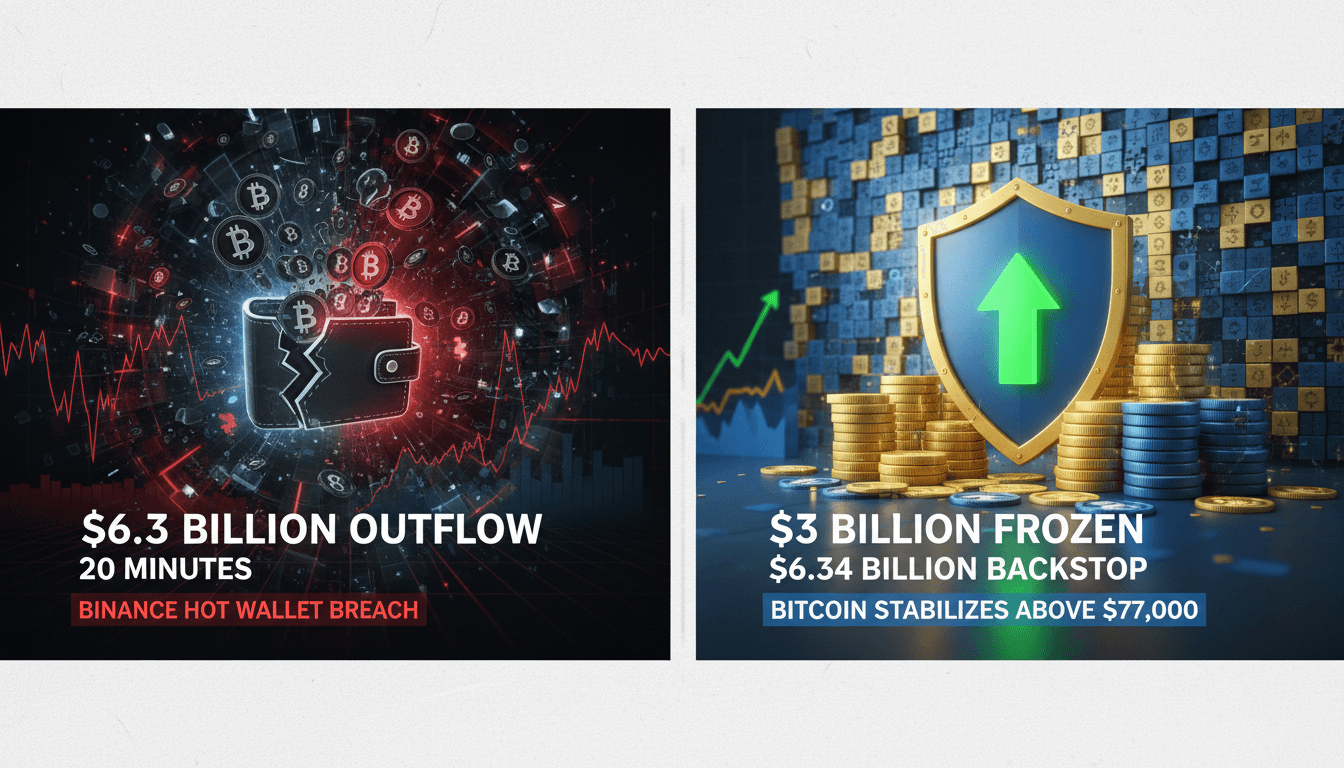
- An unauthorized intrusion drained billions: On October 29, 2026, attackers compromised Binance hot wallets across at least 10 blockchains, siphoning approximately $6.3 billion within a 20-minute window.
- Forced liquidations wiped out leverage: The incident triggered a sharp market slide that erased more than $2,500 from the price of Bitcoin, pushing it to a low of $76,320 and causing over $1.66 billion in liquidated positions.
- The market recovered its floor: Following Binance’s commitment to deploy over $6.34 billion in reserves to cover all affected balances and the freezing of $3 billion in assets by issuers, Bitcoin rebounded above $77,000 on October 30.
The context you actually need
- Macro tailwinds were interrupted: Bitcoin had climbed toward $82,000 earlier on October 29 following strong U.S. GDP data before the unauthorized withdrawals abruptly reversed upward momentum.
- The scale exceeds previous benchmarks: The $6.3 billion stolen surpasses the $1.5 billion Bybit incident from 2025, establishing this event as the largest recorded digital asset theft to date.
- Centralized intervention contained contagion: Coordinated balance freezes by centralized stablecoin issuers like Tether and Circle, combined with internal exchange backstops, insulated broader order books from full insolvency shocks.
What's really happening
The underlying mechanics of this event expose a persistent structural tension: the operational necessity of exchange hot wallets versus the concentration of counterparty risk. To facilitate instantaneous trading, clearing, and withdrawal execution, centralized exchanges must maintain billions of dollars in internet-connected multi-chain environments. When malicious actors—in this case attributed by analysts to North Korean-linked networks including the Lazarus Group—compromise private key infrastructure across 10 distinct blockchains simultaneously, the failure is purely operational, not architectural to decentralized consensus.
The institutional response illustrates how incentives dictate modern market resilience. In earlier market cycles, a deficit of $6.3 billion would have produced insolvencies across lenders, market makers, and custodians. Here, the immediate containment mechanism relied on two balance sheet backstops: internal reserves and issuer-level administrative controls. Binance committed its Secure Asset Fund for Users (SAFU) and treasury reserves exceeding $6.34 billion to guarantee a 1:1 whole-account recovery. Concurrently, major centralized stablecoin issuers, notably Tether and Circle, froze approximately $3 billion in illicit flows before the funds could enter decentralized liquidity pools or centralized off-ramps.
This response averted a systemic bank run, yet it highlights the ongoing trade-offs within the digital asset ecosystem. Market resilience is increasingly underwritten by balance sheet concentration and centralized emergency coordination rather than purely trustless systems. While Bitcoin's market capitalization stabilized near $1.55 trillion and the broader aggregate crypto market settled around $2.7 trillion, over $1.66 billion in leveraged trader equity was wiped out through automated margin calls.
For institutional allocators, the event formalizes an operational reality: exchange security risk remains decoupled from the sovereign security of underlying layer-one protocols like Bitcoin. However, as long as trading liquidity remains pooled within centralized environments, individual participants bear the drag of flash liquidations, temporary withdrawal suspensions, and spread widening during unauthorized balance sheet extractions.
Who feels it first (and how)
- Leveraged derivative traders: Long-oriented traders bore the immediate brunt of the volatility, losing $1.66 billion to automated liquidation engines as Bitcoin shed over $2,500 in minutes.
- Centralized exchange operators: Major platform treasuries now face elevated capital allocation costs to fund emergency backstops, insurance reserves, and advanced cryptographic infrastructure against state-sponsored vectors.
- Global allocators and corporate treasuries: Institutional desks face internal governance pressure to reduce exchange-held operational balances and accelerate transitions to qualified third-party cold-storage custodians.
- UAE and regional market participants: Regional institutional participants operating under clear domestic licensing frameworks experienced indirect price markdowns but avoided platform-level disruptions due to strict domestic custody mandates.
What to watch next
- Withdrawal pipeline restoration: Monitor the successful resumption of platform-wide withdrawals targeted for November 1, 2026, to verify asset solvency without triggering a delayed secondary bank run.
- Asset recovery execution: Track the legal and on-chain process of converting the $3 billion in frozen issuer assets back into unencumbered platform reserves.
- Custody mandate revisions: Watch for regulatory bodies to introduce stricter caps on the maximum capital percentages exchanges may hold in hot-wallet environments.
Attackers drained $6.3 billion from Binance hot wallets across 10 blockchains in 20 minutes, triggering $1.66 billion in market liquidations before Bitcoin stabilized above $77,000.
State-linked cyber actors targeting institutional hot wallets will prompt global exchanges to enforce mandatory multi-party computation delays on large-scale treasury transactions.
It remains uncertain how long frozen stablecoin assets will remain locked in administrative escrow before being fully returned to operational exchange reserves.
Frequently Asked Questions
- Why it matters?
- A $6.3 billion breach tests whether centralized exchange balance sheets and private issuer interventions can absorb systemic losses without triggering a structural liquidation spiral across global digital asset markets.
- What happened (in 30 seconds)?
- An unauthorized intrusion drained billions: On October 29, 2026, attackers compromised Binance hot wallets across at least 10 blockchains, siphoning approximately $6.3 billion within a 20-minute window. Forced liquidations wiped out leverage: The incident triggered a sharp market slide that erased more than $2,500 from the price of Bitcoin, pushing it to a low of $76,320 and causing over $1.66 billion in liquidated positions. The market recovered its floor: Following Binance’s commitment to depl
- What's really happening?
- The underlying mechanics of this event expose a persistent structural tension: the operational necessity of exchange hot wallets versus the concentration of counterparty risk. To facilitate instantaneous trading, clearing, and withdrawal execution, centralized exchanges must maintain billions of dollars in internet-connected multi-chain environments. When malicious actors—in this case attributed by analysts to North Korean-linked networks including the Lazarus Group—compromise private key infras
- Who feels it first (and how)?
- Leveraged derivative traders: Long-oriented traders bore the immediate brunt of the volatility, losing $1.66 billion to automated liquidation engines as Bitcoin shed over $2,500 in minutes. Centralized exchange operators: Major platform treasuries now face elevated capital allocation costs to fund emergency backstops, insurance reserves, and advanced cryptographic infrastructure against state-sponsored vectors. Global allocators and corporate treasuries: Institutional desks face internal governa
- What to watch next?
- Withdrawal pipeline restoration: Monitor the successful resumption of platform-wide withdrawals targeted for November 1, 2026, to verify asset solvency without triggering a delayed secondary bank run. Asset recovery execution: Track the legal and on-chain process of converting the $3 billion in frozen issuer assets back into unencumbered platform reserves. Custody mandate revisions: Watch for regulatory bodies to introduce stricter caps on the maximum capital percentages exchanges may hold in ho
Covers Bitcoin plus altcoin news, market updates, and educational resources.
"Bitcoin.com provides news, market data, and guides focused on Bitcoin and the wider crypto industry."
— A47 Editor
Bitcoin Price Rebounds Above $77K, but Binance Hack Keeps Traders on Edge
Bitcoin rebounded above $77,000 on October 30, 2026, but traders remain on edge after a reported multibillion-dollar hack at Binance, with the exchange stating roughly $6.3 billion in assets were involved and about $2.54 to $3 billion had been frozen...
Real-time updates, analysis, and reports on the blockchain and cryptocurrency sectors.
"Crypto News delivers real-time updates, analysis, and reports on the blockchain and cryptocurrency sectors."
— A47 Editor
Crypto stocks tumble as Coinbase loses 12.5% after Binance hack
Crypto stocks fell as much as 12.54% on October 30, with Coinbase leading the losses following its quarterly earnings release and the reported Binance security breach estimated at $6.3 billion in assets; Binance has said roughly $2.54 to $3 billion h...
Covers blockchain, cryptocurrency news, project analysis, and market insights.
"Cointelegraph is a leading crypto-focused media outlet known for timely news, analysis, and educational content related to blockchain and digital assets."
— A47 Editor
Bitcoin price metrics hint at rebound as $1.6B liquidations follow Binance hack
Bitcoin held above $76,000 after a reported multibillion-dollar hack at Binance, with about $1.6 billion in crypto liquidations following the incident and a tech-stock sell-off adding pressure, while momentum indicators pointed to a possible rebound.
Real-time updates, analysis, and reports on the blockchain and cryptocurrency sectors.
"Crypto News delivers real-time updates, analysis, and reports on the blockchain and cryptocurrency sectors."
— A47 Editor
Why is Bitcoin price falling today as Binance hack triggers $1.5B liquidations?
Bitcoin fell to around $78,419 as a reported Binance hack triggered heavy crypto liquidations estimated at $1.5 billion, with traders watching resistance near $80,000 and support near $76,300. Binance said $2.54 billion in assets had been frozen, whi...
UAE-based English-language newspaper covering regional politics, economics, and global affairs.
"The National reflects Emirati policy perspectives while maintaining international editorial standards."
— A47 Editor
Bitcoin slides below $77,000 after Binance hit by biggest crypto theft on record
Bitcoin slid below $77,000 after Binance, the world's largest cryptocurrency exchange, was hit by a security breach estimated at $6.3 billion in affected assets, which would make it the largest crypto theft on record. The exchange froze deposits and ...
Currency market headlines, FX rates, central-bank chatter, and macro drivers moving major pairs.
"Investing.com’s forex stream is useful for fast updates across USD, EUR, JPY, GBP and emerging-market FX."
— A47 Editor
Bitcoin, cryptocurrency prices fall after Binance reports security issue
Bitcoin and other cryptocurrency prices fell after Binance, the world's largest crypto exchange, reported a security breach and suspended deposits and withdrawals; the company estimates about $6.3 billion in assets were affected, which would make it ...