
Binance Suffers Record $6.3 Billion Hot Wallet Breach Attributed to North Korea-Linked TraderTraitor as Bitcoin Rebounds Above $77,000
Why it matters
The absorption of the largest digital asset heist on record without a sustained market collapse demonstrates that centralized liquidity backstops and issuer-level asset freezes can isolate systemic platform failure from asset valuation.
What happened (in 30 seconds)
- A $6.3 billion hot wallet breach hit Binance: On October 29, 2026, the North Korea-linked cyber syndicate TraderTraitor extracted $6.3 billion across Ethereum and Bitcoin chains following an intrusion initially traced to a compromised DevOps engineer's machine.
- Forced liquidations drove a rapid price drop: Bitcoin plunged more than 5% from near $82,000 to an intraday multiweek low of $76,320, triggering $1.66 billion in total derivative wipeouts, with long positions accounting for 83% of the losses.
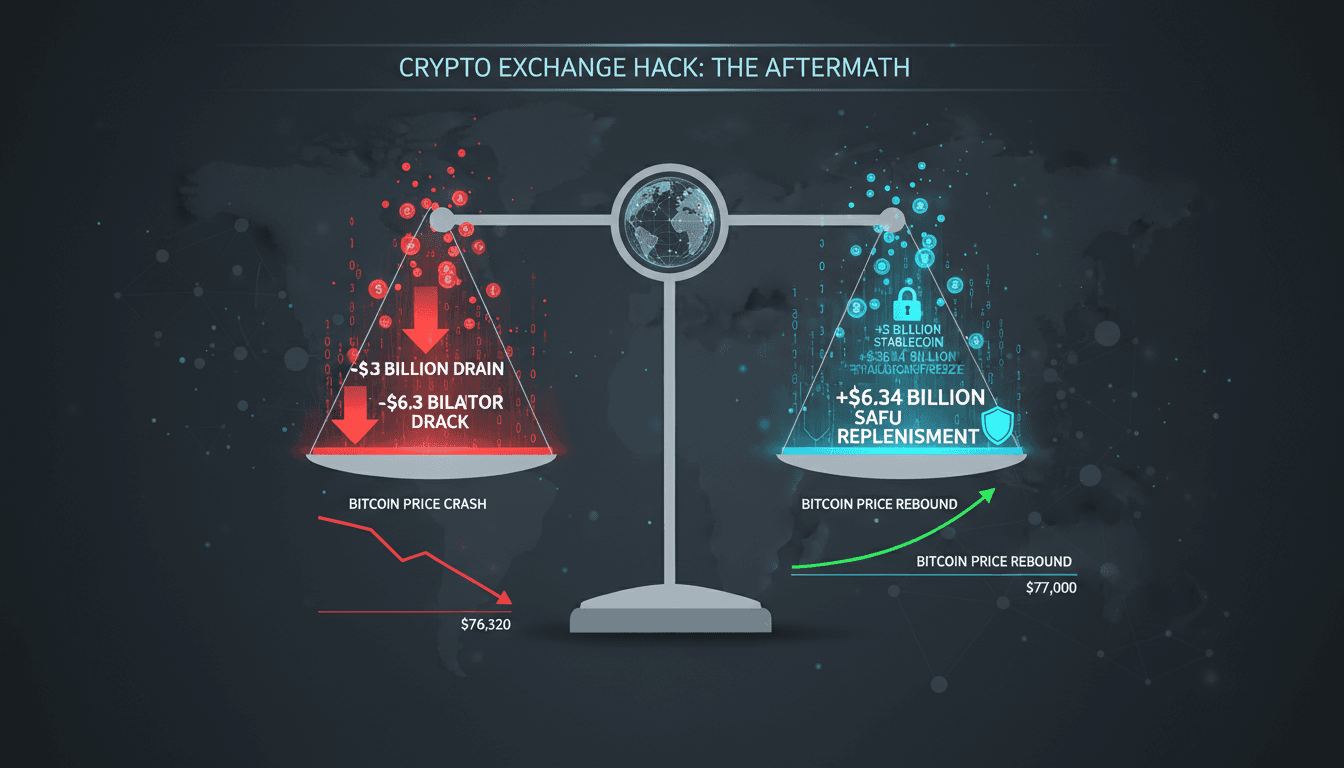
- Corporate reserves and coordinated freezes arrested the decline: Bitcoin stabilized above $77,000 after Binance committed $6.34 billion from its Secure Asset Fund for Users (SAFU) and corporate treasury, while stablecoin issuers and analytics partners froze roughly $3 billion in stolen funds.
The context you actually need
- Macro tailwinds softened the initial shock: Just prior to the disclosure, strong U.S. GDP data had propelled Bitcoin toward $82,000, establishing a baseline of institutional liquidity that prevented the breach from breaking broader macro market structures.
- The incident follows prior major exchange compromises: The scale eclipses the 2025 Bybit breach and lands directly amid active institutional deliberations over custodial risk, the CLARITY Act, and multi-signature security baselines.
- Protocol resilience decoupled from counterparty exposure: Market participants treated the event strictly as a centralized operational compromise rather than an architectural failure of Bitcoin or Ethereum, keeping total crypto market capitalization anchored at approximately $2.7 trillion.
What's really happening
The market reaction to the extraction of $6.3 billion reveals a fundamental shift in how digital asset valuations interact with exchange solvency. In previous market cycles, an exchange loss of this magnitude would have provoked an extended liquidity spiral. Instead, Bitcoin shed roughly 5% before recovering past $77,000 within 24 hours. This price resilience reflects a clear market calculation: the balance sheet capacity of the exchange, combined with swift centralized asset containment, offset the risk of an unbacked run.
The mechanics of the stabilization rest on three distinct operational levers.
First, Binance operationalized its internal backstops immediately. By deploying its dedicated SAFU reserve alongside corporate treasury assets, the exchange absorbed the entire $6.3 billion liability without shifting haircut risk to retail or institutional depositors. By October 31, Binance had replenished 90% of the drained liquidity. This demonstrated that exchange risk is increasingly functioning like private deposit insurance, where enterprise balance sheets neutralize systemic contagion before it forces fire-sales of underlying spot assets.
Second, the structural architecture of public ledgers worked against the attackers’ ability to liquidate capital. Analytics firms TRM Labs and Chainalysis mapped the illicit flows across the Bitcoin and Ethereum networks in real time. Because the stolen capital was concentrated rather than dispersed, centralized stablecoin issuers Circle and Tether intervened to freeze more than $2 billion of the illicit balances directly on-chain. When combined with partner exchange blacklists, approximately $3 billion—nearly half of the total theft—was rendered illiquid almost immediately. This structural friction prevented the attackers from dumping their loot into open order books, removing an acute source of spot selling pressure.
Third, the derivative liquidation cascade burned through overleveraged positions without damaging the fundamental spot market structure. The $1.66 billion in liquidations cleared out high-leverage long positions, leaving spot order books intact. Because the exploit originated from internal operational infrastructure—specifically a compromised DevOps entry point—rather than a vulnerability in Bitcoin’s consensus or cryptographic primitives, long-term capital allocators saw no reason to reprice the core asset. The trade-off is clear: market participants increasingly accept that while centralized hot wallets present high-value single points of operational failure, institutional balance sheets and coordinated private interventions can insulate macro asset prices from catastrophic counterparty collapse.
Who feels it first (and how)
- High-leverage derivative traders: Absorbed $1.66 billion in rapid liquidations as long positions (83% of total) were liquidated within hours of the initial announcement.
- Exchange operational and security leads: Face immediate pressure to audit internal developer access, hot-wallet limits, and multi-party computation protocols after a single DevOps compromise exposed billions.
- Active Binance depositors: Experienced paused withdrawal operations, leaving their capital temporarily illiquid pending enterprise-wide security reviews and balance sheet remediation.
- Corporate treasury and fund managers: Must evaluate the trade-off of maintaining liquidity on large centralized exchanges versus the capital drag and latency of cold-storage institutional custody models.
What to watch next
- The November 2 proof-of-reserves audit: Binance’s scheduled publication will verify whether the replenishment of the remaining 10% of lost assets is complete and transparently backed by verified reserves.
- Resumption of unrestricted fiat and crypto withdrawals: The operational restart of full withdrawal functions will test whether customer confidence remains intact or if a delayed capital flight materializes.
- Stablecoin issuer regulatory alignment: The coordination between Tether, Circle, and analytics firms to freeze $2 billion sets a clear operational precedent for how quickly private issuers can lock assets during law enforcement and security interventions.
TraderTraitor executed unauthorized withdrawals totaling $6.3 billion from Binance hot wallets on October 29, 2026; Bitcoin dropped to $76,320 alongside $1.66 billion in liquidations before recovering above $77,000; Binance tapped SAFU and corporate reserves to cover all losses; stablecoin issuers and partners froze approximately $3 billion in assets.
The full resumption of platform withdrawals will create short-term liquidity outflows from Binance toward self-custody and rival institutional venues as risk managers reduce platform concentration.
Whether the remaining unfrozen funds (over $3 billion) can be laundered through decentralized rails without being intercepted, and how regulators evaluating the CLARITY Act will respond to exchange hot-wallet exposure limits.
Frequently Asked Questions
- Why it matters?
- The absorption of the largest digital asset heist on record without a sustained market collapse demonstrates that centralized liquidity backstops and issuer-level asset freezes can isolate systemic platform failure from asset valuation.
- What happened (in 30 seconds)?
- A $6.3 billion hot wallet breach hit Binance: On October 29, 2026, the North Korea-linked cyber syndicate TraderTraitor extracted $6.3 billion across Ethereum and Bitcoin chains following an intrusion initially traced to a compromised DevOps engineer's machine. Forced liquidations drove a rapid price drop: Bitcoin plunged more than 5% from near $82,000 to an intraday multiweek low of $76,320, triggering $1.66 billion in total derivative wipeouts, with long positions accounting for 83% of the los
- What's really happening?
- The market reaction to the extraction of $6.3 billion reveals a fundamental shift in how digital asset valuations interact with exchange solvency. In previous market cycles, an exchange loss of this magnitude would have provoked an extended liquidity spiral. Instead, Bitcoin shed roughly 5% before recovering past $77,000 within 24 hours. This price resilience reflects a clear market calculation: the balance sheet capacity of the exchange, combined with swift centralized asset containment, offset
- Who feels it first (and how)?
- High-leverage derivative traders: Absorbed $1.66 billion in rapid liquidations as long positions (83% of total) were liquidated within hours of the initial announcement. Exchange operational and security leads: Face immediate pressure to audit internal developer access, hot-wallet limits, and multi-party computation protocols after a single DevOps compromise exposed billions. Active Binance depositors: Experienced paused withdrawal operations, leaving their capital temporarily illiquid pending e
- What to watch next?
- The November 2 proof-of-reserves audit: Binance’s scheduled publication will verify whether the replenishment of the remaining 10% of lost assets is complete and transparently backed by verified reserves. Resumption of unrestricted fiat and crypto withdrawals: The operational restart of full withdrawal functions will test whether customer confidence remains intact or if a delayed capital flight materializes. Stablecoin issuer regulatory alignment: The coordination between Tether, Circle, and ana
Covers Bitcoin plus altcoin news, market updates, and educational resources.
"Bitcoin.com provides news, market data, and guides focused on Bitcoin and the wider crypto industry."
— A47 Editor
Bitcoin Price Rebounds Above $77K, but Binance Hack Keeps Traders on Edge
Bitcoin rebounded above $77,000 on October 30, 2026, but traders remain on edge after a reported multibillion-dollar hack at Binance, with the exchange stating roughly $6.3 billion in assets were involved and about $2.54 to $3 billion had been frozen...
Real-time updates, analysis, and reports on the blockchain and cryptocurrency sectors.
"Crypto News delivers real-time updates, analysis, and reports on the blockchain and cryptocurrency sectors."
— A47 Editor
Crypto stocks tumble as Coinbase loses 12.5% after Binance hack
Crypto stocks fell as much as 12.54% on October 30, with Coinbase leading the losses following its quarterly earnings release and the reported Binance security breach estimated at $6.3 billion in assets; Binance has said roughly $2.54 to $3 billion h...
Real-time updates, analysis, and reports on the blockchain and cryptocurrency sectors.
"Crypto News delivers real-time updates, analysis, and reports on the blockchain and cryptocurrency sectors."
— A47 Editor
Bitcoin falls below $77,000 after Binance hack, can $80,000 return?
Bitcoin fell below $77,000 during an October 30 sell-off following Binance's estimated $6.3 billion security breach, with Binance market data placing Bitcoin at $76,944 shortly after the decline. Analysts are watching support near $76,000 and the con...
Markets desk coverage, trading insights, and investor updates.
"WSJ’s markets reporting provides in-depth analysis and context for investors."
— A47 Editor
Cryptocurrencies Pare Losses After $6.3 Billion Hack Spooks Markets
Bitcoin and Ethereum pared early losses after a reported $6.3 billion hack at the world's largest crypto exchange, Binance, spooked markets. Both cryptocurrencies had fallen more than 3% on the news before recovering some ground, according to The Wal...
Covers blockchain, cryptocurrency news, project analysis, and market insights.
"Cointelegraph is a leading crypto-focused media outlet known for timely news, analysis, and educational content related to blockchain and digital assets."
— A47 Editor
Bitcoin price metrics hint at rebound as $1.6B liquidations follow Binance hack
Bitcoin held above $76,000 after a reported multibillion-dollar hack at Binance, with about $1.6 billion in crypto liquidations following the incident and a tech-stock sell-off adding pressure, while momentum indicators pointed to a possible rebound.
Real-time updates, analysis, and reports on the blockchain and cryptocurrency sectors.
"Crypto News delivers real-time updates, analysis, and reports on the blockchain and cryptocurrency sectors."
— A47 Editor
Why is Bitcoin price falling today as Binance hack triggers $1.5B liquidations?
Bitcoin fell to around $78,419 as a reported Binance hack triggered heavy crypto liquidations estimated at $1.5 billion, with traders watching resistance near $80,000 and support near $76,300. Binance said $2.54 billion in assets had been frozen, whi...
UAE-based English-language newspaper covering regional politics, economics, and global affairs.
"The National reflects Emirati policy perspectives while maintaining international editorial standards."
— A47 Editor
Bitcoin slides below $77,000 after Binance hit by biggest crypto theft on record
Bitcoin slid below $77,000 after Binance, the world's largest cryptocurrency exchange, froze deposits and withdrawals while investigating a security breach estimated at about $6.3 billion in affected assets, which would make it the largest crypto the...
Currency market headlines, FX rates, central-bank chatter, and macro drivers moving major pairs.
"Investing.com’s forex stream is useful for fast updates across USD, EUR, JPY, GBP and emerging-market FX."
— A47 Editor
Bitcoin, cryptocurrency prices fall after Binance reports security issue
Bitcoin and other cryptocurrency prices fell after Binance, the world's largest crypto exchange, reported a security breach that it estimates affected about $6.3 billion in assets, and suspended deposits and withdrawals while it investigated.
Covers blockchain, cryptocurrency news, project analysis, and market insights.
"Cointelegraph is a leading crypto-focused media outlet known for timely news, analysis, and educational content related to blockchain and digital assets."
— A47 Editor
Binance hack rattles markets as BNB falls 8%, Bitcoin nears $77K
Binance disclosed a security breach reported at roughly $6.3 billion in assets, with about $2.54 to $3 billion frozen so far, triggering a sharp sell-off across crypto markets. BNB fell about 8% while Bitcoin slid toward the $77,000 level as the inci...