
Binance Hot Wallet Breach Expands to Multiple Attack Vectors in $6.3 Billion Theft Attributed to TraderTraitor
Why it matters
The compromise of $6.3 billion across ten blockchains demonstrates that operational transaction routing containers—rather than cold-storage custody vaults—represent the primary systemic vulnerability in digital asset market infrastructure.
What happened (in 30 seconds)
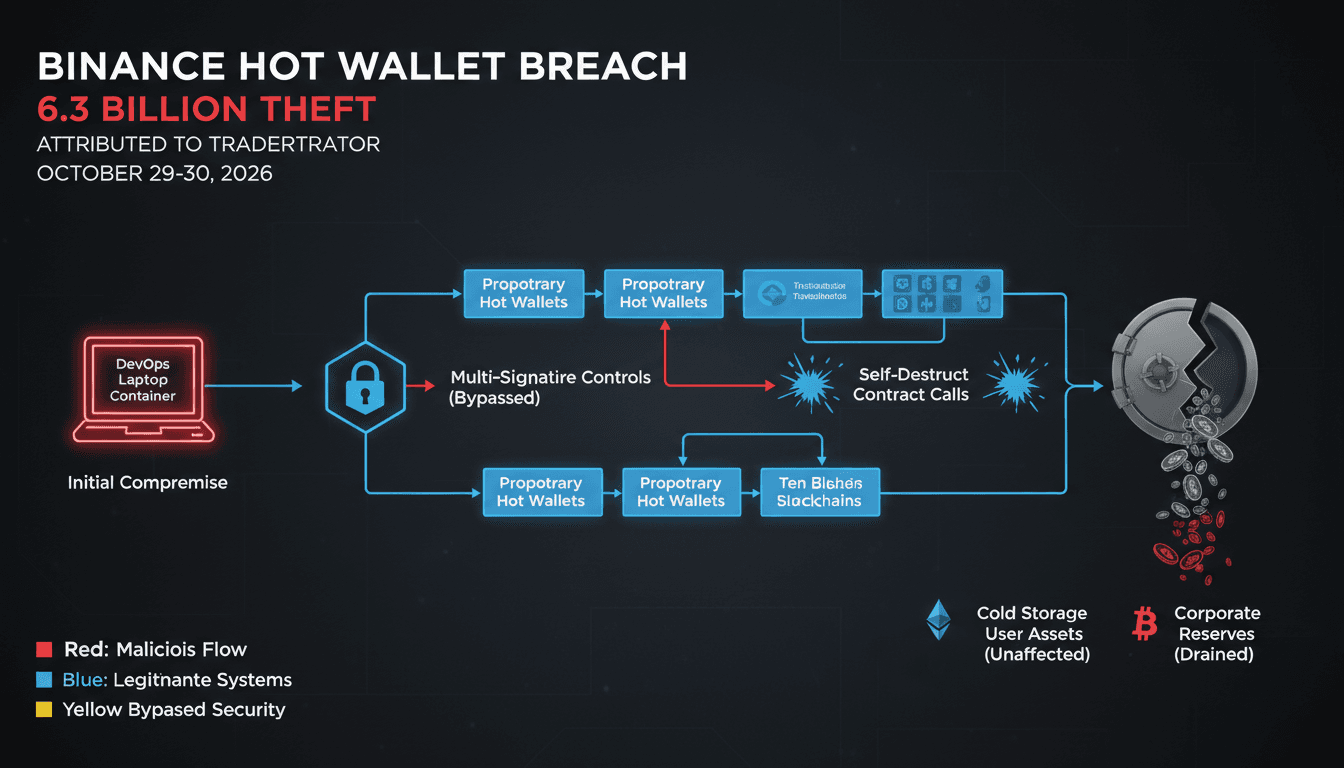
* The infrastructure breach: At 20:05 UTC on October 29, 2026, attackers compromised a DevOps engineer’s device to enter a internal service container, siphoning $6.3 billion from Binance hot wallets across at least ten blockchains in 30 minutes. * The execution vector: The attackers leveraged Ethereum standard EIP-7702 delegation to bypass established multi-signature controls and deployed smart-contract self-destruct routines to erase execution logs. * The containment action: Binance halted user withdrawals, coordinated with asset issuers and analytics firms to freeze roughly $3 billion, and committed over $6.34 billion from internal corporate reserves to backstop client balances.
The context you actually need
* Cold storage held firm: Offline reserve vaults were untouched; the entire loss occurred exclusively within operational liquidity pools used to process active withdrawals. * A repeating adversary profile: Intelligence firms and the FBI attributed the intrusion to the North Korea-linked TraderTraitor syndicate, the actor behind the $1.4 billion Bybit theft in February 2025. * Derivatives market fallout: The immediate transfer of assets triggered more than $1.5 billion in cascading liquidations across global exchanges, predominantly wiping out leveraged long contracts.
What's really happening
The mechanics of this intrusion reveal a shift in how centralized exchanges are exploited. Historical attacks relied on exfiltrating private cryptographic keys through compromised signing nodes or corrupted hardware security modules. In this incident, forensic reviews by Chainalysis, TRM Labs, and Elliptic determined that no private keys were exfiltrated. Instead, the attackers manipulated the authorization pipeline that instructs hot wallets to sign and broadcast outbound transactions.
By breaching a DevOps engineer’s machine, the intrusion gained ingress into an internal service container. That container held legitimate permissions to queue operational transfers. Rather than breaking the cryptographic signatures outright, the adversary weaponized EIP-7702. This Ethereum account abstraction mechanism allows an externally owned account to temporarily delegate execution authority to a specified contract address. By routing outbound commands through this delegated mechanism, the attacker overrode Binance’s internal multi-signature verification thresholds, issuing signed, valid transactions directly to nodes across ten separate chains.
Once assets drained, the attacker triggered contract self-destruct instructions. This mechanism purged bytecode and related state storage from the affected addresses, deliberately deleting the execution traces necessary for real-time forensic attribution.
The financial backstop reveals the corporate incentives at play. Binance co-CEO Richard Teng moved swiftly to commit more than $6.34 billion from corporate reserves and the SAFU balance to replace client balances dollar-for-dollar. Centralized venues must contain balance-sheet skepticism; letting institutional or retail depositors absorb direct haircut losses risks an immediate solvency bank run across active trading desks.
Yet, freezing roughly $3 billion of the outflow showcases the real counterweight in modern public chains: rapid, centralized coordination. Stablecoin issuers and decentralized bridge operators applied blacklists to associated addresses within hours. While decentralization promises permissionless settlement, recovering multi-billion-dollar thefts currently relies on behind-the-scenes cooperation between exchange executives, blockchain surveillance firms, and state law enforcement agencies.
Who feels it first (and how)
* Institutional Liquidity Providers: Trading desks face disrupted market-making spreads and tied-up collateral due to halted withdrawals on the primary global liquidity hub. * Leveraged Derivatives Traders: Long accounts bore the brunt of the shock, absorbing $1.5 billion in forced exchange liquidations as spot reference prices dipped during the 30-minute exploit window. * Infrastructure Security Engineers: Custody and security architects must fundamentally redesign withdrawal pipelines, as multi-signature setups no longer provide sufficient isolation against EIP-7702 account delegation exploits. * Stablecoin and Token Issuers: Treasury teams face sudden legal and operational demands to trace, freeze, and re-issue millions in blacklisted contract allocations.
What to watch next
* Resumption of Exchange Withdrawals: The targeted 40-hour testing window indicates whether internal service containers and transaction pipelines can operate safely after the purge of affected authorizations. * The November 2 Proof-of-Reserves Audit: Publication of the updated reserves balance sheet will show how much corporate capital and SAFU funds were deployed to offset the $6.3 billion deficit. * On-Chain Laundering Efficiency: The pace at which the remaining $3.3 billion un-frozen balance moves through mixers or decentralized protocols will test international law enforcement tracing operations.
Attackers siphoned $6.3 billion from Binance hot wallets, bypassed multi-signature thresholds using EIP-7702, triggered self-destruct contract scripts, and left cold-storage assets untouched.
The exploit will lead multiple major exchanges to introduce mandatory time-locks on newly delegated smart-contract accounts within automated withdrawal pipelines.
The exact percentage of the $3 billion in frozen assets that can be formally recovered, repatriated, and credited back to corporate reserves via judicial processes remains uncertain.
Frequently Asked Questions
- Why it matters?
- The compromise of $6.3 billion across ten blockchains demonstrates that operational transaction routing containers—rather than cold-storage custody vaults—represent the primary systemic vulnerability in digital asset market infrastructure.
- What happened (in 30 seconds)?
- The infrastructure breach: At 20:05 UTC on October 29, 2026, attackers compromised a DevOps engineer’s device to enter a internal service container, siphoning $6.3 billion from Binance hot wallets across at least ten blockchains in 30 minutes. The execution vector: The attackers leveraged Ethereum standard EIP-7702 delegation to bypass established multi-signature controls and deployed smart-contract self-destruct routines to erase execution logs. The containment action: Binance halted user withd
- What's really happening?
- The mechanics of this intrusion reveal a shift in how centralized exchanges are exploited. Historical attacks relied on exfiltrating private cryptographic keys through compromised signing nodes or corrupted hardware security modules. In this incident, forensic reviews by Chainalysis, TRM Labs, and Elliptic determined that no private keys were exfiltrated. Instead, the attackers manipulated the authorization pipeline that instructs hot wallets to sign and broadcast outbound transactions. By brea
- Who feels it first (and how)?
- Institutional Liquidity Providers: Trading desks face disrupted market-making spreads and tied-up collateral due to halted withdrawals on the primary global liquidity hub. Leveraged Derivatives Traders: Long accounts bore the brunt of the shock, absorbing $1.5 billion in forced exchange liquidations as spot reference prices dipped during the 30-minute exploit window. Infrastructure Security Engineers: Custody and security architects must fundamentally redesign withdrawal pipelines, as multi-sign
- What to watch next?
- Resumption of Exchange Withdrawals: The targeted 40-hour testing window indicates whether internal service containers and transaction pipelines can operate safely after the purge of affected authorizations. The November 2 Proof-of-Reserves Audit: Publication of the updated reserves balance sheet will show how much corporate capital and SAFU funds were deployed to offset the $6.3 billion deficit. On-Chain Laundering Efficiency: The pace at which the remaining $3.3 billion un-frozen balance moves
Covers Bitcoin plus altcoin news, market updates, and educational resources.
"Bitcoin.com provides news, market data, and guides focused on Bitcoin and the wider crypto industry."
— A47 Editor
New Breach Points: Binance CEO Reveals Fresh Findings in $6.3B Hack
Binance investigators have uncovered an additional breach point in a reported $6.3 billion hack, according to a fresh update from the company's CEO Richard Teng. Company statements place roughly $2.54 to $3 billion in affected assets frozen so far as...
Global business headlines with AI angles.
"General business outlet that frequently covers AI."
— A47 Editor
Binance Saw the Largest Crypto Heist Ever. Experts Explain How Security Flaws Enabled It.
Binance, the world's largest cryptocurrency exchange, suspended all deposits and withdrawals after a security incident that reporting estimates affected about $6.3 billion in assets, which would make it the largest crypto heist on record. Co-CEO Rich...
Covers blockchain, cryptocurrency news, project analysis, and market insights.
"Cointelegraph is a leading crypto-focused media outlet known for timely news, analysis, and educational content related to blockchain and digital assets."
— A47 Editor
Binance points to engineer’s hacked laptop in $6.3B breach
Binance said attackers may have used a compromised DevOps laptop belonging to an engineer to access internal infrastructure in a reported breach estimated at roughly $6.3 billion in affected assets, with about $2.54 to $3 billion frozen so far as inv...