
Binance Suffers Record 6.3 Billion USD Crypto Breach as Changpeng Zhao Publicly Confronts Elon Musk
Why it matters
The unauthorized transfer of $6.3 billion across major blockchains establishes a new ceiling for single-day digital asset theft and highlights systemic interdependencies between global tech billionaires and centralized exchange balance sheets.
What happened (in 30 seconds)
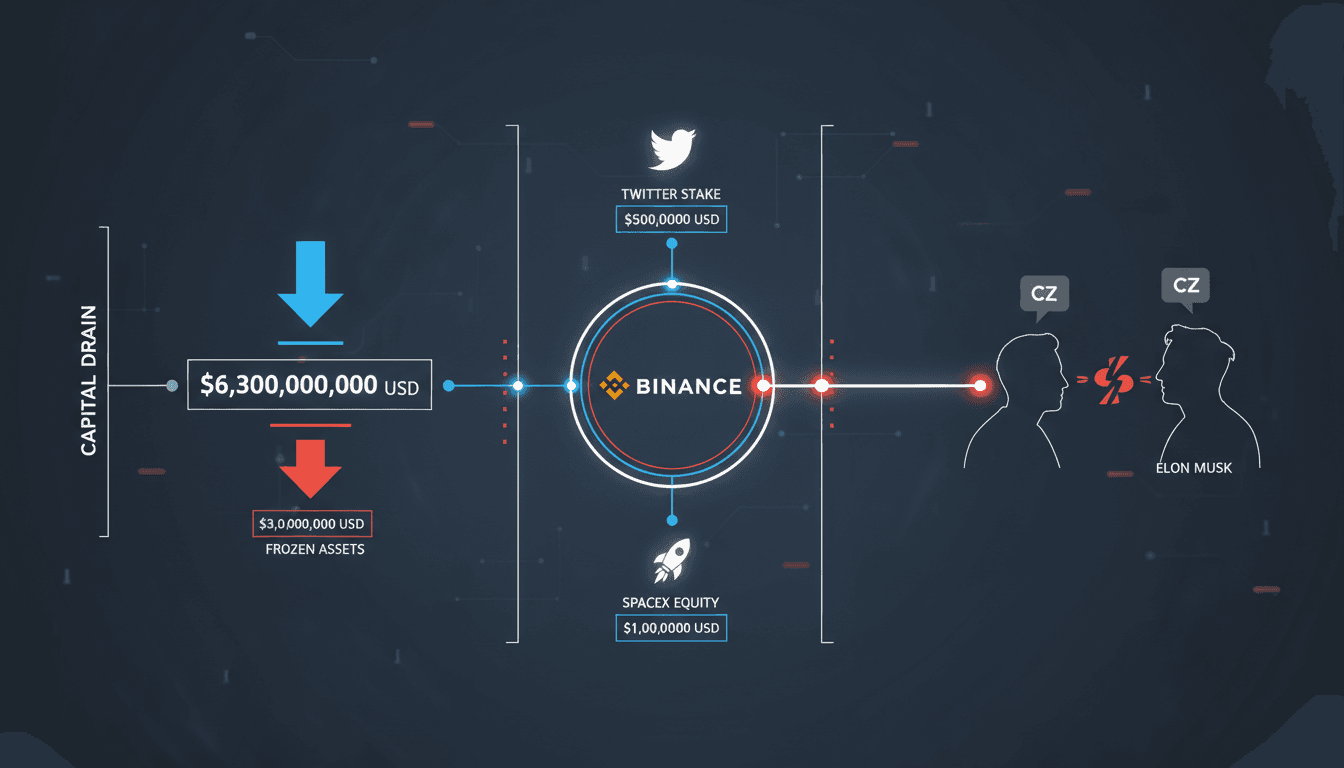
- The intrusion drained billions across multiple chains: Late on October 29, 2026, attackers compromised a DevOps engineer's device at Binance, executing unauthorized withdrawals totaling approximately $6.3 billion across Ethereum, Bitcoin, Tron, and other networks.
- Countermeasures froze nearly half the stolen funds: Binance halted platform deposits and withdrawals, working alongside industry partners and law enforcement to freeze roughly $3.0 billion of the transferred assets while co-founder Yi He pledged full coverage of all remaining losses.
- A high-profile social dispute exposed capital ties: After Elon Musk posted mocking emojis regarding the breach on X, Binance co-founder Changpeng Zhao urged him to stop trolling, citing Binance's equity stake in SpaceX—now valued above $1.0 billion stemming from an initial $500 million Twitter investment.
The context you actually need
- Preceding rivalries date back five years: Tensions between Changpeng Zhao and Elon Musk began on public forums in 2021 surrounding Dogecoin operational issues, establishing an adversarial history between two of the sector's most visible figures.
- State-aligned cyber syndicates dominate exchange targeting: Cybersecurity analytics firms linked the unauthorized transfers to the North Korean-tied TraderTraitor group, an entity responsible for sustained multi-billion-dollar campaigns against digital asset infrastructure.
- Cross-industry capital binds crypto balance sheets to private space tech: Binance's $500 million backing of Musk's acquisition of Twitter (now X) converted into an equity position in SpaceX currently exceeding $1.0 billion, linking exchange reserves directly to Musk's corporate empire.
What's really happening
The mechanics behind the $6.3 billion breach demonstrate how structural operational vulnerabilities persist inside the largest trading hubs. Rather than breaking decentralized consensus mechanisms or underlying smart contracts, the attackers compromised an individual employee's endpoint device. Gaining administrative credentials through a single DevOps engineer provided attackers with the authority required to route transactions across Ethereum, Bitcoin, and Tron rails simultaneously. This exposes an enduring reality of enterprise digital finance: centralized operational controls represent the soft underbelly of otherwise cryptographically secure networks.
The response from Binance—moving rapidly to isolate approximately $3.0 billion with partner networks and law enforcement—illustrates the dual architecture of modern crypto markets. While transactions execute instantaneously, tracing mechanisms allow exchanges to blacklist and freeze addresses if coordination occurs within hours of an exploit. However, freezing $3.0 billion still leaves $3.3 billion actively moving through mixers and non-compliant bridges. This gap forces Binance to absorb substantial liabilities onto its corporate balance sheet to satisfy its pledge to make users whole.
Beyond the technical perimeter, the public exchange between Zhao and Musk reveals the delicate economic incentives connecting speculative crypto capital to hard-tech enterprise valuations. Zhao's decision to remind Musk of Binance's $1.0 billion-plus equity stake in SpaceX was not merely a defensive social media retort; it was a clear demonstration of financial leverage. By highlighting that Binance holds substantial private equity in Musk’s aerospace firm, Zhao effectively signaled that destabilizing consumer confidence in Binance carries direct reputational and balance-sheet risks for Musk’s broader corporate ecosystem.
This dispute surfaces the corporate interconnectedness governing current technology balance sheets. When traditional tech executives publicly disparage digital asset institutions during operational failures, they often overlook that these same institutions helped finance their privatizations and infrastructure expansions. As exchange balance sheets face unprecedented recovery obligations, these cross-holdings could face secondary liquidation or strategic re-evaluations, altering liquidity across both public digital markets and private aerospace equities.
Who feels it first (and how)
- Institutional Treasury Managers: Corporate funds holding liquidity on centralized exchanges face heightened audit scrutiny regarding third-party custodial counterparty risk.
- DevOps and Cyber Risk Personnel: Security engineers at global fintech firms will absorb immediate mandate revisions, including mandatory zero-trust device access and isolated administrative signing thresholds.
- Crypto Asset Arbitrage Traders: Market makers experience compressed spreads and reduced liquidity depth while withdrawal corridors and chain-specific bridges implement extended manual review periods.
- Private Tech Equity Syndicates: Investors in non-public tech giants note the friction when major stakeholders publicly leverage equity positions during unrelated operational crises.
What to watch next
- Asset recovery trajectory: Track the liquidation or freezing of the remaining $3.3 billion, as this determines the exact capital reserve drain Binance must internally absorb.
- Consortium freeze coordination: Monitor how rapidly decentralized bridge operators and cross-chain validators cooperate with law enforcement, signaling the evolving limits of censorship resistance in digital finance.
- SpaceX and X share registry disclosure: Watch whether Binance's equity stakes in Musk-controlled enterprises undergo secondary sales to shore up corporate exchange reserves following loss compensation.
Approximately $6.3 billion in assets were transferred without authorization; $3.0 billion of those funds were frozen; the attack stemmed from a compromised DevOps credential; Binance holds over $1.0 billion in SpaceX equity derived from a $500 million Twitter investment.
The breach was executed by advanced persistent threat actors linked to North Korea's TraderTraitor collective, consistent with ongoing multi-billion-dollar exchange targeting patterns.
The exact operational timeline required for Binance to fully reimburse user balances without liquidating non-crypto corporate assets or private company stakes.
Frequently Asked Questions
- Why it matters?
- The unauthorized transfer of $6.3 billion across major blockchains establishes a new ceiling for single-day digital asset theft and highlights systemic interdependencies between global tech billionaires and centralized exchange balance sheets.
- What happened (in 30 seconds)?
- The intrusion drained billions across multiple chains: Late on October 29, 2026, attackers compromised a DevOps engineer's device at Binance, executing unauthorized withdrawals totaling approximately $6.3 billion across Ethereum, Bitcoin, Tron, and other networks. Countermeasures froze nearly half the stolen funds: Binance halted platform deposits and withdrawals, working alongside industry partners and law enforcement to freeze roughly $3.0 billion of the transferred assets while co-founder Yi
- What's really happening?
- The mechanics behind the $6.3 billion breach demonstrate how structural operational vulnerabilities persist inside the largest trading hubs. Rather than breaking decentralized consensus mechanisms or underlying smart contracts, the attackers compromised an individual employee's endpoint device. Gaining administrative credentials through a single DevOps engineer provided attackers with the authority required to route transactions across Ethereum, Bitcoin, and Tron rails simultaneously. This expos
- Who feels it first (and how)?
- Institutional Treasury Managers: Corporate funds holding liquidity on centralized exchanges face heightened audit scrutiny regarding third-party custodial counterparty risk. DevOps and Cyber Risk Personnel: Security engineers at global fintech firms will absorb immediate mandate revisions, including mandatory zero-trust device access and isolated administrative signing thresholds. Crypto Asset Arbitrage Traders: Market makers experience compressed spreads and reduced liquidity depth while withdr
- What to watch next?
- Asset recovery trajectory: Track the liquidation or freezing of the remaining $3.3 billion, as this determines the exact capital reserve drain Binance must internally absorb. Consortium freeze coordination: Monitor how rapidly decentralized bridge operators and cross-chain validators cooperate with law enforcement, signaling the evolving limits of censorship resistance in digital finance. SpaceX and X share registry disclosure: Watch whether Binance's equity stakes in Musk-controlled enterprises
Arabic-language economic and business reporting with strong UAE market relevance.
"Emarat Al Youm business coverage often centers UAE property, banking, consumer issues, and economic policy."
— A47 Editor
مؤسس بينانس لإيلون ماسك: توقف عن السخرية من الاختراق مؤسس بينانس لإيلون ماسك: توقف عن السخرية من الاختراق
Binance founder Changpeng Zhao, widely known as CZ, urged Elon Musk to stop mocking the exchange and to show support for the platform, following reports of a security breach. Coverage cited by the Emarat Al Youm report indicates that Binance froze de...
Business, investment, entrepreneurship, leadership, and innovation.
"Forbes is known for its coverage of business leaders, market trends, and entrepreneurial ventures with a pro-business editorial stance."
— A47 Editor
Binance Cofounder Asks Musk Not To ‘Troll’ After Record $6.3 Billion Crypto Hack
Binance, the world's largest cryptocurrency exchange, suspended deposits and withdrawals after a security breach estimated to have affected about $6.3 billion in assets, which would be the largest crypto heist on record. Founder Changpeng Zhao, known...
Global markets, investing, and macroeconomics from a premier financial newsroom.
"Bloomberg is respected for in-depth financial reporting and data-driven analysis."
— A47 Editor
CZ Tells Musk ‘Bad Time to Troll’ After Record Binance Hack
Binance, the world's largest cryptocurrency exchange, suspended deposits and withdrawals after a security breach estimated to affect about $6.3 billion in assets, which would make it the largest crypto heist on record. Founder Changpeng Zhao said the...
Covers Bitcoin plus altcoin news, market updates, and educational resources.
"Bitcoin.com provides news, market data, and guides focused on Bitcoin and the wider crypto industry."
— A47 Editor
CZ Tells Elon Musk to Stop Trolling Over $6.3B Binance Hack, Cites SpaceX Stake
CZ, founder of Binance, publicly told Elon Musk to stop trolling the exchange over a reported multibillion-dollar security incident involving roughly $6.3 billion in assets, with about $2.54 billion frozen so far. He cited a stake of roughly $1 billi...
Real-time updates, analysis, and reports on the blockchain and cryptocurrency sectors.
"Crypto News delivers real-time updates, analysis, and reports on the blockchain and cryptocurrency sectors."
— A47 Editor
CZ fires back at Elon Musk over Binance hack jokes, cites $1B SpaceX stake
Changpeng Zhao (CZ), founder of Binance, responded to Elon Musk's jokes about the exchange following a reported security breach involving roughly $6.3 billion in assets, with about $2.54 billion frozen so far. CZ cited a roughly $1 billion stake link...