
NYSE Selects Avalanche Blockchain as Settlement Ledger for Planned 24/7 Tokenized Securities Platform
Why it matters
By anchoring post-trade settlement to a specialized layer-1 blockchain, the New York Stock Exchange is replacing multi-day clearing buffers with atomic execution to institutionalize 24/7 equity liquidity.
What happened (in 30 seconds)
* The architecture decision: On November 9, 2026, the New York Stock Exchange announced it selected the Avalanche blockchain to serve as the core settlement ledger for its planned tokenized securities platform. * The structural design: The platform will retain the NYSE’s proprietary order-matching technology while deploying Avalanche exclusively for multi-chain trade recording and atomic settlement. * The market reaction: The native token of Avalanche, AVAX, climbed as much as 10% intraday following the disclosure, settling near $8.86 with a market capitalization around $3.95 billion.
The context you actually need
* A year of structural testing: The deployment follows roughly 12 months of technical validation between NYSE digital issuance leads and developer Ava Labs, tracking initial platform disclosures made in January 2026. * Target operational timeline: The initiative targets an operating launch in the fourth quarter of 2026, contingent on pending regulatory clearance from United States authorities. * The Wall Street infrastructure race: The mandate lands alongside rival tier-one liquidity initiatives, including Nasdaq's September 2026 backing of Payward and DTCC's October 2026 rollout of dedicated tokenized securities services.
What's really happening
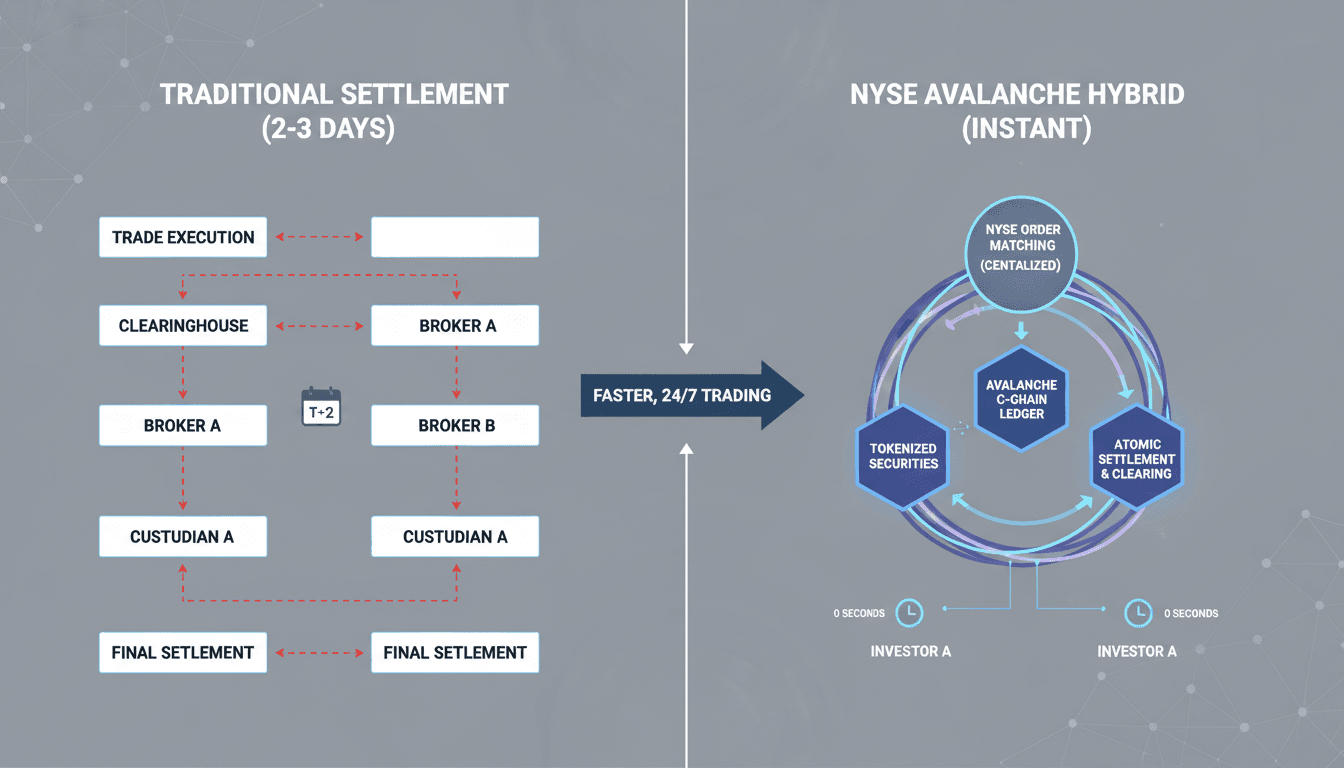
The integration of Avalanche into the New York Stock Exchange’s trading stack reflects an infrastructure migration designed to resolve the core inefficiencies of traditional equity clearing: settlement latency and trapped collateral.
In classical market plumbing, executing a trade and settling it are decoupled processes. While order books match transactions in microseconds, the delivery of shares against cash historically relies on centralized clearinghouses operating within localized banking hours. This model necessitates multi-day settlement windows, requiring clearing brokers to post capital buffers to cover counterparty risk during the transit period.
The architecture disclosed by NYSE Head of Digital Issuance Dennis Lee and Ava Labs Chief Business Officer John Nahas decouples matching from settlement in a different way. The exchange protects its low-latency competitive advantage by maintaining its established off-chain matching engines. Avalanche is plugged in strictly as the finality layer. Under this structure, Avalanche operates as an immutable, real-time settlement ledger that records ownership states and executes atomic transactions—the simultaneous exchange of asset tokens for cash equivalents across disparate blockchain environments.
The commercial incentive for the NYSE is defensive consolidation. Digital asset venues and alternative trading systems have operated 24 hours a day, 365 days a year for over a decade. By moving equities onto a public blockchain architecture, institutional market makers can trade out of overnight risk without waiting for traditional market open windows. This setup also eliminates the balance-sheet drag associated with mandatory DTCC margin deposits during periods of extreme volatility.
For Ava Labs, the selection provides institutional validation for a shared, multi-chain settlement model. While the upcoming platform will support equities originated on diverse networks, the settlement ledger itself is centralized on Avalanche. This arrangement locks transaction recording directly into Avalanche’s consensus validation layer, turning network capacity into critical financial market infrastructure.
The execution risk remains regulatory rather than strictly computational. Wall Street’s shift from centralized book-entry systems to public distributed ledgers requires federal regulators to sign off on an alternative market structure that permanently bypasses conventional clearinghouse protocols.
Who feels it first (and how)
* Institutional market makers: Prime brokers and liquidity providers capture capital efficiency gains from instant, atomic settlement, eliminating multi-day counterparty credit exposure. * Brokerage operations teams: Middle- and back-office clearing desks must adapt ledger-monitoring workflows from legacy batch-cycle reconciliation to continuous, around-the-clock validation. * Crypto asset markets: Layer-1 network operators face higher institutional performance benchmarks as Ava Labs sets a precedent for tier-one exchange operational integrations. * U.S. equity traders: Market participants gain the technical capacity to deploy capital into tokenized stocks outside of standard 9:30 AM to 4:00 PM Eastern trading windows.
What to watch next
* U.S. regulatory filings: Track public filings and approval decisions from regulatory authorities leading up to the targeted Q4 2026 operational rollout. * Cross-chain asset interoperability: Monitor technical disclosures on how non-Avalanche tokenized equities are bridged into the core settlement engine without introducing third-party custody risks. * Clearing bank liquidity adjustments: Watch how major custody banks adapt their reserve holdings when capital is settled continuously rather than in structured end-of-day batches.
The NYSE selected Avalanche to serve as the settlement engine for an upcoming tokenized equities trading platform, targeting a launch in Q4 2026.
The platform's 24/7 continuous settlement model will compress margins for legacy settlement intermediaries while reducing collateral requirements for institutional trading desks.
The exact regulatory preconditions and licensing approvals that United States authorities will mandate before authorizing atomic settlement on a public blockchain ledger.
Frequently Asked Questions
- Why it matters?
- By anchoring post-trade settlement to a specialized layer-1 blockchain, the New York Stock Exchange is replacing multi-day clearing buffers with atomic execution to institutionalize 24/7 equity liquidity.
- What happened (in 30 seconds)?
- The architecture decision: On November 9, 2026, the New York Stock Exchange announced it selected the Avalanche blockchain to serve as the core settlement ledger for its planned tokenized securities platform. The structural design: The platform will retain the NYSE’s proprietary order-matching technology while deploying Avalanche exclusively for multi-chain trade recording and atomic settlement. The market reaction: The native token of Avalanche, AVAX, climbed as much as 10% intraday following t
- What's really happening?
- The integration of Avalanche into the New York Stock Exchange’s trading stack reflects an infrastructure migration designed to resolve the core inefficiencies of traditional equity clearing: settlement latency and trapped collateral. In classical market plumbing, executing a trade and settling it are decoupled processes. While order books match transactions in microseconds, the delivery of shares against cash historically relies on centralized clearinghouses operating within localized banking h
- Who feels it first (and how)?
- Institutional market makers: Prime brokers and liquidity providers capture capital efficiency gains from instant, atomic settlement, eliminating multi-day counterparty credit exposure. Brokerage operations teams: Middle- and back-office clearing desks must adapt ledger-monitoring workflows from legacy batch-cycle reconciliation to continuous, around-the-clock validation. Crypto asset markets: Layer-1 network operators face higher institutional performance benchmarks as Ava Labs sets a precedent
- What to watch next?
- U.S. regulatory filings: Track public filings and approval decisions from regulatory authorities leading up to the targeted Q4 2026 operational rollout. Cross-chain asset interoperability: Monitor technical disclosures on how non-Avalanche tokenized equities are bridged into the core settlement engine without introducing third-party custody risks. Clearing bank liquidity adjustments: Watch how major custody banks adapt their reserve holdings when capital is settled continuously rather than in st
Covers blockchain, cryptocurrency news, project analysis, and market insights.
"Cointelegraph is a leading crypto-focused media outlet known for timely news, analysis, and educational content related to blockchain and digital assets."
— A47 Editor
Avalanche’s AVAX leads crypto gains following NYSE tokenization deal
Avalanche's AVAX token rose as much as 10% after the New York Stock Exchange selected the Avalanche blockchain to support settlement for a planned tokenized stock trading platform, according to Cointelegraph.
Covers Bitcoin plus altcoin news, market updates, and educational resources.
"Bitcoin.com provides news, market data, and guides focused on Bitcoin and the wider crypto industry."
— A47 Editor
NYSE Chooses Avalanche to Power 24/7 Tokenized Stock Trades
The New York Stock Exchange has selected Avalanche's blockchain technology to power an upcoming digital alternative trading system intended to support 24/7 trading of tokenized stocks, according to a Bitcoin.com report. The initiative is part of NYSE...
Real-time updates, analysis, and reports on the blockchain and cryptocurrency sectors.
"Crypto News delivers real-time updates, analysis, and reports on the blockchain and cryptocurrency sectors."
— A47 Editor
NYSE selects Avalanche to power settlement for tokenized stock platform
The New York Stock Exchange has selected Avalanche to provide the core blockchain ledger technology for the clearing firm supporting its upcoming tokenized securities trading platform, with Ava Labs announcing on November 9 that its infrastructure wi...
Markets desk coverage, trading insights, and investor updates.
"WSJ’s markets reporting provides in-depth analysis and context for investors."
— A47 Editor
NYSE to Settle Tokenized Stocks on Avalanche Blockchain
The New York Stock Exchange said it will settle tokenized stocks on its upcoming 24/7 trading platform exclusively using the Avalanche blockchain, according to a report by The Wall Street Journal.