
21 Global Banks Commit $270 Million to Project Faro Stablecoin Issuer Targeting H1 2027 USD Launch
Why it matters
A collective balance-sheet intervention by 21 global lenders introduces direct commercial-bank competition to non-bank stablecoins by establishing institutional, reserve-backed digital currency directly inside existing compliance perimeters.
What happened (in 30 seconds)
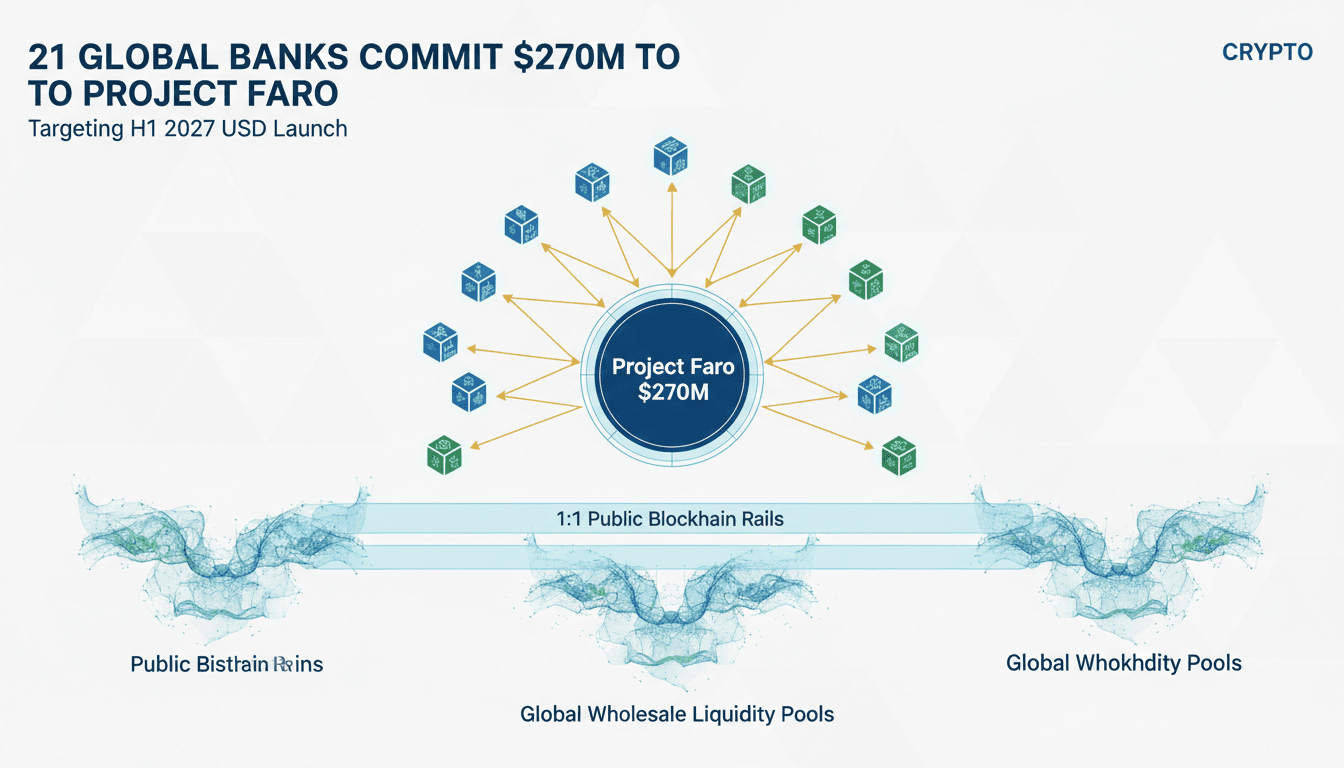
- Twenty-one global banks committed approximately $270 million on November 10, 2026, to fund five years of corporate operations for a planned U.S.-incorporated digital asset issuer codenamed Project Faro.
- The consortium plans a phased currency rollout, targeting an initial U.S. dollar-denominated stablecoin launch in the first half of 2027, followed by euro and other G7 currency variants.
- The roster spans major universal and investment banks, including Goldman Sachs, Citigroup, Bank of America, Banco Santander, Deutsche Bank, BBVA, Wells Fargo, Fidelity Investments, UBS, Lloyds Banking Group, MUFG Bank, and Standard Bank.
The context you actually need
- The project expanded over a 13-month runway, growing from an initial exploratory group of 10 lenders in October 2025 to 21 institutions committing to legal incorporation by September 1, 2026.
- The $270 million pool serves as pure operating capital, segregated entirely from the 1:1 liquid reserves required to back the actual digital currency tokens issued on public blockchains.
- Regulatory frameworks created the operating perimeter, as the consortium specifically structured its architecture to comply with the U.S. GENIUS Act and the European Union's Markets in Crypto-Assets (MiCA) regulation.
What's really happening
The traditional banking sector is no longer content to sit on the sidelines of digital cash settlement. By pooling $270 million across 21 institutions, the participating banks are attempting to solve a fundamental coordination problem that has historically held back institutional blockchain adoption: fragmentation.
Until now, individual bank digital token projects operated inside closed, private intranets, or institutions simply deposited balance-sheet reserves into third-party, crypto-native stablecoin issuers. That dynamic left non-bank issuers capturing the lucrative yield generated by underlying reserve assets while processing hundreds of billions of dollars in volume outside the core banking perimeter.
Project Faro changes this incentive structure. By building a unified, multi-bank issuer on public blockchains, the participating institutions preserve their role in payment routing, trade finance, and tokenized asset settlement. Rather than relying on disparate bespoke systems, a single interoperable token backed by a common reserve mechanism allows these lenders to clear cross-border transactions at wholesale scale without surrendering market share to non-bank fintechs.
Operating incentives dictate the structure. The $270 million capital commitment funds the operational runway through approximately late 2031, covering software engineering, regulatory compliance, operational infrastructure, and governance. Because this capital is isolated from the 1:1 liquid reserves required for redemption, the issuer can build dedicated technological infrastructure while participant balance sheets manage reserve custody and mint-and-burn functionality.
The competitive landscape is deliberately layered. Multiple consortium members maintain dual tracks across overlapping initiatives, holding exposure to projects like Open USD and Qivalis simultaneously. This multi-consortium participation reflects an institutional hedging strategy: lenders want exposure to whichever common standard achieves network dominance for tokenized asset settlement and wholesale liquidity.
For institutional users, this architecture introduces a bank-governed alternative for collateral movement. By aligning the project with codified frameworks like the GENIUS Act in the United States and MiCA in Europe, Project Faro attempts to eliminate the legal and settlement counterparty risks that have prevented corporate treasuries and regulated fund managers from using digital assets for daily liquidity management.
Who feels it first (and how)
- Corporate Treasury Officers: Multinationals managing multi-currency cash pools will gain an avenue to move settlement balances 24/7 on public blockchains without taking counterparty risk on non-bank issuers.
- Institutional Asset Managers: Funds trading tokenized securities can settle asset purchases atomically against regulated, G7-denominated commercial bank reserves rather than navigating fiat-to-crypto off-ramps.
- Cross-Border Operators in the Middle East and Africa: With lenders like Standard Bank participating in the consortium, corporate entities running trade corridors between the UAE, Africa, and global financial hubs will see regulated digital rails integrated into their correspondent banking networks.
- Crypto-Native Stablecoin Issuers: Incumbent non-bank issuers will face direct yield and volume competition for institutional and wholesale payment flows as tier-1 lenders provide regulated native alternatives.
What to watch next
- Corporate Formation and Leadership (H2 2026): The selection of a chief executive officer, finalized branding, and the formal legal incorporation of the U.S. entity will signal whether the 21 banks can resolve governance hurdles.
- Technical Architecture Disclosures: Specific details on supported public blockchain networks and mint-and-burn validation mechanics will reveal how the issuer balances public network composability with institutional compliance controls.
- Consortium Boundary Overlaps: How participant banks resolve their simultaneous commitments to parallel consortia—such as Open USD and Qivalis—will demonstrate whether Project Faro emerges as the consolidated market standard.
Twenty-one financial institutions have committed approximately $270 million to fund five years of operations for Project Faro, with a target U.S. dollar launch scheduled for the first half of 2027.
The initial adoption will concentrate heavily in wholesale banking, tokenized securities clearing, and interbank settlement before any material retail market deployment takes shape.
Whether participating lenders can align divergent regional regulatory priorities across G7 jurisdictions quickly enough to maintain their H1 2027 release window without operational delays.
Frequently Asked Questions
- Why it matters?
- A collective balance-sheet intervention by 21 global lenders introduces direct commercial-bank competition to non-bank stablecoins by establishing institutional, reserve-backed digital currency directly inside existing compliance perimeters.
- What happened (in 30 seconds)?
- Twenty-one global banks committed approximately $270 million on November 10, 2026, to fund five years of corporate operations for a planned U.S.-incorporated digital asset issuer codenamed Project Faro. The consortium plans a phased currency rollout, targeting an initial U.S. dollar-denominated stablecoin launch in the first half of 2027, followed by euro and other G7 currency variants. The roster spans major universal and investment banks, including Goldman Sachs, Citigroup, Bank of America, Ba
- What's really happening?
- The traditional banking sector is no longer content to sit on the sidelines of digital cash settlement. By pooling $270 million across 21 institutions, the participating banks are attempting to solve a fundamental coordination problem that has historically held back institutional blockchain adoption: fragmentation. Until now, individual bank digital token projects operated inside closed, private intranets, or institutions simply deposited balance-sheet reserves into third-party, crypto-native
- Who feels it first (and how)?
- Corporate Treasury Officers: Multinationals managing multi-currency cash pools will gain an avenue to move settlement balances 24/7 on public blockchains without taking counterparty risk on non-bank issuers. Institutional Asset Managers: Funds trading tokenized securities can settle asset purchases atomically against regulated, G7-denominated commercial bank reserves rather than navigating fiat-to-crypto off-ramps. Cross-Border Operators in the Middle East and Africa: With lenders like Standard
- What to watch next?
- Corporate Formation and Leadership (H2 2026): The selection of a chief executive officer, finalized branding, and the formal legal incorporation of the U.S. entity will signal whether the 21 banks can resolve governance hurdles. Technical Architecture Disclosures: Specific details on supported public blockchain networks and mint-and-burn validation mechanics will reveal how the issuer balances public network composability with institutional compliance controls. Consortium Boundary Overlaps: How
Covers blockchain, cryptocurrency news, project analysis, and market insights.
"Cointelegraph is a leading crypto-focused media outlet known for timely news, analysis, and educational content related to blockchain and digital assets."
— A47 Editor
Global banks commit $270M to stablecoin venture targeting 2027 launch
Project Faro, backed by Goldman Sachs, Citigroup and BBVA, has secured about $270 million in funding to launch a US dollar stablecoin in the first half of 2027, according to Cointelegraph. Coverage from Bloomberg, cited by Crypto News, reports that S...
Covers Bitcoin plus altcoin news, market updates, and educational resources.
"Bitcoin.com provides news, market data, and guides focused on Bitcoin and the wider crypto industry."
— A47 Editor
Wall Street Banks Commit $270M to Stablecoin Challenger Project Faro: Bloomberg
Wall Street banks including Goldman Sachs and Citigroup have committed about $270 million to Project Faro, a planned U.S. dollar stablecoin venture, according to a Bloomberg report cited by Bitcoin.com. The funding backs a stablecoin initiative with ...
Curated tech headlines including AI stories.
"Influential aggregator surfacing the day’s top tech/AI links."
— A47 Editor
Sources: Citigroup, Goldman Sachs, and others in a 21-bank consortium committed around $270M to fund five years of a stablecoin venture announced in September (Bloomberg)
Citigroup, Goldman Sachs, Banco Santander, Deutsche Bank and 17 other firms in a 21-bank consortium have reportedly committed around $270 million to fund five years of a stablecoin venture first announced in September, according to sources cited by B...
Real-time updates, analysis, and reports on the blockchain and cryptocurrency sectors.
"Crypto News delivers real-time updates, analysis, and reports on the blockchain and cryptocurrency sectors."
— A47 Editor
Stablecoin venture draws $270M backing from Goldman, Citi and peers
Goldman Sachs, Citi, Santander and Deutsche Bank have joined financial firms committing around $270 million to a planned U.S. dollar stablecoin venture, according to a Bloomberg report citing people familiar with the matter. The funding backs a stabl...