
Binance Restores Withdrawals Across 87 Networks Following 6.3 Billion Hot Wallet Breach
Why it matters
The extraction and corporate absorption of $6.34 billion establishes a new solvency benchmark for centralized market infrastructure facing state-sponsored operational exploits.
What happened (in 30 seconds)
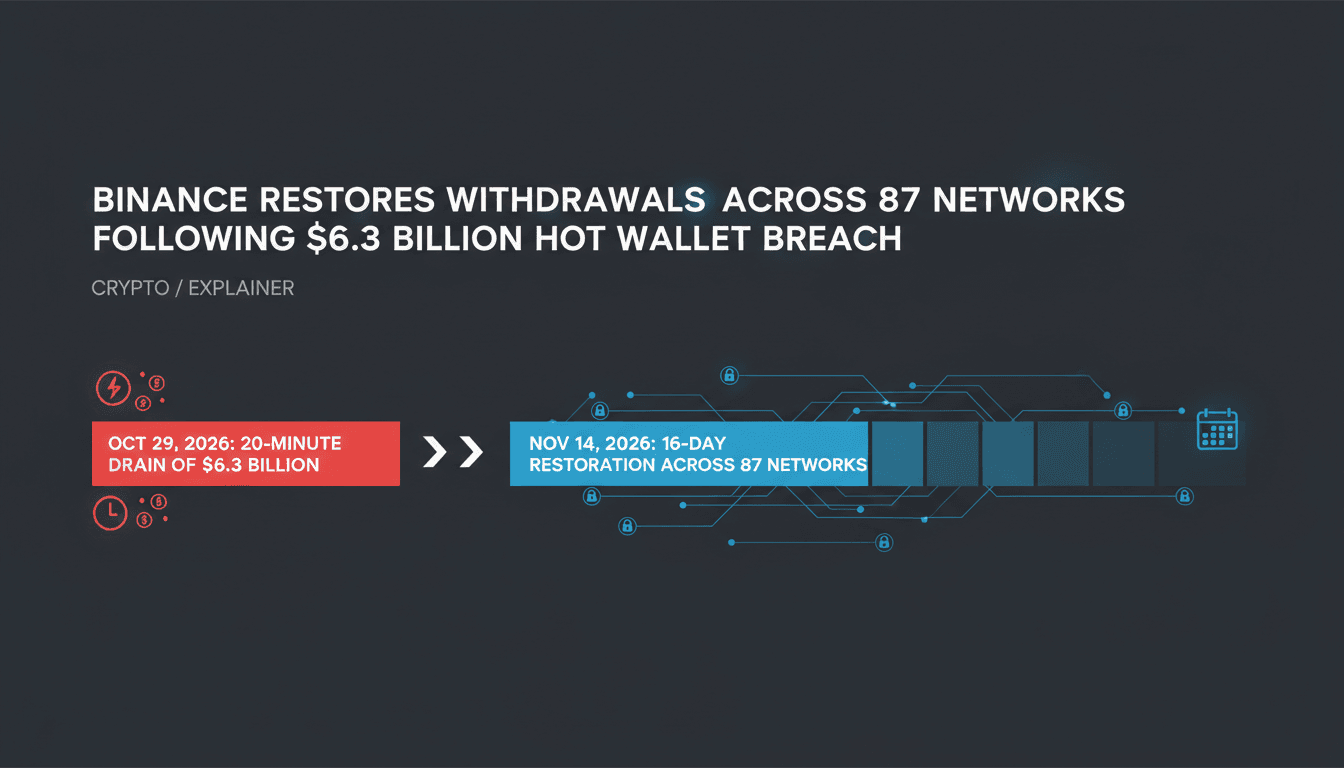
- The exploit drained $6.3 billion from Binance hot wallets on October 29, 2026, across more than a dozen blockchains in an operation lasting approximately 20 minutes.
- The access vector combined a compromised DevOps engineer's workstation with the programmatic abuse of Ethereum's EIP-7702 account mechanism.
- Service restoration reached 87 networks on November 14, 2026, backed by a corporate commitment of $6.34 billion drawn from treasury reserves, SAFU, and futures insurance funds to cover customer balances.
The context you actually need
- State-sponsored attribution: The Federal Bureau of Investigation formally tied the incident to TraderTraitor, an advanced persistent threat group linked to North Korea that consistently targets financial infrastructure.
- Coordinated external containment: Blockchain analytics firms Chainalysis and TRM Labs, alongside institutional third parties, successfully froze roughly $3 billion of the moved assets before total mixing could occur.
- Phased network access: After immediately pausing all outflows on October 29, Binance restored an initial cohort of 15 networks on November 1, expanded to 87 networks by November 14, and outlined a timetable to finalize access across remaining chains by the close of the subsequent week.
What's really happening
The architectural failure of October 29 highlights how administrative access privileges interact with evolving on-chain transaction protocols. Attackers secured credentials through a single DevOps engineer's laptop. From there, they did not simply sign unauthorized outbound transfers; they leveraged Ethereum’s EIP-7702 mechanism, which allows standard externally owned accounts to temporarily batch actions and execute smart contract code. This technical capability enabled the automated, simultaneous drainage of hot wallet reserves across multiple independent blockchains within 1,200 seconds.
By running programmatic balance calls against dozens of sub-chains, the exploit bypassed conventional volume-based transaction limits that traditionally slow automated hot-wallet extractions. The speed of the execution left internal risk monitors unable to throttle egress prior to capital depletion across those specific endpoints.
The subsequent market dynamic reveals an operational trade-off between customer confidence and balance-sheet liquidity. To prevent a self-reinforcing panic that could destabilize institutional order books, Binance committed $6.34 billion in total restitution funds on November 12, using a mixture of the Secure Asset Fund for Users (SAFU), futures contract insurance pools, and raw corporate treasury holdings. By fully self-insuring customer balances, the entity averted balance-sheet impairment for users, but it structurally reduced its internal capital cushion.
Despite these commitments, market behavior shifted. Exchange metrics recorded sustained negative Bitcoin netflows following the initial breach, leaving the exchange's baseline reserves around 688,900 BTC. Market participants reallocated capital toward external custody as withdrawals opened, illustrating that balance-sheet guarantees alone do not immediately offset counterparty risk perceptions.
Simultaneously, the recovery of approximately $3 billion in stolen funds depended heavily on rapid intervention by decentralized analytics protocols, law enforcement, and centralized stablecoin or protocol validators executing targeted asset freezes. This establishes a structural precedent: modern exchange security relies less on stopping perimeter penetration and far more on post-incident asset quarantining across external ecosystem partners.
Who feels it first (and how)
- Treasury officers at crypto firms: Immediate re-evaluation of counterparty exposure limits across centralized venues, focusing on whether other platforms can sustain multi-billion-dollar drawdowns.
- Institutional market makers: Increased operational drag caused by the phased, asymmetric reopening of liquidity networks, forcing desks to divert routing around offline chains.
- Protocol security engineers: An urgent mandate to audit infrastructure touchpoints that interact with EIP-7702 and similar account delegation updates.
- Retail depositors on delayed chains: Extended balance illiquidity while specific minority protocols remain suspended pending individual security reviews.
What to watch next
- Full protocol completion: The reopening of remaining suspended networks by the close of the designated week, signaling that key generation and node infrastructure are fully restored.
- Reserve stabilization rates: Whether Bitcoin netflows invert from negative territory or if reserves drop materially below the 688,900 BTC mark over consecutive reporting intervals.
- EIP-7702 enterprise safeguards: How other centralized exchanges restrict batched smart contract permissions on operational hot-wallet addresses to prevent parallel multi-chain drains.
Attackers extracted $6.3 billion in 20 minutes using an employee endpoint and EIP-7702; Binance committed $6.34 billion from internal reserves; 87 networks resumed withdrawals on November 14, 2026.
Long-term compliance requirements will mandate cold-storage segregation for higher percentages of exchange operational balances, reducing hot-wallet limits across the entire sector.
The final recovery rate of the $3 billion currently frozen by external third parties, and the timeline required for those assets to return to the exchange's core treasury.
Frequently Asked Questions
- Why it matters?
- The extraction and corporate absorption of $6.34 billion establishes a new solvency benchmark for centralized market infrastructure facing state-sponsored operational exploits.
- What happened (in 30 seconds)?
- The exploit drained $6.3 billion from Binance hot wallets on October 29, 2026, across more than a dozen blockchains in an operation lasting approximately 20 minutes. The access vector combined a compromised DevOps engineer's workstation with the programmatic abuse of Ethereum's EIP-7702 account mechanism. Service restoration reached 87 networks on November 14, 2026, backed by a corporate commitment of $6.34 billion drawn from treasury reserves, SAFU, and futures insurance funds to cover customer
- What's really happening?
- The architectural failure of October 29 highlights how administrative access privileges interact with evolving on-chain transaction protocols. Attackers secured credentials through a single DevOps engineer's laptop. From there, they did not simply sign unauthorized outbound transfers; they leveraged Ethereum’s EIP-7702 mechanism, which allows standard externally owned accounts to temporarily batch actions and execute smart contract code. This technical capability enabled the automated, simultane
- Who feels it first (and how)?
- Treasury officers at crypto firms: Immediate re-evaluation of counterparty exposure limits across centralized venues, focusing on whether other platforms can sustain multi-billion-dollar drawdowns. Institutional market makers: Increased operational drag caused by the phased, asymmetric reopening of liquidity networks, forcing desks to divert routing around offline chains. Protocol security engineers: An urgent mandate to audit infrastructure touchpoints that interact with EIP-7702 and similar ac
- What to watch next?
- Full protocol completion: The reopening of remaining suspended networks by the close of the designated week, signaling that key generation and node infrastructure are fully restored. Reserve stabilization rates: Whether Bitcoin netflows invert from negative territory or if reserves drop materially below the 688,900 BTC mark over consecutive reporting intervals. EIP-7702 enterprise safeguards: How other centralized exchanges restrict batched smart contract permissions on operational hot-wallet ad
Covers Bitcoin plus altcoin news, market updates, and educational resources.
"Bitcoin.com provides news, market data, and guides focused on Bitcoin and the wider crypto industry."
— A47 Editor
Binance Reopens 87 Networks Following Historic $6.3 Billion Breach
Binance reopened 87 networks after a hot wallet breach that the exchange estimates affected roughly $6.3 billion in assets, one of the largest reported crypto thefts to date. Withdrawals have been restored for some tokens, including HYPE and APT, whi...
U.S. company headlines: M&A, product launches, legal/regulatory actions, and leadership moves.
"U.S.-centric corporate tape; good for tracking single-name catalysts."
— A47 Editor
Binance aims to restore all withdrawals next week after $6.3 billion hack
Binance, the world's largest cryptocurrency exchange, has moved to restore customer withdrawals and aims to reopen all withdrawals next week after a security breach estimated at about $6.3 billion in assets, which would be the largest crypto heist on...
Real-time updates, analysis, and reports on the blockchain and cryptocurrency sectors.
"Crypto News delivers real-time updates, analysis, and reports on the blockchain and cryptocurrency sectors."
— A47 Editor
Binance says $6.3B hack losses covered, new reserve proof pending
Binance says it has fully covered user assets affected by a hot wallet breach that the exchange estimates at roughly $6.3 billion, and has published a new Proof of Reserves snapshot, with the accompanying zero-knowledge proof still pending. The breac...