
South Korea Proposes 20% Shareholding Cap on Designated Crypto Exchange Operators Amid Naver-Dunamu Deal
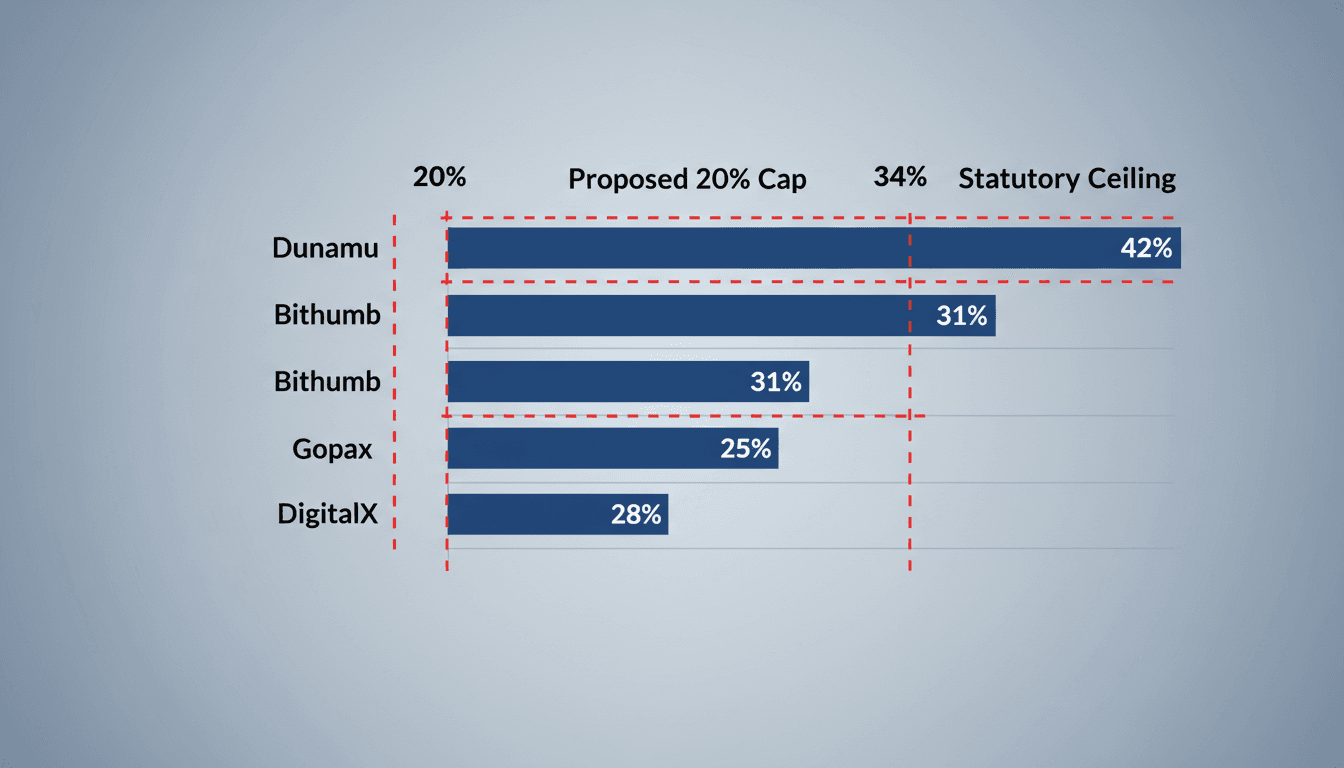
Why it matters
South Korea is treating centralized crypto exchanges as public financial utilities by borrowing structural limits from alternative trading systems, forcing founders and strategic acquirers to divest controlling stakes across a 53-trillion-won market.
What happened (in 30 seconds)
- A strict ceiling proposed: On November 24, 2026, the Financial Services Commission (FSC) introduced draft legislation capping major shareholder ownership in designated digital asset platform operators at 20%, with an approval-based exception up to 34%.
- Voting rights stripped on excess holdings: Shareholders possessing equity above the threshold will see their excess shares lose voting rights, governed by a three-year compliance grace period following official designation.
- Immediate impact on market heavyweights: The measure directly affects every major domestic exchange operator, including Dunamu (Upbit), Bithumb, Coinone, DigitalX (formerly Korbit), and Gopax, intersecting directly with Naver Financial's pending acquisition plans.
The context you actually need
- A shift from registration to licensing: South Korea previously operated on an anti-money laundering registration regime supplemented by a 2024 user protection statute; this draft Act on the Innovation of the Digital Asset Industry introduces formal activity-specific licensing for trading, brokerage, and custody alongside a 2-billion-won capital floor.
- Severe ownership concentration: Across the top domestic exchanges, single shareholders dominate cap tables: Bithumb Holdings holds 73.56% of Bithumb, Mirae Asset Consulting controls 97.15% of DigitalX, Binance maintains 67.45% in Gopax, Coinone’s CEO holds 30.36%, and Dunamu chairman Song Chi-hyung holds 25.51%.
- Mass retail participation: The domestic virtual asset market accounts for approximately 53 trillion won in capitalization across 11.18 million verified users as of mid-2026, elevating exchange operations into critical public infrastructure.
What's really happening
The Financial Services Commission is executing a classic regulatory playbook: transposing the governance framework of traditional alternative trading systems (ATS) directly onto virtual asset infrastructure.
Centralized crypto exchanges routinely combine trade execution, order matching, asset custody, proprietary listing decisions, and market surveillance under a single corporate umbrella. When one individual or conglomerate owns an outright majority of that entity, the structural incentives skew toward maximizing platform listing fees and internal transaction volume rather than maintaining market neutrality. By capping major shareholding at 20%—or 34% with specific regulatory sign-off—the FSC seeks to decouple operational execution from concentrated ownership influence.
This creates an immediate mathematical problem for the sector's incumbents. Under the 34% ceiling, Bithumb Holdings must liquidate or distribute 39.56 percentage points of its current 73.56% equity position. In the case of DigitalX, Mirae Asset Consulting must shed up to 63.15 percentage points of its 97.15% stake to maintain voting power. Foreign strategic investors face identical friction: Binance’s 67.45% stake in Gopax exceeds the absolute ceiling by 33.45 percentage points.
Because excess shares lose voting rights upon designation, platform operators cannot simply warehouse non-compliant stakes in holding companies without surrendering corporate control. The draft law does provide a three-year grace period post-designation, with potential extensions for smaller operators. However, the requirement to unwind massive blocks of private equity will introduce significant secondary market liquidity challenges. Finding institutional buyers capable of clearing regulatory scrutiny for non-controlling minority stakes in crypto infrastructure will not be straightforward.
The proposal also collides directly with pending corporate consolidation. Naver Financial arranged a 100% acquisition of Upbit operator Dunamu via a share exchange targeted for March 2027. Under a strict 20% baseline or a 34% conditional ceiling, full balance-sheet consolidation via 100% ownership becomes legally impossible if Dunamu is designated a platform operator.
Rather than abandoning the deal, the participants are accelerating execution. Dunamu and Naver Financial moved their shareholder approval meeting forward to February 26, 2027, with targeted closing on March 31, 2027. Their strategy relies on finalizing the transaction before the FSC’s bill clears the National Assembly and before formal designation decrees take legal effect, banking on the three-year statutory grace period to determine subsequent restructuring.
Who feels it first (and how)
- Exchange founders and parent entities: Executives at Bithumb Holdings, Binance, and Mirae Asset Consulting face mandatory equity divestments or the neutralization of their voting rights above the 34% limit.
- Domestic tech conglomerates: Companies like Naver Financial must recalibrate cross-holding plans, shifting deal models from complete vertical absorption to federated minority partnerships.
- Institutional secondary buyers: Private equity firms and asset managers will encounter rare opportunities to acquire substantial, non-controlling equity positions in cash-generative, licensed trading venues during the three-year grace window.
- Retail market participants: The 11.18 million domestic digital asset users will see exchange operations mirror standard equity bourses, with listing and surveillance decisions separated from single-shareholder corporate priorities.
What to watch next
- National Assembly legislative markups: Track committee debate schedules to identify whether lawmakers introduce grandfathering clauses or adjust the 20% and 34% caps during legislative review.
- Naver-Dunamu shareholder vote on February 26, 2027: The passage of this vote serves as a proxy for how corporate boards assess their legal ability to navigate post-closing ownership caps.
- Secondary market equity auctions: Watch for Bithumb Holdings, Binance, and Mirae Asset initiating exploratory divestment processes to offload 30% to 63% stakes to institutional consortiums.
The FSC draft specifies a 20% cap on major shareholders with an approved 34% maximum, strips voting rights from non-compliant excess shares, requires a 2-billion-won capital floor, and provides a baseline three-year transition window.
The National Assembly will face intense lobbying from fintech conglomerates and venture capital backers seeking exemptions, higher thresholds, or lengthened grace windows for earlier investments.
Whether the FSC will grant the conditional 34% upper limit to strategic industrial buyers such as Naver Financial, or restrict that exception exclusively to diversified financial institutions.
Frequently Asked Questions
- Why it matters?
- South Korea is treating centralized crypto exchanges as public financial utilities by borrowing structural limits from alternative trading systems, forcing founders and strategic acquirers to divest controlling stakes across a 53-trillion-won market.
- What happened (in 30 seconds)?
- A strict ceiling proposed: On November 24, 2026, the Financial Services Commission (FSC) introduced draft legislation capping major shareholder ownership in designated digital asset platform operators at 20%, with an approval-based exception up to 34%. Voting rights stripped on excess holdings: Shareholders possessing equity above the threshold will see their excess shares lose voting rights, governed by a three-year compliance grace period following official designation. Immediate impact on mar
- What's really happening?
- The Financial Services Commission is executing a classic regulatory playbook: transposing the governance framework of traditional alternative trading systems (ATS) directly onto virtual asset infrastructure. Centralized crypto exchanges routinely combine trade execution, order matching, asset custody, proprietary listing decisions, and market surveillance under a single corporate umbrella. When one individual or conglomerate owns an outright majority of that entity, the structural incentives s
- Who feels it first (and how)?
- Exchange founders and parent entities: Executives at Bithumb Holdings, Binance, and Mirae Asset Consulting face mandatory equity divestments or the neutralization of their voting rights above the 34% limit. Domestic tech conglomerates: Companies like Naver Financial must recalibrate cross-holding plans, shifting deal models from complete vertical absorption to federated minority partnerships. Institutional secondary buyers: Private equity firms and asset managers will encounter rare opportunitie
- What to watch next?
- National Assembly legislative markups: Track committee debate schedules to identify whether lawmakers introduce grandfathering clauses or adjust the 20% and 34% caps during legislative review. Naver-Dunamu shareholder vote on February 26, 2027: The passage of this vote serves as a proxy for how corporate boards assess their legal ability to navigate post-closing ownership caps. Secondary market equity auctions: Watch for Bithumb Holdings, Binance, and Mirae Asset initiating exploratory divestmen
Real-time updates, analysis, and reports on the blockchain and cryptocurrency sectors.
"Crypto News delivers real-time updates, analysis, and reports on the blockchain and cryptocurrency sectors."
— A47 Editor
South Korea’s crypto bill could redraw who controls its exchanges
South Korea's crypto bill could redraw who controls its exchanges. A proposed ownership cap would put a founder's stake in Upbit's operator, Naver Financial's acquisition plan and several majority-owned exchanges to different tests. The proposal coul...
Covers blockchain, cryptocurrency news, project analysis, and market insights.
"Cointelegraph is a leading crypto-focused media outlet known for timely news, analysis, and educational content related to blockchain and digital assets."
— A47 Editor
How South Korea’s proposed 20% cap could change who runs Upbit
South Korea has proposed a 20% cap on shareholder stakes in cryptocurrency exchanges, a measure that, according to Cointelegraph, could strip Naver Financial of voting rights on roughly four-fifths of the shares it agreed to acquire in Upbit's operat...
Covers blockchain, cryptocurrency news, project analysis, and market insights.
"Cointelegraph is a leading crypto-focused media outlet known for timely news, analysis, and educational content related to blockchain and digital assets."
— A47 Editor
South Korea proposes bank-led stablecoins, 20% cap on crypto exchange stakes
South Korea has put forward a draft Digital Asset Basic Act that would allow bank-led consortia to issue won-backed stablecoins, cap shareholder stakes in cryptocurrency exchanges at 20%, and reopen domestic initial coin offerings after a ban dating ...