
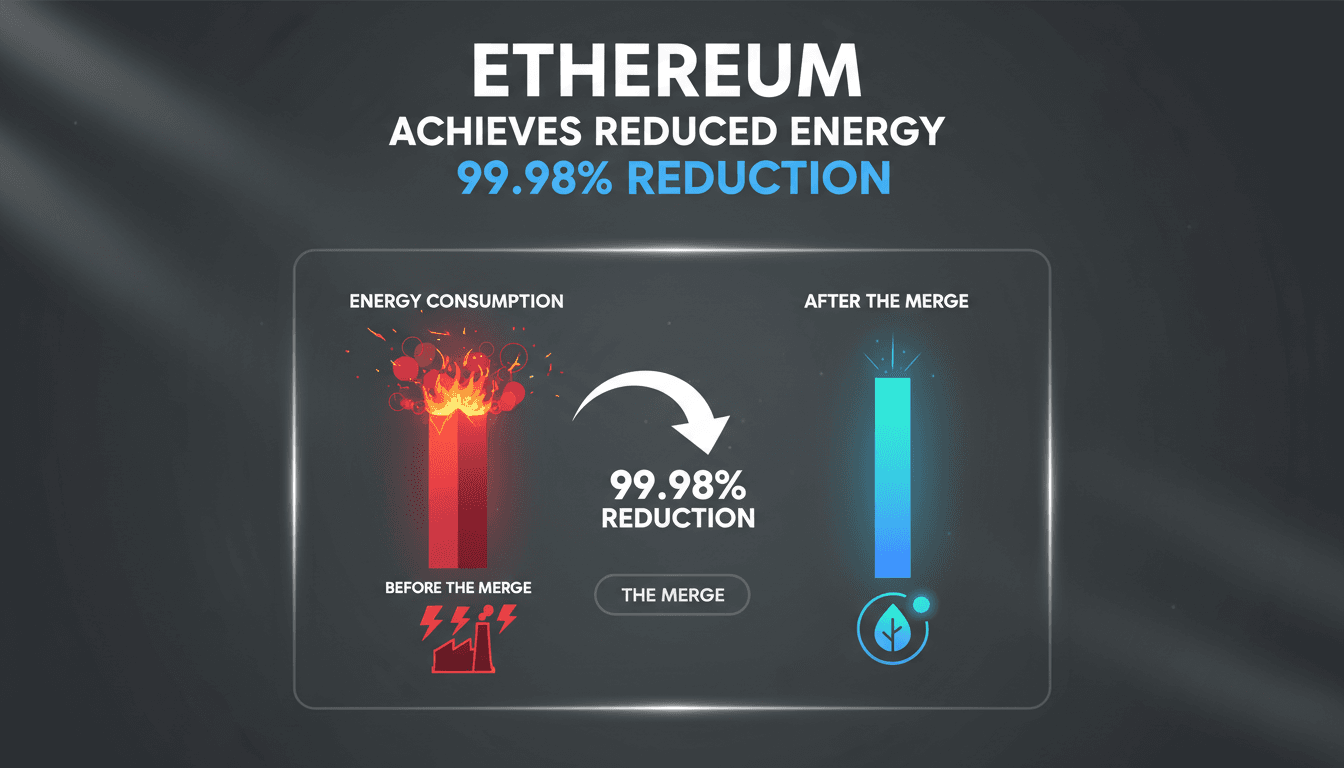
Ethereum achieves 99.98% reduction in energy consumption post-Merge
Here's what it means for you.
Ethereum's transition to a proof-of-stake consensus mechanism has dramatically improved its sustainability profile, making it an attractive option for environmentally conscious investors. This shift not only enhances Ethereum's market position but also sets a precedent for other blockchain technologies to follow suit. As the demand for energy-efficient solutions grows, Ethereum's success may influence regulatory frameworks and adoption rates across the cryptocurrency landscape.
What happened
Ethereum's energy consumption has seen a staggering decrease of 99.98% following its transition to a proof-of-stake system, known as 'The Merge.' This significant reduction positions Ethereum as one of the most energy-efficient blockchain networks available today. The Cambridge report highlights that Ethereum's annual energy consumption is now estimated at just 7.87 GWh, a remarkable shift from its previous levels.
Before The Merge, Ethereum's energy usage was comparable to that of a small nation-state, raising concerns about its environmental impact. The transition to proof-of-stake has not only reduced energy demand but also improved Ethereum's overall sustainability profile.
The Context
The Merge marked a pivotal moment for Ethereum, transitioning from a proof-of-work to a proof-of-stake consensus mechanism. This change is crucial as it aligns with the growing emphasis on sustainability within the cryptocurrency sector. Ethereum now ranks second-lowest in energy intensity among major proof-of-stake networks, showcasing its commitment to reducing its environmental footprint.
The timing of this transition coincides with increasing scrutiny on energy consumption in blockchain technology. As more investors prioritize sustainability, Ethereum's improved energy efficiency may attract a broader audience and encourage other blockchain projects to adopt similar practices.
Takeaway
The significant reduction in energy consumption positions Ethereum favorably in the ongoing discourse surrounding environmentally friendly blockchain technologies. As Ethereum continues to evolve, its commitment to sustainability may lead to increased adoption and regulatory support for energy-efficient solutions in the cryptocurrency space. Stakeholders should watch for potential regulatory impacts on energy consumption and further developments in Ethereum's scalability and efficiency improvements.
Covers Bitcoin plus altcoin news, market updates, and educational resources.
"Bitcoin.com provides news, market data, and guides focused on Bitcoin and the wider crypto industry."
— A47 Editor
Cambridge Report Reveals Ethereum’s Energy Consumption Dropped 99.98% Post-Merge
A recent report from the Cambridge Center indicates that Ethereum's energy consumption has plummeted by 99.98% following its transition to a proof-of-stake consensus mechanism known as The Merge, reducing its annual power usage to 7.87 GWh. This sign...
Real-time updates, analysis, and reports on the blockchain and cryptocurrency sectors.
"Crypto News delivers real-time updates, analysis, and reports on the blockchain and cryptocurrency sectors."
— A47 Editor
Ethereum’s Merge cut power use over 99.9%, Cambridge finds
A recent study by Cambridge has revealed that Ethereum's annual power consumption has significantly decreased to 7.87 GWh following its transition to a proof-of-stake consensus mechanism known as The Merge, cutting power usage by over 99.9%. This pos...
Covers blockchain, cryptocurrency news, project analysis, and market insights.
"Cointelegraph is a leading crypto-focused media outlet known for timely news, analysis, and educational content related to blockchain and digital assets."
— A47 Editor
Cambridge study puts Ethereum near lower end of PoS energy intensity
A recent study by Cambridge has revealed that Ethereum's annual power consumption has decreased to 7.87 GWh, positioning it among the lowest energy-intensive proof-of-stake networks. This significant reduction follows Ethereum's transition to a proof...