
Total solar eclipse to be visible from northern Spain on August 12, 2026
What happened
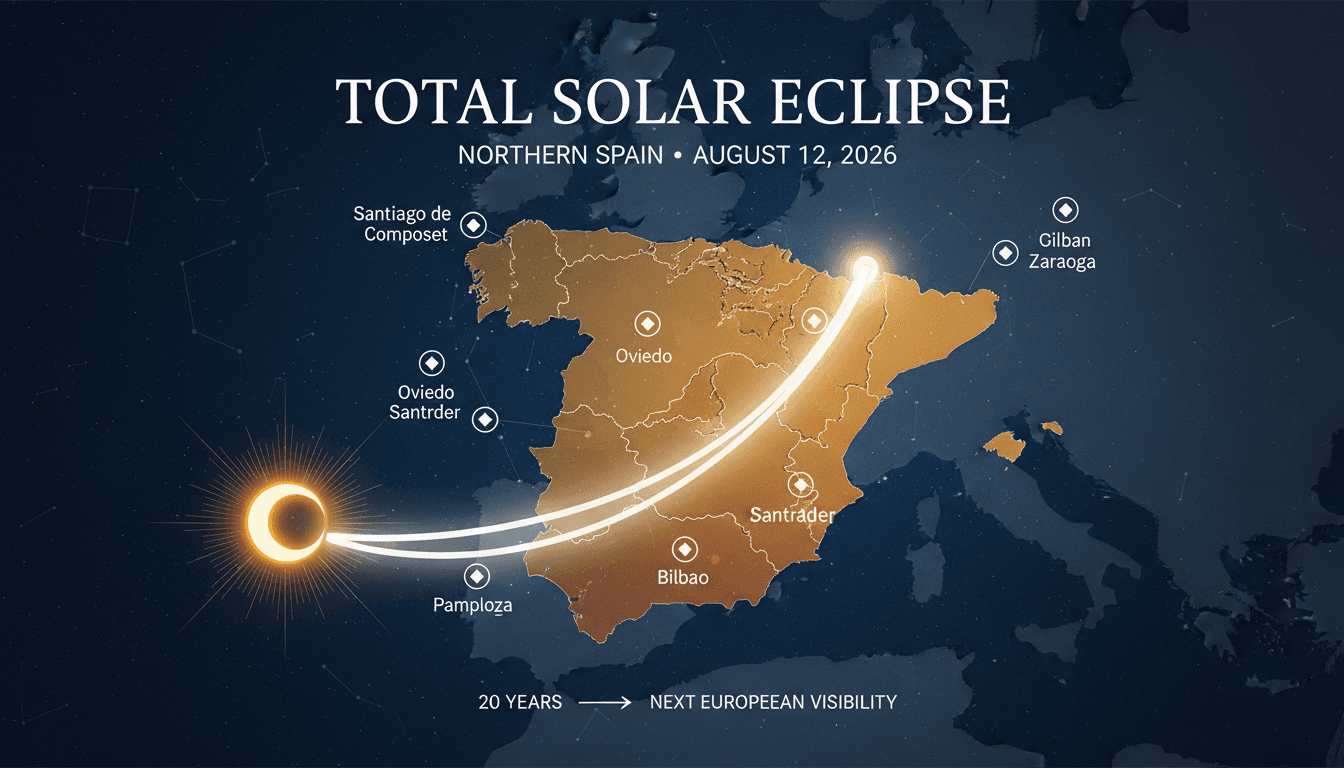
A total solar eclipse is set to occur on August 12, 2026, with significant visibility across northern Spain. This astronomical event is particularly noteworthy as it marks the first total solar eclipse observable from mainland Europe in 20 years. The eclipse will provide a unique opportunity for both tourists and scientists to witness and study its effects.
As the date approaches, preparations are underway in various locations across northern Spain to accommodate the expected influx of visitors. Iceland is also gearing up for the eclipse, anticipating hundreds of tourists eager to experience the phenomenon.
The Context
The rarity of this total solar eclipse, the first in two decades for mainland Europe, has generated considerable excitement among both the public and scientific communities. The event is expected to draw attention not only for its visual spectacle but also for the scientific opportunities it presents. Scientists plan to conduct experiments during the eclipse, aiming to gain insights into various phenomena that occur during such events.
The timing of the eclipse coincides with a growing interest in astronomy and space science, making it a pivotal moment for public engagement. The potential for increased tourism in northern Spain and Iceland highlights the broader implications of this celestial event for local economies and scientific research.
Takeaway
As the total solar eclipse approaches, anticipation continues to build for its impact on tourism and scientific research in the regions affected. Observers should keep an eye on developments related to viewing events in Spain and Iceland, as well as the scientific findings that may emerge from experiments conducted during the eclipse.
This event not only promises a spectacular visual experience but also serves as a catalyst for public interest in science and astronomy. The long-term implications for both tourism and research could be significant, making this eclipse a noteworthy occasion for many.
Global news coverage with extensive reporting on Middle Eastern conflicts and geopolitics.
"Al Jazeera is a Qatar-based broadcaster known for wide regional coverage and alternative perspectives."
— A47 Editor
Tourists rush to Iceland to witness rare total solar eclipse
Iceland is set to welcome hundreds of tourists eager to witness a rare total solar eclipse occurring on August 12, 2026. This astronomical event will see the Moon completely obscure the Sun, providing a spectacular view for those in the path of total...
Comprehensive coverage of Middle Eastern and global issues.
"Al Jazeera is a prominent voice from the Global South, especially the Middle East, with an emphasis on underreported stories."
— A47 Editor
Tourists rush to Iceland to witness rare total solar eclipse
Iceland is set to welcome hundreds of tourists eager to witness a rare total solar eclipse occurring on August 12, 2026. This astronomical event will see the Moon completely obscure the Sun, providing a spectacular view for those in the path of total...
24/7 international news from a French perspective in multiple languages.
"France 24 is viewed as a globally focused outlet with balanced coverage and a European perspective."
— A47 Editor
Solar Eclipse: Three things we could learn on August 12
A total solar eclipse is set to occur on August 12, 2026, when the Moon will completely obscure the Sun, visible across much of northern Spain. This event marks the first total solar eclipse observable from mainland Europe in two decades, drawing sig...
24/7 international news from a French perspective in multiple languages.
"France 24 is viewed as a globally focused outlet with balanced coverage and a European perspective."
— A47 Editor
From Solar corona to human emotions: What can we learn from eclipses? (2/4)
A total solar eclipse is set to occur on August 12, 2026, sweeping across northern Spain, marking the first total solar eclipse observable from mainland Europe in two decades. This rare astronomical event will see the Moon completely obscure the Sun,...
European current affairs, EU politics, and regional developments.
"France 24 is viewed as a globally focused outlet with balanced coverage and a European perspective."
— A47 Editor
Eclipse chasers: When chasing totality becomes a way of life (1/4)
A total solar eclipse is set to occur on August 12, 2026, sweeping across northern Spain, marking the first total solar eclipse observable from mainland Europe in two decades. This astronomical event has drawn eclipse chasers like Singaporean family ...