
Van Gogh Chestnut Trees Sells for $190.4 Million at Sotheby's After Restitution Claim Settled
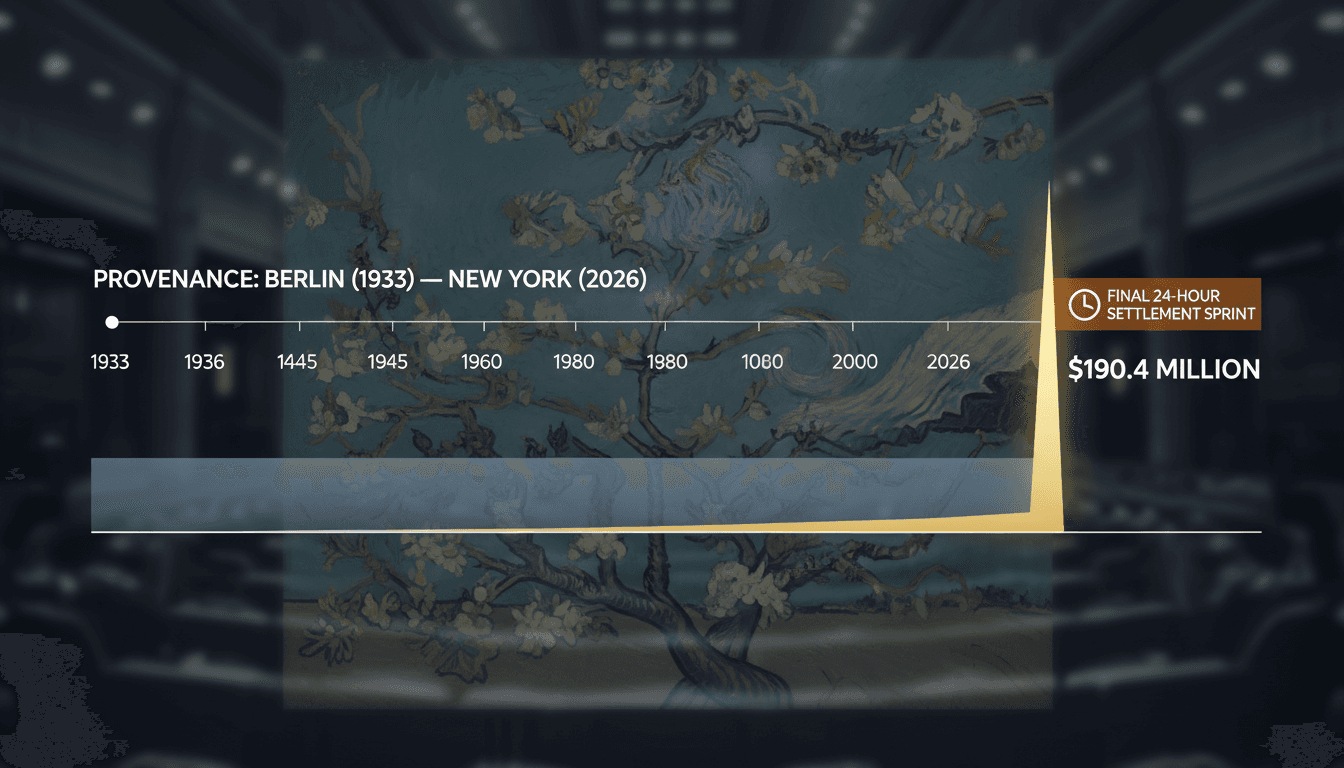
Why it matters
The transaction demonstrates that major auction houses will deploy eleventh-hour settlement mechanisms to insulate trophy asset values from unresolved historical duress claims.
What happened (in 30 seconds)
- A new auction high: Vincent van Gogh's 1890 canvas *Châtaigniers en Fleurs* fetched $190.4 million at Sotheby's New York on November 18, 2026, surpassing his previous record of $117.2 million.
- A last-minute challenge: Descendants of German Jewish publisher Samuel Fischer brought legal claims days prior, stating their ancestors surrendered the artwork in 1936 under economic duress caused by Nazi flight taxes and capital restrictions.
- A confidential pact: Sotheby's, the Fischer heirs, and the seller (the Blaquier-Arrieta family) negotiated a private settlement on November 17, 2026, allowing the public sale to proceed unimpeded 24 hours later.
The context you actually need
- The flight tax mechanism: During the 1930s, statutory instruments such as the Reich flight tax stripped German Jewish families of capital, forcing the Fischer family to leave the canvas in an Amsterdam gallery around 1932–1933 before their 1936 asset sale.
- A 51-year holding period: The artwork passed through multiple private collections after the 1936 transaction until Argentina's Blaquier family acquired it in 1975, holding it for over five decades before consigning it to auction.
- Non-binding standards: Restitution disputes over works subject to financial coercion rather than outright physical seizure continue to test the 1998 Washington Principles, which lack statutory enforcement across cross-border private sales.
What's really happening
The $190.4 million realization for *Châtaigniers en Fleurs* clarifies how elite auction houses treat legal provenance disputes when capital commitments reach nine figures. When an asset's valuation surpasses the $100 million mark, withdrawal from an evening sale introduces severe downside risk for consignors, auction guarantees, and institutional reputation.
Rather than pulling the work to litigate the nuances of the 1936 transaction, the primary participants opted for immediate settlement risk management. The challenge brought by restitution attorney Gunnar Schnabel on behalf of Samuel and Hedwig Fischer's heirs did not allege an overt, physical looting of the canvas. Instead, it targeted the grey zone of Holocaust-era art transfers: economic duress. The Fischer family had deposited the 1890 post-Impressionist work in Amsterdam in 1932–1933 while escaping Berlin. The subsequent 1936 disposal occurred while the Netherlands was still an independent jurisdiction, but under statutory conditions where the sellers faced punitive asset levies, flight taxes, and restricted repatriation rules imposed by their home state.
This specific category of transactional history creates friction under the 1998 Washington Principles. Because these principles serve as non-binding international guidelines rather than hard legal statutes, cross-border claims frequently stall when works enter private collections outside European regulatory oversight. The Blaquier-Arrieta family, who held title to the painting from 1975 to 2026, had no statutory obligation under Argentinian law to forfeit the piece. However, offering the work at a marquee New York auction exposed the title to United States jurisdiction and public scrutiny.
By resolving the claim privately on November 17, 2026—one day before the sale—Sotheby's and the Blaquier-Arrieta estate secured clean passage for the title. The financial incentive structure is transparent: clearing the dispute enabled the work to achieve a $190.4 million benchmark, clearing the previous record of $117.2 million by $73.2 million. The settlement essentially functioned as an operational insurance premium that unlocked maximum liquidity, proving that the top tier of the art market views confidential restitution payouts not as ideological admissions, but as standard transactional clearing costs.
Who feels it first (and how)
- Trophy art consignors: Must now prepare for exhaustive historical audit trails covering 1933–1945 commercial transactions, even if the works traded in non-occupied territories.
- Private family offices and wealth managers: Face rising compliance, legal defense, and insurance escrow requirements before listing legacy collection assets at major auction houses.
- Restitution attorneys and historical researchers: Gain stronger leverage to demand settlements prior to public sales, as auction houses prioritize date-certain liquidity over prolonged title litigation.
- Collectors and institutions in emerging hubs like Dubai: Experience stricter provenance due diligence requirements when onboarding high-value European Modernist and Impressionist works into local trusts, freeport storage, or exhibition spaces.
What to watch next
- Discount rates on disputed provenance: Monitor whether secondary market buyers begin factoring a measurable discount into pre-war assets with indirect duress claims, or if confidential settlements completely erase price resistance.
- Shifting auction house disclosure protocols: Watch whether global houses adopt formal pre-clearance certification periods for 1930s European sales to prevent 11th-hour injunction threats.
- Cross-border asset migration to emerging markets: Track whether collectors relocate historic Impressionist inventories to jurisdictions outside the US and Western Europe to avoid Washington Principles scrutiny.
The painting sold for $190.4 million on November 18, 2026, establishing a new record for Vincent van Gogh after a confidential agreement was signed on November 17 between the Fischer heirs, Sotheby's, and the Blaquier-Arrieta family.
The settlement value paid to the Fischer heirs was structured as a percentage cut of the final hammer price, aligning the legal claimants' incentives with maximizing the auction outcome.
The exact percentage and financial consideration received by the Fischer family, as all parties bound themselves to non-disclosure terms regarding the final allocation.
Frequently Asked Questions
- Why it matters?
- The transaction demonstrates that major auction houses will deploy eleventh-hour settlement mechanisms to insulate trophy asset values from unresolved historical duress claims.
- What happened (in 30 seconds)?
- A new auction high: Vincent van Gogh's 1890 canvas *Châtaigniers en Fleurs* fetched $190.4 million at Sotheby's New York on November 18, 2026, surpassing his previous record of $117.2 million. A last-minute challenge: Descendants of German Jewish publisher Samuel Fischer brought legal claims days prior, stating their ancestors surrendered the artwork in 1936 under economic duress caused by Nazi flight taxes and capital restrictions. A confidential pact: Sotheby's, the Fischer heirs, and the sell
- What's really happening?
- The $190.4 million realization for *Châtaigniers en Fleurs* clarifies how elite auction houses treat legal provenance disputes when capital commitments reach nine figures. When an asset's valuation surpasses the $100 million mark, withdrawal from an evening sale introduces severe downside risk for consignors, auction guarantees, and institutional reputation. Rather than pulling the work to litigate the nuances of the 1936 transaction, the primary participants opted for immediate settlement ris
- Who feels it first (and how)?
- Trophy art consignors: Must now prepare for exhaustive historical audit trails covering 1933–1945 commercial transactions, even if the works traded in non-occupied territories. Private family offices and wealth managers: Face rising compliance, legal defense, and insurance escrow requirements before listing legacy collection assets at major auction houses. Restitution attorneys and historical researchers: Gain stronger leverage to demand settlements prior to public sales, as auction houses prior
- What to watch next?
- Discount rates on disputed provenance: Monitor whether secondary market buyers begin factoring a measurable discount into pre-war assets with indirect duress claims, or if confidential settlements completely erase price resistance. Shifting auction house disclosure protocols: Watch whether global houses adopt formal pre-clearance certification periods for 1930s European sales to prevent 11th-hour injunction threats. Cross-border asset migration to emerging markets: Track whether collectors reloc
Public radio coverage of American news and issues.
"NPR is an American public media organization known for thoughtful reporting and a slightly left-leaning editorial tone."
— A47 Editor
A Van Gogh could break auction records. An art recovery lawyer sees a darker history
A Van Gogh painting, rich in color, could fetch as much as $180 million at auction tonight, potentially setting a record for the artist. The sale is drawing attention to a dispute that an art recovery lawyer says reveals a darker history the art mark...
Reports on arts, film, culture, literature, and entertainment industry developments.
"Dow Jones Arts & Culture offers coverage of visual arts, theater, music, and cultural events with a WSJ-backed journalistic lens."
— A47 Editor
The Dramatic, Down-to-the-Wire Fight Over a $180 Million Van Gogh
A Van Gogh painting, "Blossoming Chestnut Trees," valued at roughly $180 million, is set to be auctioned by Sotheby's and is expected to break the record for the artist, but a German family has claimed the work was wrongfully sold during the Nazi era...
Markets, economy, and company analysis from NYT’s business desk.
"The New York Times is a globally recognized newspaper offering authoritative reporting with a center-left editorial stance."
— A47 Editor
Doubts Loom Over a van Gogh as Auctions Aim for a $2.8 Billion Week
Sotheby's is preparing a major auction week, with paintings by Vincent van Gogh, Paul Cézanne, Pablo Picasso and Gustav Klimt positioned to attract collectors, according to The New York Times. Doubts surround the van Gogh, the auction's most coveted ...