
US Navy MQ-4C Triton Drone Crashes in Persian Gulf During Surveillance Mission
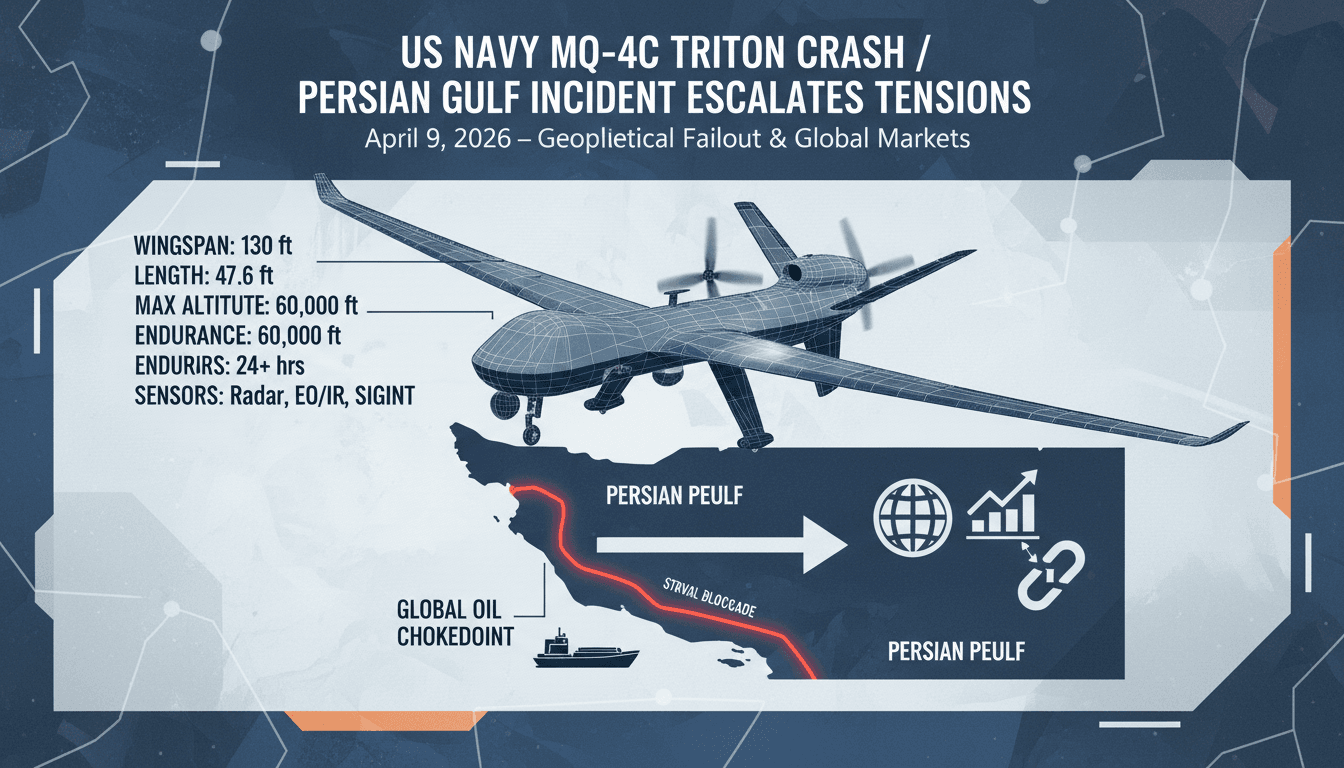
What happened
On April 9, 2026, a United States Navy MQ-4C Triton surveillance drone crashed in international airspace over the Persian Gulf during a routine maritime reconnaissance mission.
The Context
- Escalated hostilities: The crash occurred amid increased US-Iran tensions, with the US enforcing a naval blockade in the Strait of Hormuz.
- High-value asset: The MQ-4C Triton, valued at approximately $240 million, is a critical tool for maritime surveillance, with only 20 units operational.
- Ongoing operations: Despite the crash, the US Navy continues its surveillance missions in the region, indicating a commitment to maintaining presence and monitoring.
The Number
— the cost of the MQ-4C Triton drone, which exceeds the price of two F-35 fighters, highlighting the significant investment in advanced military technology.
Takeaway
Expect continued military operations in the region as the US seeks to maintain strategic oversight amid ongoing tensions.
Arabic-language coverage of international news and geopolitics.
"RT Arabic is a Russian state-funded outlet often criticized for promoting Kremlin-aligned narratives."
— A47 Editor
صحيفة: الولايات المتحدة تخسر طائرة مسيرة بقيمة 240 مليون دولار في منطقة الخليج
The U.S. Navy confirmed that an MQ-4C Triton unmanned reconnaissance aircraft crashed on April 9 in the Gulf region, as reported by Military Watch Magazine. The aircraft, valued at $240 million, represents a significant loss for the military.
Arabic-language coverage of political affairs and current events.
"Okaz political coverage typically follows mainstream Saudi framing on national and regional affairs."
— A47 Editor
غموض يلفّ مصير أغلى المسيرات الأمريكية فوق «هرمز»
Recent reports indicate that the United States lost one of its most expensive drones, the MQ-4C Triton, while it was flying over the Arabian Gulf near the Strait of Hormuz. The incident occurred on April 9, with the drone disappearing shortly after t...